


Strength and tempo of directional selection in the wild
- PMID: 11470913
- PMCID: PMC55389
- DOI: 10.1073/pnas.161281098
Strength and tempo of directional selection in the wild
Abstract
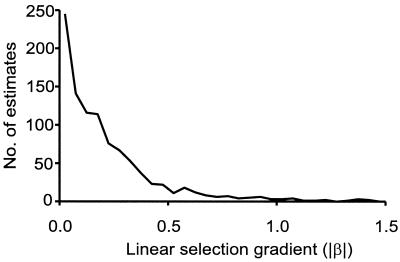
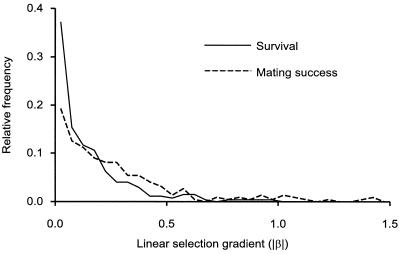
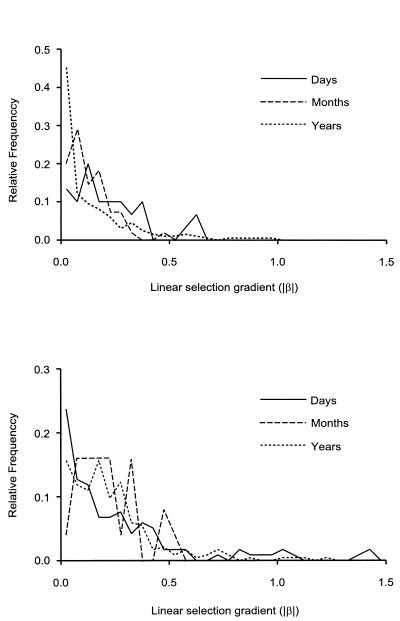
Directional selection is a major force driving adaptation and evolutionary change. However, the distribution, strength, and tempo of phenotypic selection acting on quantitative traits in natural populations remain unclear across different study systems. We reviewed the literature (1984-1997) that reported the strength of directional selection as indexed by standardized linear selection gradients (beta). We asked how strong are viability and sexual selection, and whether strength of selection is correlated with the time scale over which it was measured. Estimates of the magnitude of directional selection (absolute value of beta) were exponentially distributed, with few estimates greater than 0.50 and most estimates less than 0.15. Sexual selection (measured by mating success) appeared stronger than viability selection (measured by survival). Viability selection that was measured over short periods (days) was typically stronger than selection measured over longer periods (months and years), but the strength of sexual selection did not vary with duration of selection episodes; as a result, sexual selection was stronger than viability selection over longer time scales (months and years), but not over short time scales (days).
Figures
References
-
- Lande R, Arnold S J. Evolution (Lawrence, Kans) 1983;37:1210–1226. - PubMed
-
- Lande R. Evolution (Lawrence, Kans) 1979;33:402–416. - PubMed
-
- Boag P T, Grant P R. Science. 1981;214:82–85. - PubMed
-
- Endler J A. Natural Selection in the Wild. Princeton: Princeton Univ. Press; 1986.
-
- Hendry A P, Kinnison M T. Evolution (Lawrence, Kans) 1999;53:1637–1653. - PubMed
Publication types
MeSH terms
LinkOut - more resources
Full Text Sources
