. 2001 Jul 31;98(16):9116-21.
doi: 10.1073/pnas.161284298. Epub 2001 Jul 24.

A glucose-responsive transcription factor that regulates carbohydrate metabolism in the liver

Affiliations

A glucose-responsive transcription factor that regulates carbohydrate metabolism in the liver

H Yamashita et al. Proc Natl Acad Sci U S A. .

Abstract

Carbohydrates mediate their conversion to triglycerides in the liver by promoting both rapid posttranslational activation of rate-limiting glycolytic and lipogenic enzymes and transcriptional induction of the genes encoding many of these same enzymes. The mechanism by which elevated carbohydrate levels affect transcription of these genes remains unknown. Here we report the purification and identification of a transcription factor that recognizes the carbohydrate response element (ChRE) within the promoter of the L-type pyruvate kinase (LPK) gene. The DNA-binding activity of this ChRE-binding protein (ChREBP) in rat livers is specifically induced by a high carbohydrate diet. ChREBP's DNA-binding specificity in vitro precisely correlates with promoter activity in vivo. Furthermore, forced ChREBP overexpression in primary hepatocytes activates transcription from the L-type Pyruvate kinase promoter in response to high glucose levels. The DNA-binding activity of ChREBP can be modulated in vitro by means of changes in its phosphorylation state, suggesting a possible mode of glucose-responsive regulation. ChREBP is likely critical for the optimal long-term storage of excess carbohydrates as fats, and may contribute to the imbalance between nutrient utilization and storage characteristic of obesity.


Figures
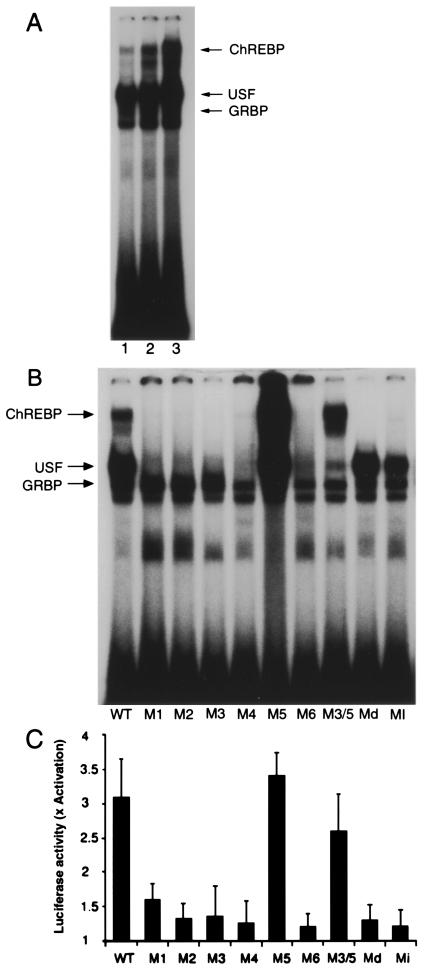
Figure 1
Figure 1
(A) Gel-shift analysis of hepatic nuclear factors that recognize the WT LPK ChRE. Rats were starved for 48 h (lane 1) and subsequently re-fed a high-fat diet for 24 h (lane 2) or a high-carbohydrate diet for 24 h (lane 3). Nuclear extracts were prepared from the rat livers and incubated with a radiolabeled oligonucleotide corresponding to the WT LPK ChRE. Lanes 2 and 3 contain equal protein loads. Arrows indicate the positions of the DNA-binding complexes containing USF or the glucose response element binding protein (GRBP) as determined by supershift of the DNA-binding complex with antibodies specific for each protein. (B) Mutations to the LPK ChRE differentially affect the formation of the various DNA-binding complexes. The seuences of the mutated oligonucleotides are shown in Table 1 (Md and Mi correspond to S−1 and S+1, respectively). Liver nuclear extracts from rats r-fed a high-carbohydrate diet for 24 h after 48-h starvation were incubated with the WT and the mutated oligonucleotides and examined by gel-shift analysis. (C) Mutations to the LPK ChRE affect glucose-responsive transcription of a downstream luciferase reporter gene. Construction of luciferase reporters driven by the WT and variant LPK promoter sequences (Table 1) was described in ref. . Primary hepatocytes were transfected with the reporter constructs and the fold activation of luciferase expression in response to high glucose (27.5 mM) was determined. Values represent the mean ± standard error of four experiments.
Figure 2
Figure 2
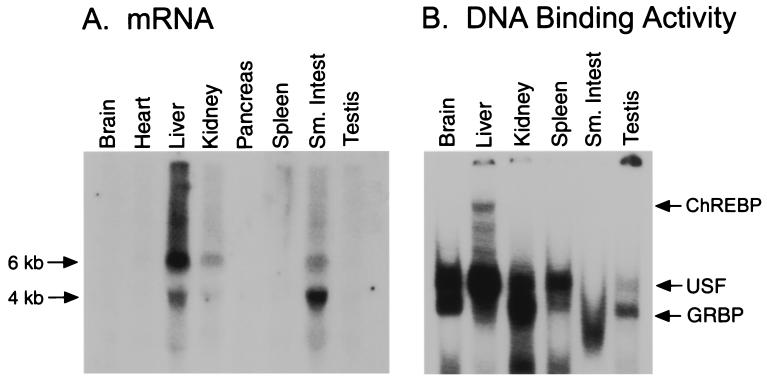
(A) Tissue distribution of ChREBP as determined by Northern blot analysis. Message levels were visualized from total RNA (25 μg) with a 32P-radiolabeled probe derived from the ChREBP cDNA. (B) ChREBP activity is detected only in liver nuclear extracts. Nuclear extracts were prepared from rats re-fed a high carbohydrate diet for 24 h after 48-h starvation and incubated with the 32P-radiolabeled WT oligonucleotide (Table 1) followed by gel-shift analysis. Arrows indicate the positions of the DNA-binding complexes containing USF or GRBP as determined by supershift of the DNA-binding complex with antibodies specific for each protein.
Figure 3
Figure 3
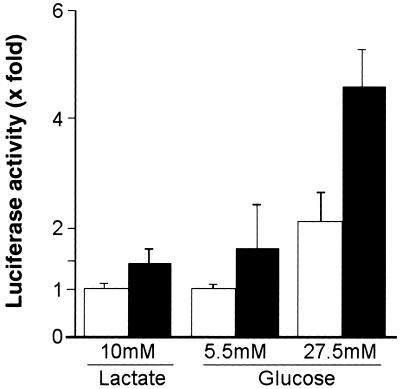
Forced expression of ChREBP activates expression from the LPK promoter in response to glucose in vivo. Primary hepatocytes were cotransfected with 0.5 μg of the luciferase reporter construct driven by the LPK promoter and 1.5 μg of the ChREBP cDNA under the control of the constitutively active cytomegalovirus (CMV) promoter (filled bars) or with the empty expression vector (open bars). After transfection, the cells were incubated for 12 h in medium containing 10 mM lactate, 5.5 mM glucose, or 27.5 mM glucose. Values represent the mean ± standard error of five experiments.
Figure 4
Figure 4
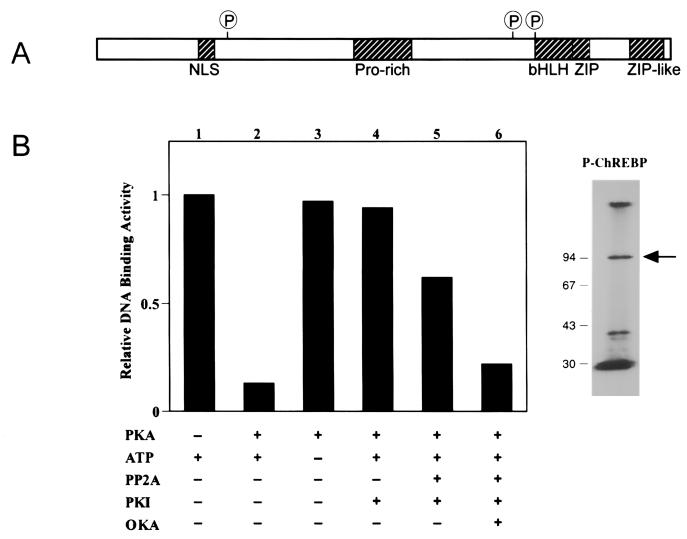
(A) ChREBP contains several recognizable protein motifs, including a bipartite nuclear localization signal (NLS), a basic helix–loop–helix leucine zipper (bHLH-ZIP) motif, and three consensus PKA phosphorylation sites (P) including one (sequence RRIT) within the bHLH region. (B) (Left) DNA-binding activity of ChREBP can be regulated by phosphorylation in vitro. Incubation of active ChREBP (lane 1) for 20 min with both ATP (1 mM) and PKA (0.1 unit/μl) abolished DNA-binding activity (lane 2) as measured by gel-shift analysis with the 32P-radiolabeled WT oligonucleotide. Omission of ATP from the reaction mixture prevents ChREBP inactivation (lane 3). PKA-dependent ChREBP inactivation is blocked by 0.2 unit/μl protein kinase inhibitor (PKI) (lane 4). After PKI addition, DNA-binding activity of phosphorylated ChREBP can be restored by addition of 0.025 unit/μl protein phosphatase 2A (PP2A) (lane 5). Addition of the PP2A inhibitor okadaic acid (OKA) (10 nM) prevents reactivation of the ChREBP DNA-binding activity. (Right) Incubation of the protein with [γ-32P]ATP in the presence of PKA leads to radiolabeling of ChREBP observed after SDS/PAGE.

References

    1. Neel J N. Nutr Rev. 1999;57:S2–S9. - PubMed
    1. Troiano R P, Flegal K M. Int J Obes Relat Metab Disord. 1999;23:S22–S27. - PubMed
    1. Goodridge A G. Annu Rev Nutr. 1987;7:157–185. - PubMed
    1. Granner D, Pilkis S. J Biol Chem. 1990;265:10173–10176. - PubMed
    1. Girard J, Ferré P, Foufelle F. Annu Rev Nutr. 1997;17:325–352. - PubMed

Publication types

MeSH terms

LinkOut - more resources