Multicentre controlled trial of parenting groups for childhood antisocial behaviour in clinical practice
- PMID: 11473908
- PMCID: PMC35270
- DOI: 10.1136/bmj.323.7306.194
Multicentre controlled trial of parenting groups for childhood antisocial behaviour in clinical practice
Abstract
Objective: To see whether a behaviourally based group parenting programme, delivered in regular clinical practice, is an effective treatment for antisocial behaviour in children.
Design: Controlled trial with permuted block design with allocation by date of referral.
Setting: Four local child and adolescent mental health services.
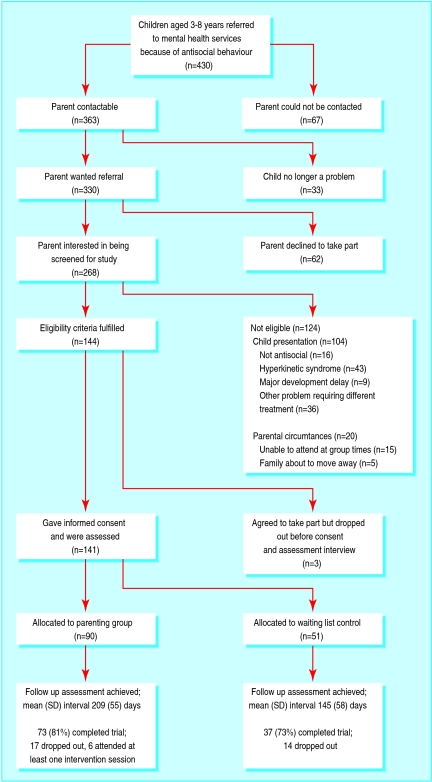
Participants: 141 children aged 3-8 years referred with antisocial behaviour and allocated to parenting groups (90) or waiting list control (51).
Intervention: Webster-Stratton basic videotape programme administered to parents of six to eight children over 13-16 weeks. This programme emphasises engagement with parental emotions, rehearsal of behavioural strategies, and parental understanding of its scientific rationale.
Main outcome measures: Semistructured parent interview and questionnaires about antisocial behaviour in children administered 5-7 months after entering trial; direct observation of parent-child interaction.
Results: Referred children were highly antisocial (above the 97th centile on interview measure). Children in the intervention group showed a large reduction in antisocial behaviour; those in the waiting list group did not change (effect size between groups 1.06 SD (95% confidence interval 0.71 to 1.41), P<0.001). Parents in the intervention group increased the proportion of praise to ineffective commands they gave their children threefold, while control parents reduced it by a third (effect size between groups 0.76 (0.16 to 1.36), P=0.018). If the 31 children lost to follow up were included in an intention to treat analysis the effect size on antisocial behaviour was reduced by 16%.
Conclusions: Parenting groups effectively reduce serious antisocial behaviour in children in real life conditions. Follow up is needed to see if the children's poor prognosis is improved and criminality prevented.
References
-
- Meltzer H, Gatward R, Goodman R, Ford T. The mental health of children and adolescents in Great Britain. London: Office of National Statistics; 2000. - PubMed
-
- Rutter M, Hagell A, Giller H. Antisocial behaviour by young people. Cambridge: Cambridge University Press; 1998.
-
- Farrington DP. The development of offending and antisocial behaviour from childhood: key findings from the Cambridge study in delinquent development. J Child Psychol Psychiatry. 1995;36:929–964. - PubMed
Publication types
MeSH terms
Grants and funding
LinkOut - more resources
Full Text Sources
Medical