


DNA damage-inducible gene p33ING2 negatively regulates cell proliferation through acetylation of p53
- PMID: 11481424
- PMCID: PMC55510
- DOI: 10.1073/pnas.161151798
DNA damage-inducible gene p33ING2 negatively regulates cell proliferation through acetylation of p53
Abstract
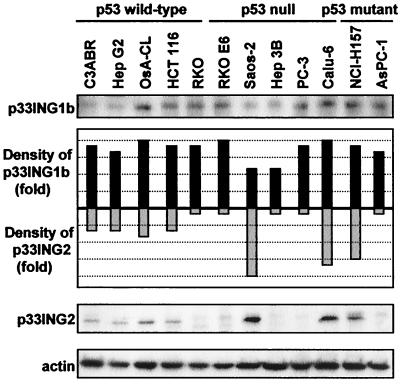
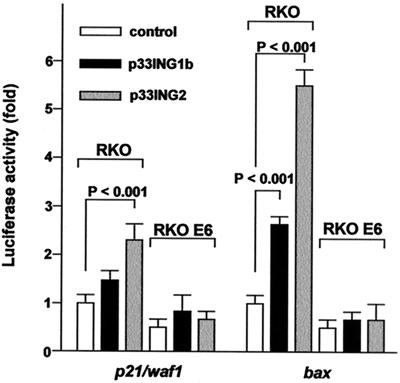
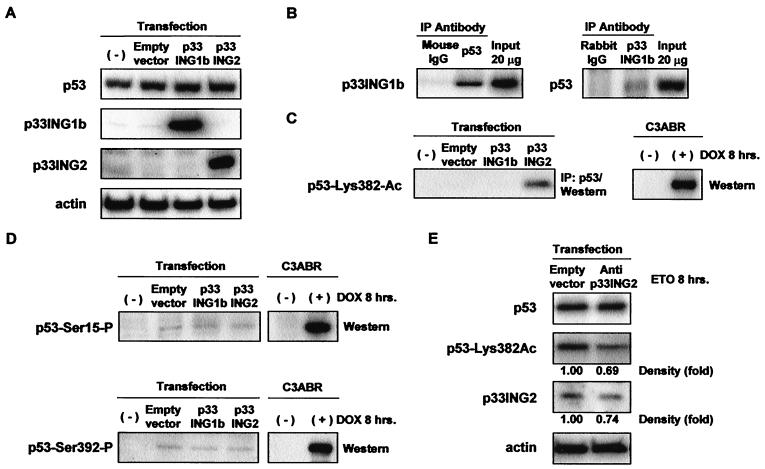
The p33ING1 protein is a regulator of cell cycle, senescence, and apoptosis. Three alternatively spliced transcripts of p33ING1 encode p47ING1a, p33ING1b, and p24ING1c. We cloned an additional ING family member, p33ING2/ING1L. Unlike p33ING1b, p33ING2 is induced by the DNA-damaging agents etoposide and neocarzinostatin. p33ING1b and p33ING2 negatively regulate cell growth and survival in a p53-dependent manner through induction of G(1)-phase cell-cycle arrest and apoptosis. p33ING2 strongly enhances the transcriptional-transactivation activity of p53. Furthermore, p33ING2 expression increases the acetylation of p53 at Lys-382. Taken together, p33ING2 is a DNA damage-inducible gene that negatively regulates cell proliferation through activation of p53 by enhancing its acetylation.
Figures


References
-
- Garkavtsev I, Kazarov A, Gudkov A, Riabowol K. Nat Genet. 1996;14:415–420. - PubMed
-
- Garkavtsev I, Demetrick D, Riabowol K. Cytogenet Cell Genet. 1997;76:176–178. - PubMed
-
- Helbing C C, Veillette C, Riabowol K, Johnston R N, Garkavtsev I. Cancer Res. 1997;57:1255–1258. - PubMed
-
- Garkavtsev I. Nat Genet. 1999;23:373. - PubMed
MeSH terms
Substances
Associated data
- Actions
- Actions
LinkOut - more resources
Full Text Sources
Other Literature Sources
Molecular Biology Databases
Research Materials
Miscellaneous
