


Compartmental neurodegeneration and synaptic plasticity in the Wld(s) mutant mouse
- PMID: 11483696
- PMCID: PMC2278742
- DOI: 10.1111/j.1469-7793.2001.00627.x
Compartmental neurodegeneration and synaptic plasticity in the Wld(s) mutant mouse
Abstract
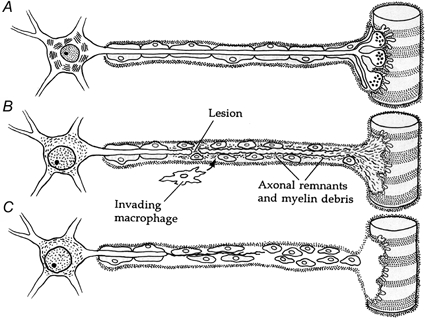
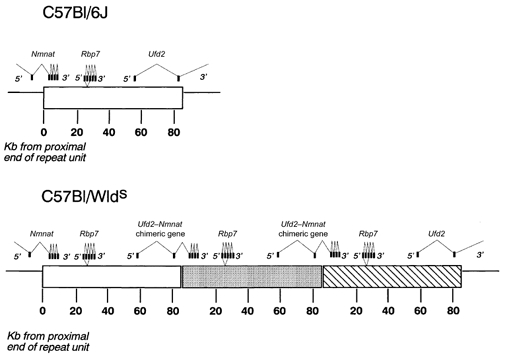
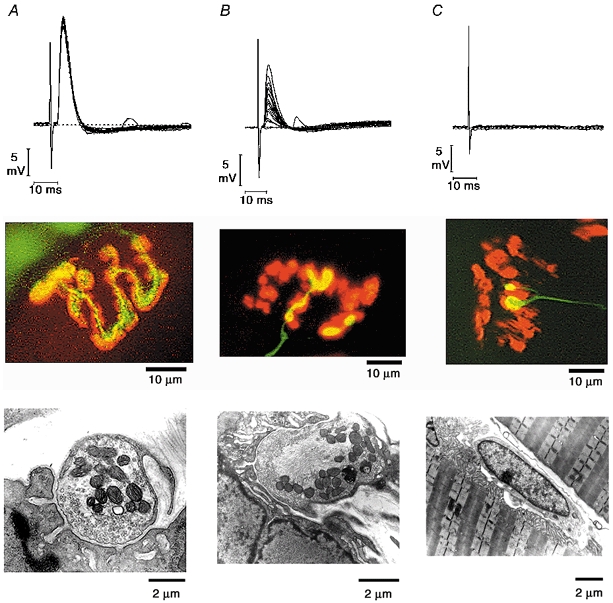
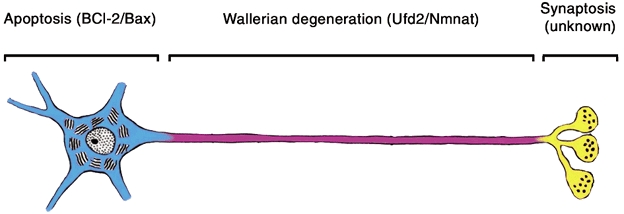
This review focuses on recent developments in our understanding of neurodegeneration at the mammalian neuromuscular junction. We provide evidence to support a hypothesis of compartmental neurodegeneration, whereby synaptic degeneration occurs by a separate, distinct mechanism from cell body and axonal degeneration. Studies of the spontaneous mutant Wld(s) mouse, in which Wallerian degeneration is characteristically slow, provide key evidence in support of this hypothesis. Some features of synaptic degeneration in the absence of Wallerian degeneration resemble synapse elimination in neonatal muscle. This and other forms of synaptic plasticity may be accessible to further investigations, exploiting advantages afforded by the Wld(s) mutant, or transgenic mice that express the Wld(s) gene.
Figures
References
-
- Abercrombie M, Johnson ML. Quantitative histology of Wallerian degeneration, I. Nuclear population in rabbit sciatic nerve. Journal of Anatomy. 1946;80:37–50. - PubMed
-
- Allt G. Pathology of the peripheral nerve. In: Landon DN, editor. The Peripheral Nerve. London: Chapman & Hall; 1976. pp. 666–739.
-
- Alvarez J, Giuditta A, Koenig E. Protein synthesis in axons and terminals: Significance for maintenance, plasticity and regulation of phenotype with a critique of slow transport theory. Progress in Neurobiology. 2000;62:1–62. - PubMed
-
- Balice-Gordon RJ, Chua CK, Nelson CC, Lichtman JW. Gradual loss of synaptic cartels precedes axon withdrawal at developing neuromuscular junctions. Neuron. 1993;11:801–815. - PubMed
Publication types
MeSH terms
Grants and funding
LinkOut - more resources
Full Text Sources
Other Literature Sources
