. 2001 Aug 1;534(Pt 3):753-61.
doi: 10.1111/j.1469-7793.2001.t01-1-00753.x.

Measurement of chloride flux associated with the myogenic response in rat cerebral arteries

Affiliations

Measurement of chloride flux associated with the myogenic response in rat cerebral arteries

J M Doughty et al. J Physiol. .

Abstract

1. Self-referencing ion-selective (SERIS) electrodes were used to measure the temperature and pressure dependence of Cl(-) efflux, during myogenic contraction of pressurized rat cerebral resistance arteries. 2. At room temperature (18-21 degrees C), a small, pressure-independent Cl(-) efflux was measured. On warming to 37 degrees C, arteries developed pressure-dependent myogenic tone, and this was associated with a pressure-dependent increase in Cl(-) efflux (n = 5). 3. Both myogenic tone and the pressure- and temperature-dependent Cl(-) efflux were abolished on application of 10 microM tamoxifen, a Cl(-) channel blocker (IC(50) 3.75 +/- 0.2 microM). Tamoxifen (10 microM) also prevented contraction to 60 mM K(+), suggesting non-specific effects of tamoxifen (n = 5). 4. Myogenic tone was abolished by 2 microM nimodipine, but Cl(-) efflux was unaffected. In the presence of nimodipine, 10 microM tamoxifen still abolished pressure- and temperature-dependent Cl(-) efflux (n = 3). 5. In summary, a Cl(-) efflux can be measured from rat cerebral arteries, with a temperature dependence that is closely correlated with myogenic contraction. We conclude that Cl(-) efflux through Cl(-) channels contributes to the depolarization associated with myogenic contraction.


Figures
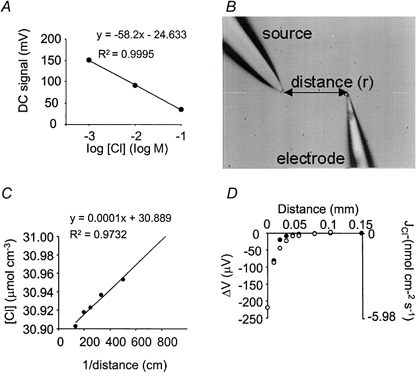
Figure 1
Figure 1. Calibration of Cl-selective SERIS electrodes
A, the Nernstian properties of each electrode were tested by measuring the voltage output (DC signal) of the probe in 1, 10 and 100 mm NaCl (balanced to 300 mosmol l−1 with sodium gluconate). A regression of the voltage ouput (mV) against the log of the Cl concentration yielded a line with a mean Nernstian slope of -60.5 ± 1.25 mV (n = 15; mean ±s.e.m.). A single example is shown, with a Nernstian slope of -58.2 mV. R2 = regression coefficient. B, chloride-selective probes were verified against an artificial point source - a glass pipette filled with 0.5 % agar containing 120 mm NaCl and 30 mm sodium gluconate. The electrode was positioned at known distances from the source. Two measurements were made at any one distance: (1) a static measurement (DC signal), (2) A self-referencing measurement (AC signal) over a 10 μm excursion at 0.3 Hz. C, the DC signal measurements were converted to concentrations using the Nernstian relationship in A. The characteristics of the Cl gradient were defined by a plot of Cl concentration (C) against 1/distance, fitted with a linear regression in the format: C = CB+K/r, where CB = background Cl concentration, K = empirical constant, r = distance from source (cm). D, from the characteristics of the Cl gradient, a prediction of the differential voltage (AC signal) (mV; •), self-referenced over a 10 μm excursion, can be made from the equation: ΔV = S[(-KΔr)/(CBr2+Kr)]/2.3, where S = Nernstian slope (see panel A), CB = background Cl concentration, K = empirical constant, r = distance from source (cm), and Δr = excursion distance (cm). This follows closely the measured AC signal (○).
Figure 2
Figure 2. Measurement of pressure-dependent Cl fluxes
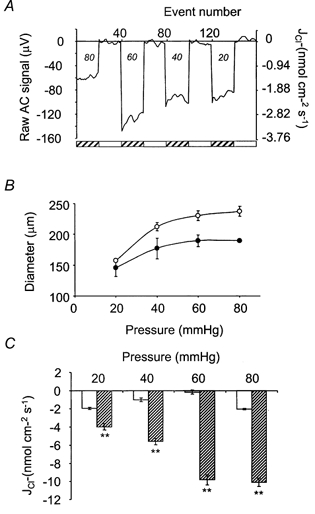
The electrode was positioned so that the tip just touched the artery wall. This was set as distance zero. The electrode was then moved 1 μm away from the artery, and self-referencing measurements made over a 10 μm excursion, at 0.3 Hz. Between each set of measurements ‘at tissue’, a set of ‘background’ measurements were made 500 μm away from the artery. A, a representative data trace. Typically, at background, the noise of the probe was less than ± 5 μV, which equates to a flux of approximately 0.1 nmol cm−2 s−1. These measurements were made at room temperature. Measurements made close to the artery (at tissue) (hatched bars), over a range of pressures (mmHg; indicated in italics), are clearly resolvable from background measurements (open bars). B, at 37 °C (•), the diameter of the artery reduced, compared with 18-21 °C (○), because of myogenic contraction (n = 5). C, myogenic contraction was accompanied by an increase in efflux of Cl. This increase in efflux at 37 °C (formula image) was significant, when compared with measurements at the equivalent flux at 18-21 °C (□) at each pressure. **P < 0.01(n = 5).
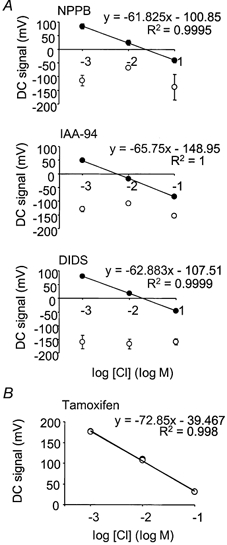
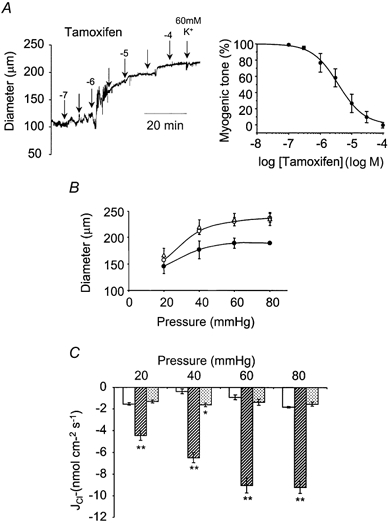
Figure 3
Figure 3. Testing Cl channel blockers on SERIS electrodes
A, 100 μm NPPB (n = 3), 100 μm IAA-94 (n = 3) and 500 μm DIDS (n = 3) disrupted the Nernstian properties of the electrodes. Control, •; drug, ○. B, 10 μm tamoxifen did not affect the Nernstian properties of the Cl-selective electrodes (n = 3), and was used for further investigations. Control, •; tamoxifen, ○.
Figure 4
Figure 4. The effects of tamoxifen on myogenic tone and Cl fluxes
A, tamoxifen concentration-dependently depressed myogenic contraction. An example data trace is shown. Inhibition of myogenic tone by tamoxifen was fitted to a Hill Equation, with an IC50 of 3.75 ± 0.2 μm and a slope of -1.1 ± 0.1 (n = 5). B, 10 μm tamoxifen abolished myogenic tone at all pressures tested. (18-21 °C, ○; 37 °C, •; 10 μm tamoxifen, 37 °C, ▵) (n = 4). C, 10 μm tamoxifen also abolished pressure- and temperature-dependent Cl efflux at all pressures tested (18-21 °C, □; 37 °C, formula image; 10 μm tamoxifen, 37 °C, formula image) (n = 4). **P < 0.01, *P < 0.05, compared to control at 18-21 °C.
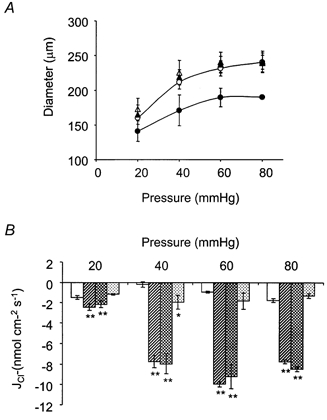
Figure 5
Figure 5. The effects of nimodipine on myogenic tone and Cl fluxes
A, 2 μm nimodipine abolished myogenic tone at all pressures tested. (18-21 °C, ○; 37 °C, •; 2 μm nimodipine, 37 °C, ▴). Tamoxifen (10 μm) showed no further effect on tone in the presence of nimodipine (▵) (n = 3). B, 2 μm nimodipine did not affect pressure- and temperature-dependent Cl fluxes at all pressures tested. Tamoxifen (10 μm), in the presence of 2 μm nimodipine, abolished pressure- and temperature-dependent Cl efflux at all pressures tested (18-21 °C, □; 37 °C, formula image; 2 μm nimodipine, 37 °C, formula image; 2 μm nimodipine + 10 μm tamoxifen, 37 °C, formula image) (n = 4). **P < 0.01, *P < 0.05, compared to control at 18-21 °C.

References

    1. Ackerman MJ, Wickman KD, Clapham DE. Hypotonicity activates a native chloride current in Xenopus oocytes. Journal of General Physiology. 1994;103:153–179. - PMC - PubMed
    1. Aickin CC. Chloride transport across the sarcolemma of vertebrate smooth and skeletal muscle. In: Alvarez-Leefmans FJ, Russel JM, editors. Chloride Channels and Carriers in Nerve, Muscle and Glial Cells. New York: Plenum Press; 1990. pp. 209–249.
    1. Ammann D. In: Ion-selective Microelectrodes: Principles, Design and Application. Ammann D, editor. New York: Springer-Verlag; 1986.
    1. Brayden JE, Nelson MT. Regulation of arterial tone by activation of calcium-dependent potassium channels. Science. 1992;256:532–535. - PubMed
    1. Brayden JE, Quayle JM, Standen NB, Nelson MT. Role of potassium channels in the vascular response to endogenous and pharmacological vasodilators. Blood Vessels. 1991;28:147–153. - PubMed

Publication types

MeSH terms

LinkOut - more resources