


Experience- and age-related outgrowth of intrinsic neurons in the mushroom bodies of the adult worker honeybee
- PMID: 11487663
- PMCID: PMC6763189
- DOI: 10.1523/JNEUROSCI.21-16-06395.2001
Experience- and age-related outgrowth of intrinsic neurons in the mushroom bodies of the adult worker honeybee
Abstract
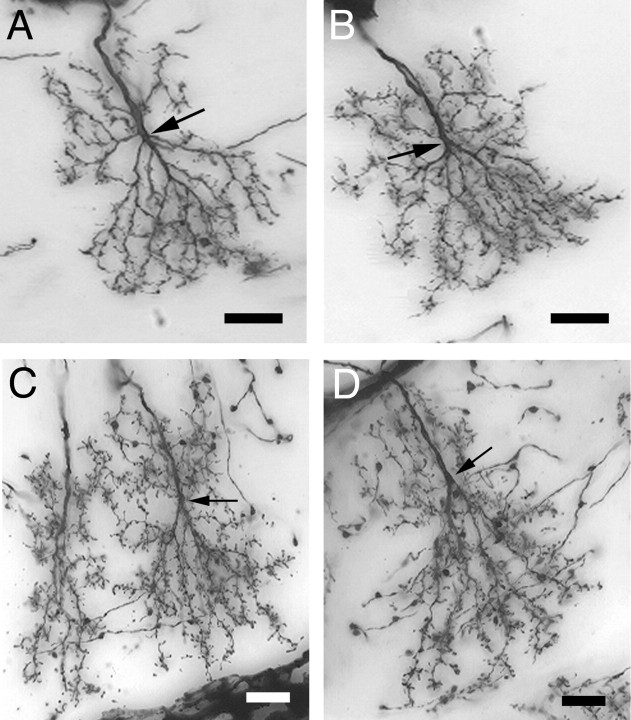
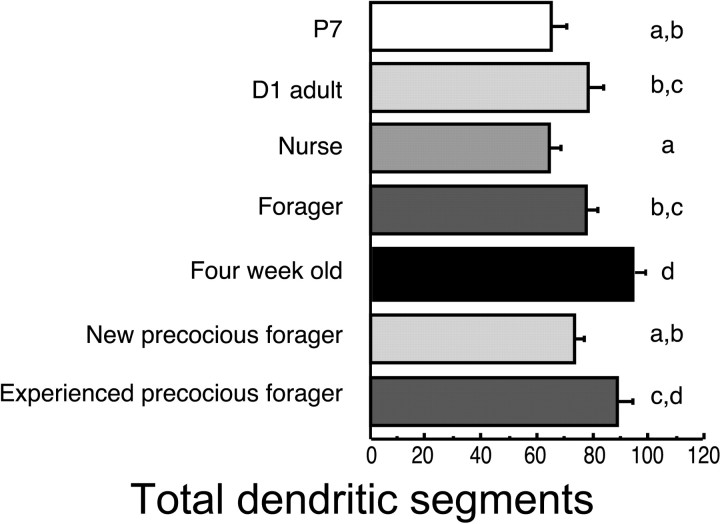
A worker honeybee performs tasks within the hive for approximately the first 3 weeks of adult life. After this time, it becomes a forager, flying repeatedly to collect food outside of the hive for the remainder of its 5-6 week life. Previous studies have shown that foragers have an increased volume of neuropil associated with the mushroom bodies, a brain region involved in learning, memory, and sensory integration. We report here that growth of the mushroom body neuropil in adult bees occurs throughout adult life and continues after bees begin to forage. Studies using Golgi impregnation asked whether the growth of the collar region of the mushroom body neuropil was a result of growth of the dendritic processes of the mushroom body intrinsic neurons, the Kenyon cells. Branching and length of dendrites in the collar region of the calyces were strongly correlated with worker age, but when age-matched bees were directly compared, those with foraging experience had longer, more branched dendrites than bees that had foraged less or not at all. The density of Kenyon cell dendritic spines remained constant regardless of age or behavioral state. Older and more experienced foragers therefore have a greater total number of dendritic spines in the mushroom body neuropil. Our findings indicate that, under natural conditions, the cytoarchitectural complexity of neurons in the mushroom bodies of adult honeybees increases as a function of increasing age, but that foraging experience promotes additional dendritic branching and growth.
Figures






References
-
- Bertholf LM. The moults of the honeybee. J Econ Entomol. 1925;18:380–384.
-
- Brandon J, Coss R. Rapid dendritic spine shortening during one-trial learning: the honeybee's first orientation flight. Brain Res. 1982;252:51–61. - PubMed
-
- Bullock TH, Horridge GA. Structure and function in the nervous systems of invertebrates. Freeman; San Francisco: 1965.
-
- Burrows M. The neurobiology of an insect brain. Oxford UP; New York: 1996.
-
- Capaldi EA, Smith AD, Osborne J, Fahrbach SE, Farris SM, Reynolds DR, Edwards AS, Martin A, Robinson GE, Poppy GM, Riley JR. Ontogeny of orientation flight in the honeybee revealed by harmonic radar. Nature. 2000;403:537–540. - PubMed
Publication types
MeSH terms
LinkOut - more resources
Full Text Sources
Medical
