. 2001 Aug;13(8):1865-75.
doi: 10.1105/tpc.010094.

EMF1, a novel protein involved in the control of shoot architecture and flowering in Arabidopsis

Affiliations

EMF1, a novel protein involved in the control of shoot architecture and flowering in Arabidopsis

D Aubert et al. Plant Cell. 2001 Aug.

Abstract

Shoot architecture and flowering time in angiosperms depend on the balanced expression of a large number of flowering time and flower meristem identity genes. Loss-of-function mutations in the Arabidopsis EMBRYONIC FLOWER (EMF) genes cause Arabidopsis to eliminate rosette shoot growth and transform the apical meristem from indeterminate to determinate growth by producing a single terminal flower on all nodes. We have identified the EMF1 gene by positional cloning. The deduced polypeptide has no homology with any protein of known function except a putative protein in the rice genome with which EMF1 shares common motifs that include nuclear localization signals, P-loop, and LXXLL elements. Alteration of EMF1 expression in transgenic plants caused progressive changes in flowering time, shoot determinacy, and inflorescence architecture. EMF1 and its related sequence may belong to a new class of proteins that function as transcriptional regulators of phase transition during shoot development.


Figures
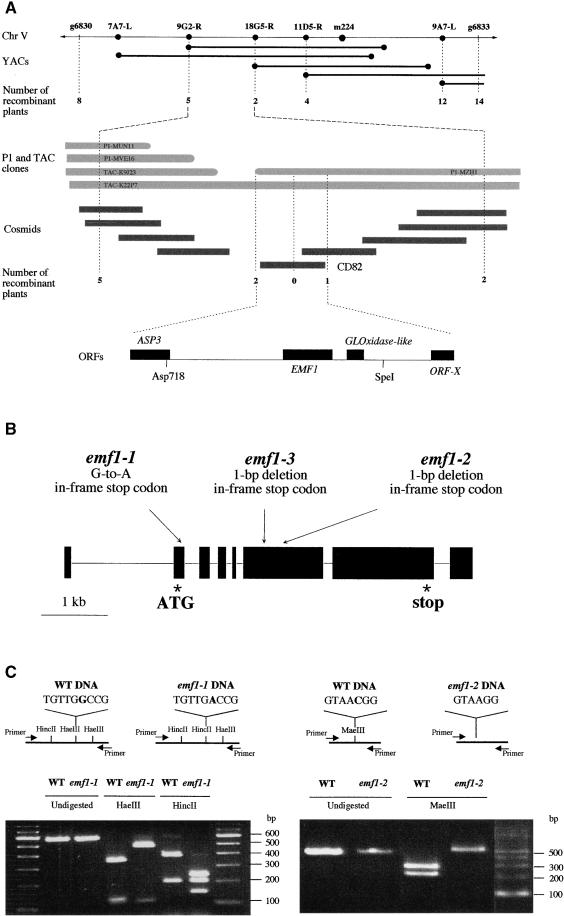
Figure 1.
Figure 1.
Map-Based Cloning and Gene Structure of EMF1. (A) Summary of the physical and genetic positions of EMF1 on chromosome (Chr) V. The top horizontal line represents the markers used to fine map the EMF1 locus between 9G2-R and 18G5-R on chromosome V. Values indicate the number of recombinant plants identified between the EMF1 locus and a given RFLP marker (circles). The bottom horizontal line shows the organization of the four genes deduced from the sequence of the CD82 clone: ORF-X (a putative ORF), the GLOxidase-like gene, EMF1, and ASP3 (aspartate aminotransferase3). (B) Structure of the EMF1 gene and positions of the three mutations in the mutant alleles, emf1-1, emf1-2, and emf1-3. Black boxes indicate exons, and lines between the boxes indicate introns. (C) Allele-specific RFLPs created by the emf1-1 and emf1-2 mutations. The positions of primers and enzyme restriction sites for each genotype, wild type (WT) and mutants (emf1-1 and emf1-2), are depicted in the schemes. Below, the left and right panels show the allele-specific RFLP analysis associated with the emf1-1 and emf1-2 alleles, respectively. Molecular mass markers are identified to the right of each gel.
Figure 2.
Figure 2.
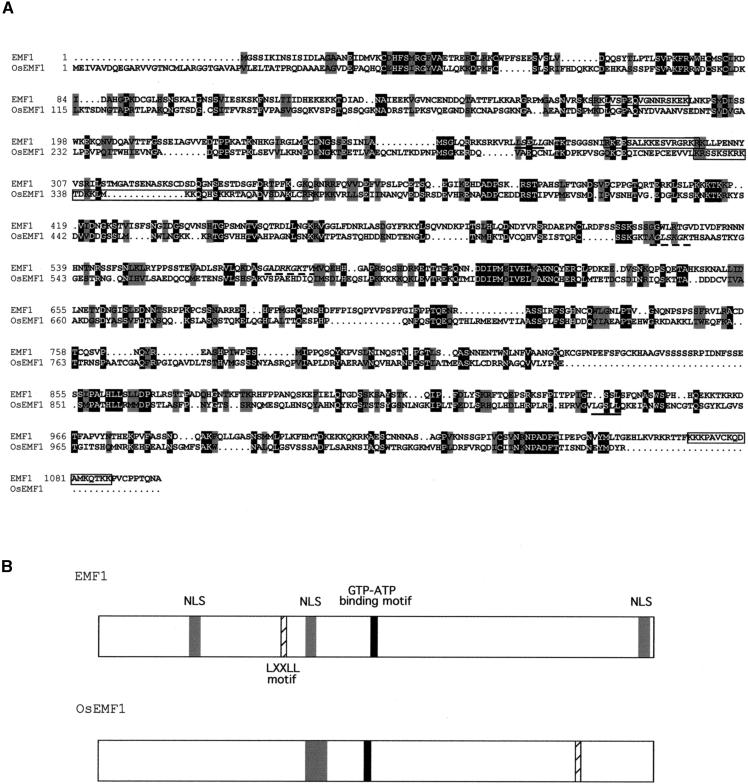
Alignment between Predicted EMF1 and OsEMF1 Amino Acid Sequences and Protein Structures. (A) Alignment between predicted EMF1 and OsEMF1 amino acid sequences. Identical amino acid residues are shaded in black, and similar amino acid residues are shaded in gray. Dots denote gaps introduced by the alignment program. Boxed sequences indicate putative nuclear localization signals (NLSs). In Arabidopsis, each box includes one possible NLS, whereas in rice, the box includes four possible overlapping NLSs. The solid underlines mark the LXXLL motif. The dashed underlines mark the GTP-ATP binding motif (P-loop motif). (B) Predicted EMF1 and OsEMF1 protein structures. Gray boxes, NLSs; black boxes, GTP-ATP binding motif (P-loop motif); hatched boxes, LXXLL motif.
Figure 3.
Figure 3.
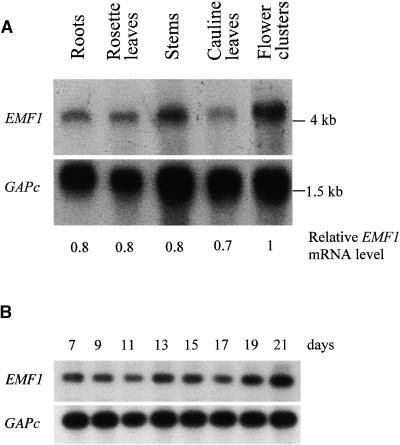
Expression of EMF1 RNA in Wild-Type Arabidopsis. (A) Autoradiographic determination of the relative amount of EMF1 RNA from a blot containing 1 μg of poly(A)+ RNA isolated from different tissues. The RNA gel blot was hybridized with an EMF1 radioactive probe and, after stripping, with a GAPc probe as a loading control. The numbers below the gels indicate the relative amounts of EMF1 RNA after standardization using the GAPc signal as a reference. Tissue samples were from roots of 2-week-old plants on agar plates; rosette leaves of 3- to 4-week-old plants in soil under short-day conditions; stems, cauline leaves, and flower clusters from an inflorescence shoot apex with developing buds and open flowers. (B) An autoradiograph from semiquantitative RT-PCR analysis of the EMF1 level in wild-type plants grown under short-day conditions. Total RNAs were isolated from seedlings at the times indicated. RT-PCR products were amplified with EMF1 primers and GAPc primers and hybridized with an EMF1 probe (top) or a GAPc probe (bottom).
Figure 4.
Figure 4.
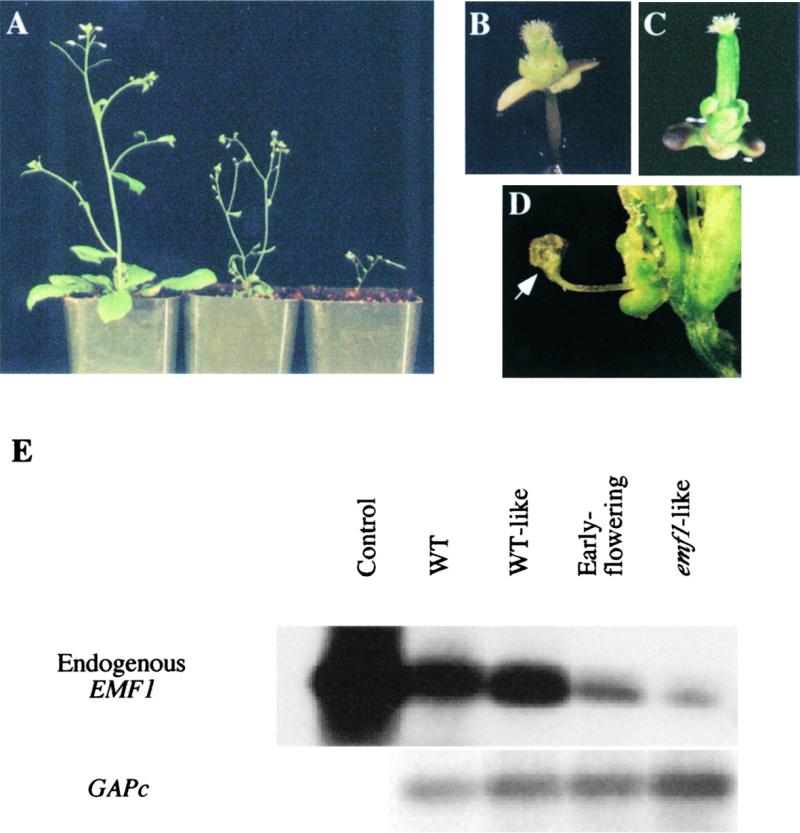
Phenotypes and EMF1 mRNA Levels of 35S::Antisense EMF1 Transgenic Plants. Phenotypes of antisense transgenic plants and emf1-1 mutants are shown in (A) to (D). (A) Thirty-four-day-old plants grown under long-day conditions. A wild-type–like plant is shown on the left, and two early-flowering antisense transgenic plants are shown on the right. (B) A 25-day-old emf1-1–like transgenic plant grown under short-day conditions. (C) A 25-day-old emf1-1 mutant grown under short-day conditions. (D) A flower of a 32-day-old early-flowering transgenic plant with ovule-like structures on stamens (arrow) or sepals. (E) Semiquantitative RT-PCR analysis of endogenous EMF1 levels in 25-day-old Columbia wild-type (WT) plants and antisense transgenic plants grown under short-day conditions. Total RNA in the wild-type plants, wild-type–like transgenic plants, and early-flowering transgenic plants was isolated from rosette/cauline leaves, and total RNA in emf1-like transgenic plants was isolated from seedlings. Control EMF1 fragments were amplified using EMF1 cDNA as a template. Shown are autoradiographs of RT-PCR products of endogenous EMF1 mRNA (top) and GAPc mRNA (bottom).

References

    1. Altschul, S.F., Madden, T.L., Schaffer, A.A., Zhang, J., Zhang, Z., Miller, W., and Lipman, D.J. (1997). Gapped BLAST and PSI-BLAST: A new generation of protein database search programs. Nucleic Acids Res. 25, 3389–3402. - PMC - PubMed
    1. Alvarez, J., Guli, C.L., Yu, X.-H., and Smyth, D.R. (1992). terminal flower: A gene affecting inflorescence development in Arabidopsis thaliana. Plant J. 2, 103–116.
    1. Amaya, I., Ratcliffe, O.J., and Bradley, D.J. (1999). Expression of CENTRORADIALIS (CEN) and CEN-like genes in tobacco reveals a conserved mechanism controlling phase change in diverse species. Plant Cell 11, 1405–1418. - PMC - PubMed
    1. Bechtold, N., Ellis, J., and Pelletier, G. (1993). In planta Agrobacterium-mediated gene transfer by infiltration of adult Arabidopsis thaliana plants. C. R. Acad. Sci. Paris Life Sci. 316, 1194–1199.
    1. Blazquez, M. (2000). Flower development pathways. J. Cell Sci. 113, 3547–3548. - PubMed

Publication types

MeSH terms