


Effects of hyaluronan on the invasive properties of human breast cancer cells in vitro
- PMID: 11488992
- PMCID: PMC2517708
- DOI: 10.1046/j.1365-2613.2001.iep0082-0193-x
Effects of hyaluronan on the invasive properties of human breast cancer cells in vitro
Abstract
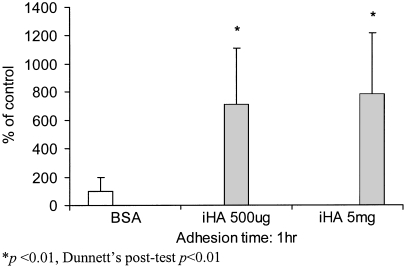
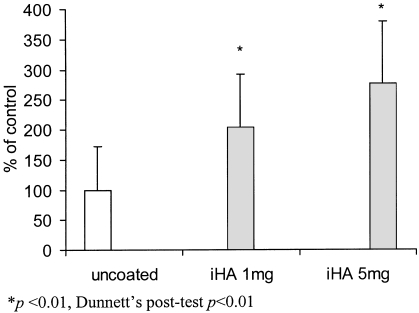
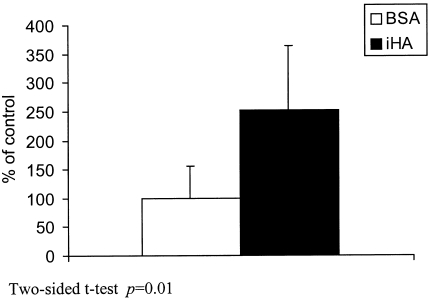
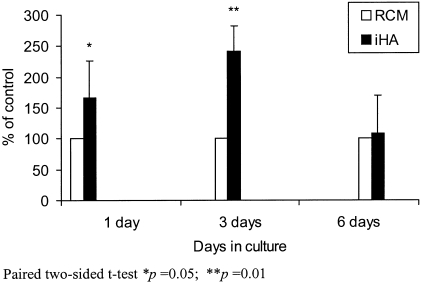
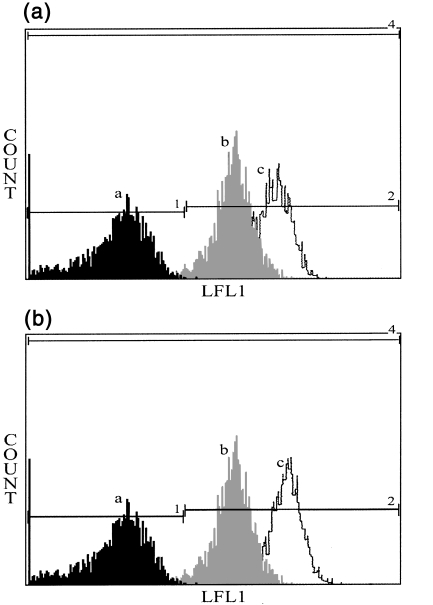
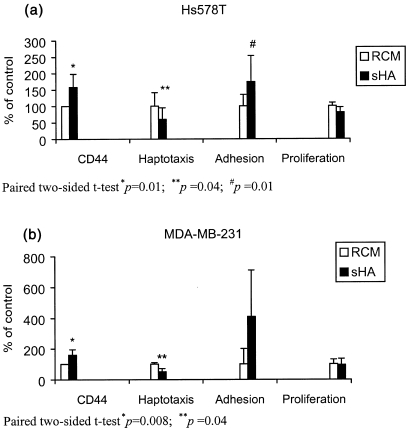
Hyaluronan (HA) is a high molecular weight glycosaminoglycan present mostly in the extracellular matrix (ECM). HA binds to specific receptors such as CD44. Its production is increased at the tumour-stroma interface, including those in breast cancer tumours. It has been suggested that it facilitates invasion of tumour cells into the ECM by a hydrodynamic effect, or by altering tumour cell behaviour. Using in vitro tests we studied the effect of immobilized (iHA) and soluble (sHA) HA on the invasive properties of four human breast cancer cell lines with different levels of CD44 expression. Our results show that iHA acts as an adhesive, haptotactic, and motility stimulating factor for the CD44 positive Hs578T cells and induces the expression of membrane CD44. sHA also changes the motility properties of the Hs578T and MDA-231 cells and increases their CD44 expression. sHA or iHA have no measurable effect on the adhesion, motility or CD44 expression of the ZR-75-1 and MCF-7 breast cancer cells. Our results establish that in high CD44 expressing breast cancer cells HA modulates tumour cell adhesion and motility and also increases the expression of its own receptor, CD44.
Figures
References
-
- Aruffo A, Stamenkovic IMM, Underhill CB, Seed B. CD44 is the principal cell surface receptor for hyaluronate. Cell. 1990;61:1303–1313. - PubMed
-
- Bae SN, Arand G, Azzam H, et al. Molecular and cellular analysis of basement membrane invasion by human breast cancer cells in Matrigel-based in vitro assays. Breast Cancer ResTreat. 1993;24:241–255. - PubMed
-
- Bertrand P, Girard N, Delpech B, Duval C, d'Anjou J, Dauce JP. Hyaluronan (hyaluronic acid) and hyaluronectin in the extracellular matrix of human breast carcinomas: comparison between invasive and non- invasive areas. Int. J. Cancer. 1992;52:1–6. - PubMed
-
- Boyce DE, Thomas A, Hart J, Moore K, Harding K. Hyaluronic acid induces tumour necrosis factor-alpha production by human macrophages in vitro. Br. J. Plast. Surg. 1997;50:362–368. - PubMed
-
- Culty M, Shizari M, Thompson EW, Underhill CB. Binding and degradation of hyaluronan by human breast cancer cell lines expressing different forms of CD44: correlation with invasive potential. J. Cell Physiol. 1994;160:275–286. - PubMed
Publication types
MeSH terms
Substances
LinkOut - more resources
Full Text Sources
Other Literature Sources
Medical
Miscellaneous
