


Review
doi: 10.1172/JCI13713.
Heparan sulfate: growth control with a restricted sequence menu
Affiliations
- PMID: 11489926
- PMCID: PMC209370
- DOI: 10.1172/JCI13713
Item in Clipboard
Review
Heparan sulfate: growth control with a restricted sequence menu
J Clin Invest.
2001 Aug.
No abstract available
Figures
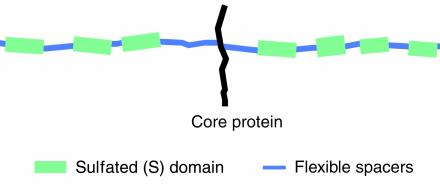
The sulfated domains of HS are the main regions involved in the recognition of growth factors and other proteins. They are separated by flexible spacers of low sulfation. Although there is a vast potential for sequence diversity in the S-domains, the variation in any one cell type may be restricted as a result of the substrate specificities of the polymer-modifying enzymes that convert the precursor heparan (GlcA-GlcNAc)n to HS. Several proteins will bind to any individual S-domain, often by recognizing different structural features of the domain. Minimal sequences designed for binding exclusively to one protein are predicted to be rare but of major importance in cell biology. Evidence from animals deficient in HS-biosynthetic enzymes suggests that weak GAG-protein interactions may be more significant than was previously realized, and this has implications for understanding the mode of action of HS and for the design of HS/heparin mimetics.
References
-
- Kjellen L, Lindhal U. Proteoglycans: structures and interactions. Annu Rev Biochem. 1991;60:443–475. - PubMed
-
- Perrimon N, Bernfield M. Specificities of heparan sulphate proteoglycans in developmental processes. Nature. 2000;404:725–728. - PubMed
-
- Lyon M, Gallagher JT. Bio-specific sequences and domains in heparan sulphate and the regulation of cell growth and adhesion. Matrix Biol. 1998;17:485–493. - PubMed
-
- Couchman, J.R., and Woods, A. 2000. Signalling through the syndecan proteoglycans. In Proteoglycans: structure, biology and molecular interactions. R.V. Iozzo, editor. Marcel Dekker Inc. New York, New York, USA. 147–160.
-
- Iozzo RV. Matrix proteoglycans: from molecular design to cellular function. Annu Rev Biochem. 1998;67:609–652. - PubMed
Publication types
MeSH terms
Substances
LinkOut - more resources
Full Text Sources
Other Literature Sources
