. 2001 Aug 6;194(3):375-8.
doi: 10.1084/jem.194.3.375.

Somatic hypermutation shapes the antibody repertoire of memory B cells in humans

Affiliations

Somatic hypermutation shapes the antibody repertoire of memory B cells in humans

E Meffre et al. J Exp Med. .

Abstract

High-affinity antibodies produced by memory B cells differ from antibodies produced in naive B cells in two respects. First, many of these antibodies show somatic hypermutation, and second, the repertoire of antibodies expressed in memory responses is highly selected. To determine whether somatic hypermutation is responsible for the shift in the antibody repertoire during affinity maturation, we analyzed the immunoglobulin lambda light chain (Iglambda) repertoire expressed by naive and antigen-selected memory B cells in humans. We found that the Iglambda repertoire differs between naive and memory B cells and that this shift in the repertoire does not occur in the absence of somatic hypermutation in patients lacking activation-induced cytidine deaminase (AID). Our work suggests that somatic hypermutation makes a significant contribution to shaping the antigen-selected antibody repertoire in humans.


Figures
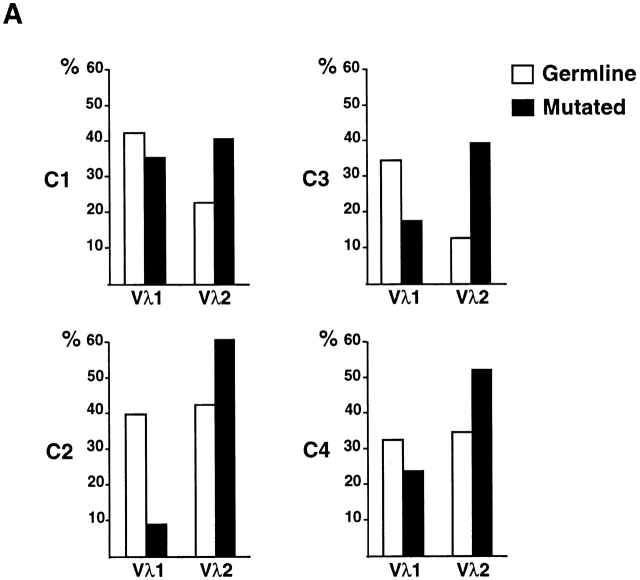
Figure 1
Figure 1
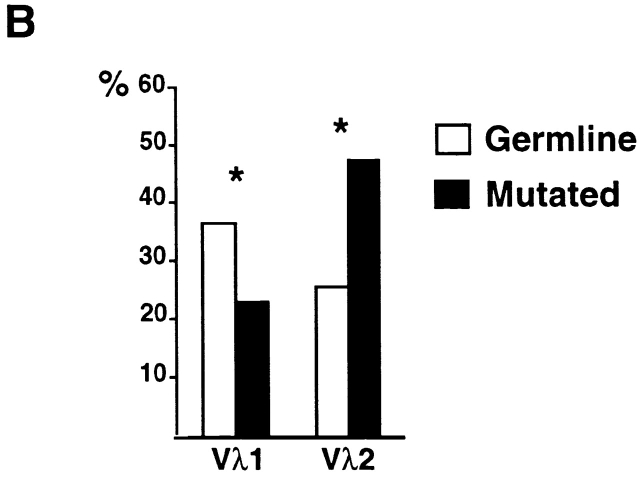
Igλ repertoire expressed in peripheral B cells from control donors. (A) Vλ1 and Vλ2 gene usage in germline-encoded (open bars) and mutated (solid bars) sequences from CD19+ peripheral B cells in four unrelated controls. 25, 15, 46, and 34 germline VλJλ sequences from donors C1, C2, C3, and C4 were compared with 33, 23, 33, and 29 mutated VλJλ sequences from the same individuals. The percent Vλ utilization is indicated on the y axis. (B) Combined total of Vλ1 and Vλ2 gene usage in germline and mutated VλJλ sequences from control donors. 121 germline-encoded and 118 mutated sequences were obtained from the four control donors. Asterisk (*) indicates statistically significant difference (Vλ1, P = 0.022; Vλ2, P = 0.0004).
Figure 1
Figure 1
Igλ repertoire expressed in peripheral B cells from control donors. (A) Vλ1 and Vλ2 gene usage in germline-encoded (open bars) and mutated (solid bars) sequences from CD19+ peripheral B cells in four unrelated controls. 25, 15, 46, and 34 germline VλJλ sequences from donors C1, C2, C3, and C4 were compared with 33, 23, 33, and 29 mutated VλJλ sequences from the same individuals. The percent Vλ utilization is indicated on the y axis. (B) Combined total of Vλ1 and Vλ2 gene usage in germline and mutated VλJλ sequences from control donors. 121 germline-encoded and 118 mutated sequences were obtained from the four control donors. Asterisk (*) indicates statistically significant difference (Vλ1, P = 0.022; Vλ2, P = 0.0004).
Figure 3
Figure 3
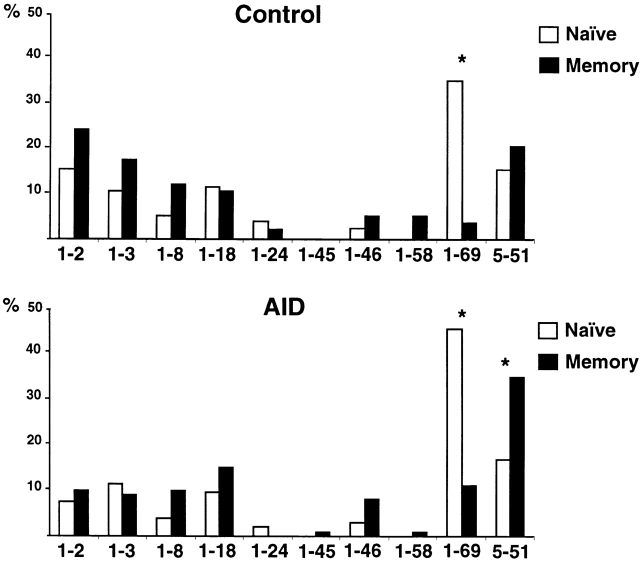
VH1 and VH5 repertoire analysis of naive and memory B cells from control donors and AID-deficient patients. 77 control C5, C6, and C7 (top) and 105 AID (bottom) VH1 and VH5 sequences from naive B cells (open bars) are compared with 58 control and 112 AID sequences from memory B cells (solid bars). The percent VH1 and VH5 utilization is indicated on the y axis. Asterisk (*) indicates statistically significant difference (VH1–69, P < 0.0001 for both controls and AID-deficient patients; VH5–51, P = 0.03 for AID-deficient patients).
Figure 2
Figure 2
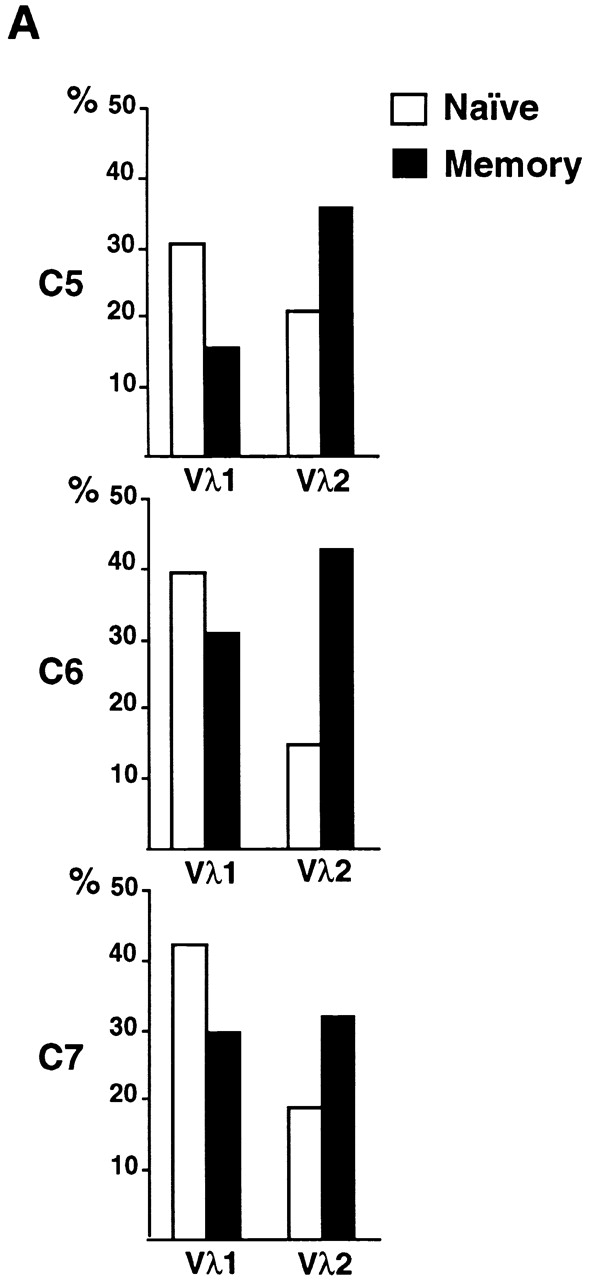
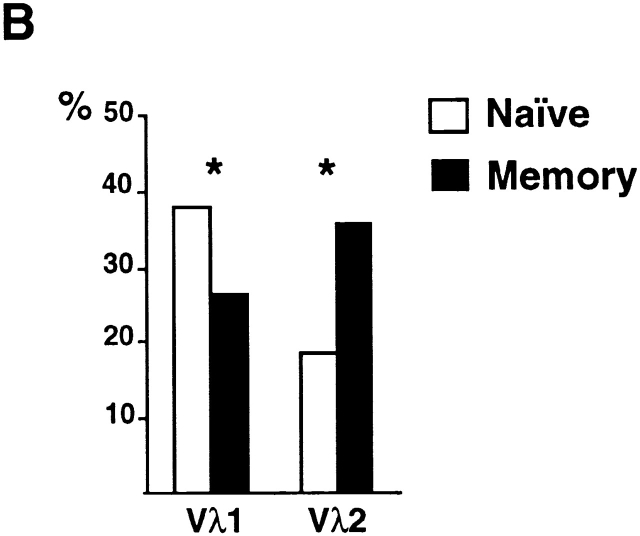
Igλ repertoire expressed in naive and memory B cells from control donors. (A) Vλ1 and Vλ2 gene usage in naive CD19+IgM+CD27 (open bars) and memory CD19+IgM+CD27+ (solid bars) B cells in three unrelated controls. 33, 33, and 52 VλJλ sequences from naive B cells from donors C5, C6, and C7, respectively were compared with 39, 42, and 63 VλJλ sequences from memory B cells from the same individuals. The percent Vλ utilization is indicated on the y axis. (B) Combined total Vλ1 and Vλ2 gene usage in CD19+ IgM+CD27 and CD19+IgM+ CD27+ B cells. Asterisk (*) indicates statistically significant difference (Vλ1, P = 0.035; and Vλ2, P = 0.0017).
Figure 2
Figure 2
Igλ repertoire expressed in naive and memory B cells from control donors. (A) Vλ1 and Vλ2 gene usage in naive CD19+IgM+CD27 (open bars) and memory CD19+IgM+CD27+ (solid bars) B cells in three unrelated controls. 33, 33, and 52 VλJλ sequences from naive B cells from donors C5, C6, and C7, respectively were compared with 39, 42, and 63 VλJλ sequences from memory B cells from the same individuals. The percent Vλ utilization is indicated on the y axis. (B) Combined total Vλ1 and Vλ2 gene usage in CD19+ IgM+CD27 and CD19+IgM+ CD27+ B cells. Asterisk (*) indicates statistically significant difference (Vλ1, P = 0.035; and Vλ2, P = 0.0017).
Figure 4
Figure 4
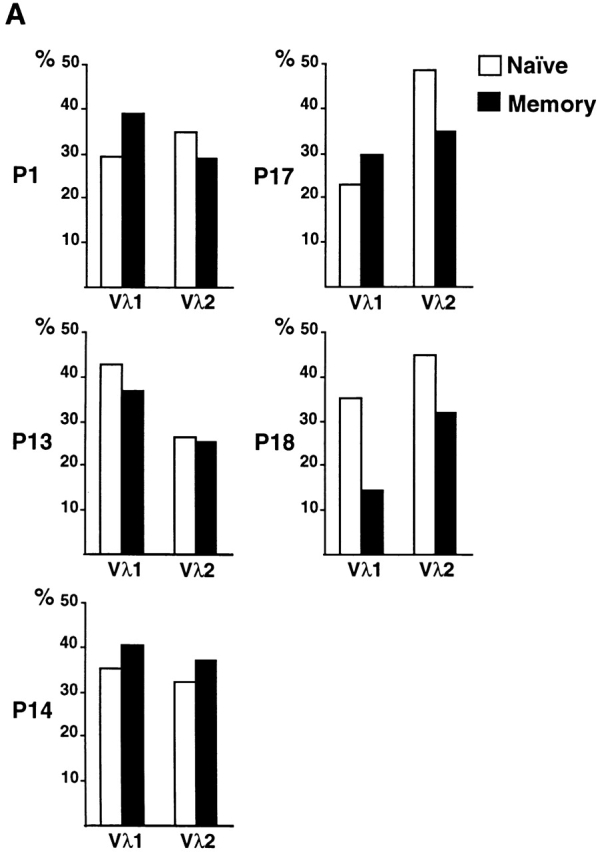
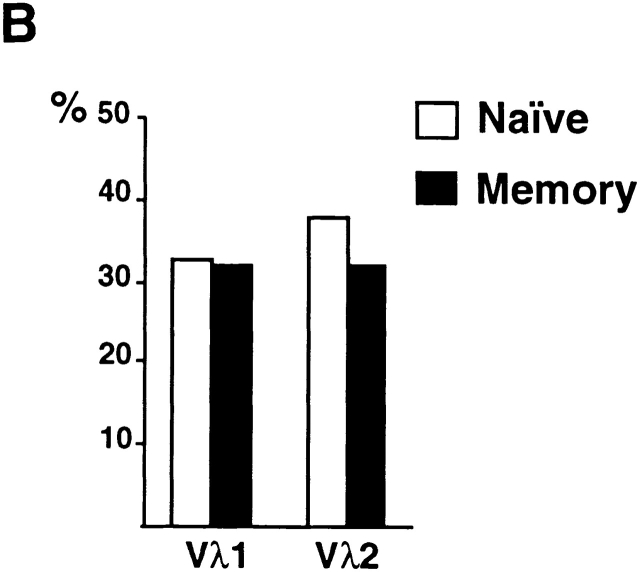
Vλ1 and Vλ2 gene usage in naive and memory B cells from AID-deficient patients. (A) Vλ1 and Vλ2 gene usage in naive CD19+CD27 (open bars) and memory CD19+CD27+ (solid bars) B cells in five unrelated AID-deficient patients. The patient numbers are as described in reference 18. 34, 30, 31, 35, and 31 VλJλ sequences from naive B cells from AID-deficient patients P1, P13, P14, P17, and P18, respectively were compared with 31, 35, 32, 37, and 34 VλJλ sequences from memory B cells from the same individuals. The percent Vλ utilization is indicated on the y axis. (B) Combined total Vλ1 and Vλ2 gene usage in CD19+CD27 and CD19+CD27+ B cells for AID-deficient patients.
Figure 4
Figure 4
Vλ1 and Vλ2 gene usage in naive and memory B cells from AID-deficient patients. (A) Vλ1 and Vλ2 gene usage in naive CD19+CD27 (open bars) and memory CD19+CD27+ (solid bars) B cells in five unrelated AID-deficient patients. The patient numbers are as described in reference 18. 34, 30, 31, 35, and 31 VλJλ sequences from naive B cells from AID-deficient patients P1, P13, P14, P17, and P18, respectively were compared with 31, 35, 32, 37, and 34 VλJλ sequences from memory B cells from the same individuals. The percent Vλ utilization is indicated on the y axis. (B) Combined total Vλ1 and Vλ2 gene usage in CD19+CD27 and CD19+CD27+ B cells for AID-deficient patients.

References

    1. Siskind G.W., Eisen H.N. Effect of variation in antibody-hapten association constant upon the biologic activity of the antibody. J. Immunol. 1965;95:436–441. - PubMed
    1. Weigert M.G., Cesari I.M., Yonkovich S.J., Cohn M. Variability in the lambda light chain sequences of mouse antibody. Nature. 1970;228:1045–1047. - PubMed
    1. Griffiths G.M., Berek C., Kaartinen M., Milstein C. Somatic mutation and the maturation of immune response to 2-phenyl oxazolone. Nature. 1984;312:271–275. - PubMed
    1. Kaartinen M., Griffiths G.M., Hamlyn P.H., Markham A.F., Karjalainen K., Pelkonen J.L., Makela O., Milstein C. Anti-oxazolone hybridomas and the structure of the oxazolone idiotype. J. Immunol. 1983;130:937–945. - PubMed
    1. Kaartinen M., Griffiths G.M., Markham A.F., Milstein C. mRNA sequences define an unusually restricted IgG response to 2-phenyloxazolone and its early diversification. Nature. 1983;304:320–324. - PubMed

Publication types