Math5 is required for retinal ganglion cell and optic nerve formation
- PMID: 11493566
- PMCID: PMC1480839
- DOI: 10.1242/dev.128.13.2497
Math5 is required for retinal ganglion cell and optic nerve formation
Abstract
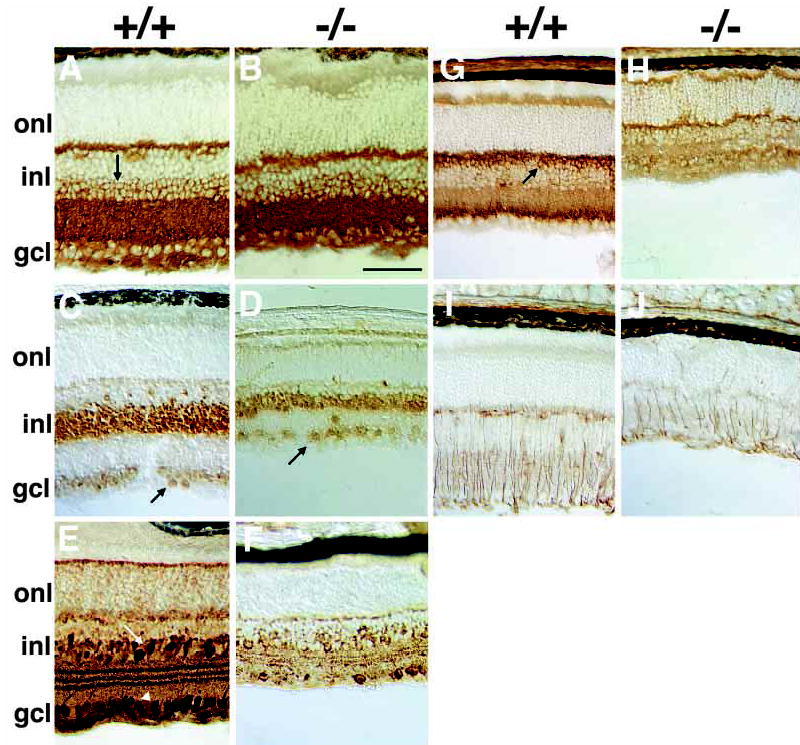
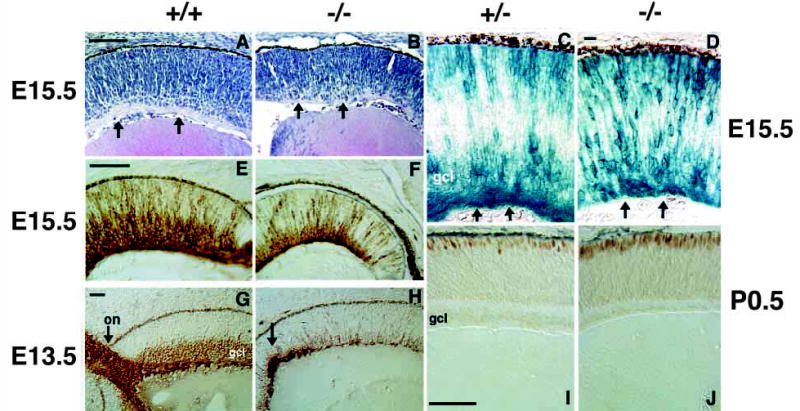
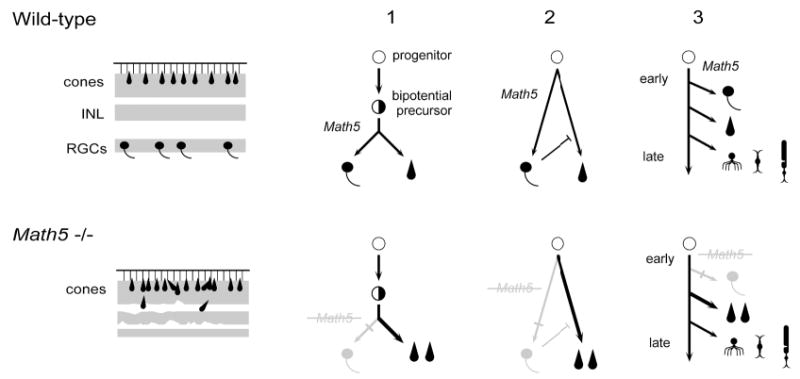
The vertebrate retina contains seven major neuronal and glial cell types in an interconnected network that collects, processes and sends visual signals through the optic nerve to the brain. Retinal neuron differentiation is thought to require both intrinsic and extrinsic factors, yet few intrinsic gene products have been identified that direct this process. Math5 (Atoh7) encodes a basic helix-loop-helix (bHLH) transcription factor that is specifically expressed by mouse retinal progenitors. Math5 is highly homologous to atonal, which is critically required for R8 neuron formation during Drosophila eye development. Like R8 cells in the fly eye, retinal ganglion cells (RGCs) are the first neurons in the vertebrate eye. Here we show that Math5 mutant mice are fully viable, yet lack RGCs and optic nerves. Thus, two evolutionarily diverse eye types require atonal gene family function for the earliest stages of retinal neuron formation. At the same time, the abundance of cone photoreceptors is significantly increased in Math5(-/-) retinae, suggesting a binary change in cell fate from RGCs to cones. A small number of nascent RGCs are detected during embryogenesis, but these fail to develop further, suggesting that committed RGCs may also require Math5 function.
Figures
References
-
- Altshuler D, Cepko C. A temporally regulated, diffusible activity is required for rod photoreceptor development in vitro. Development. 1992;114:947–957. - PubMed
-
- Altshuler, D. M., Turner, D. L. and Cepko, C. L. (1991). Specification of cell type in the vertebrate retina. In Cell Lineage and Cell fate in Visual System Development (ed. D. M.-K. Lam and C. J. Shatz), pp. 37–58. Cambridge, MA: MIT Press.
-
- Applebury ML, Antoch MP, Baxter LC, Chun LL, Falk JD, Farhangfar F, Kage K, Krzystolik MG, Lyass LA, Robbins JT. The murine cone photoreceptor: a single cone type expresses both S and M opsins with retinal spatial patterning. Neuron. 2000;27:513–523. - PubMed
-
- Austin CP, Feldman DE, Ida JA, Cepko CL. Vertebrate retinal ganglion cells are selected from competent progenitors by the action of Notch. Development. 1995;121:3637–3650. - PubMed
-
- Ballesta J, Terenghi G, Thibault J, Polak JM. Putative dopamine-containing cells in the retina of seven species demonstrated by tyrosine hydroxylase immunocytochemistry. Neuroscience. 1984;12:1147–1156. - PubMed
Publication types
MeSH terms
Substances
Grants and funding
LinkOut - more resources
Full Text Sources
Other Literature Sources
Molecular Biology Databases