. 2001 Aug 14;98(17):9842-6.
doi: 10.1073/pnas.171318198.

A new recommended dietary allowance of vitamin C for healthy young women

Affiliations

A new recommended dietary allowance of vitamin C for healthy young women

M Levine et al. Proc Natl Acad Sci U S A. .

Abstract

The recently released Recommended Dietary Allowance of vitamin C for women, 75 mg daily, was based on data for men. We now report results of a depletion-repletion study with healthy young women hospitalized for 186 +/- 28 days, using vitamin C doses of 30-2,500 mg daily. The relationship between dose and steady-state plasma concentration was sigmoidal. Only doses above 100 mg were beyond the linear portion of the curve. Plasma and circulating cells saturated at 400 mg daily, with urinary elimination of higher doses. Biomarkers of endogenous oxidant stress, plasma and urine F(2)-isoprostanes, and urine levels of a major metabolite of F(2)-isoprostanes were unchanged by vitamin C at all doses, suggesting this vitamin does not alter endogenous lipid peroxidation in healthy young women. By using Food and Nutrition Board guidelines, the data indicate that the Recommended Dietary Allowance for young women should be increased to 90 mg daily.


Figures
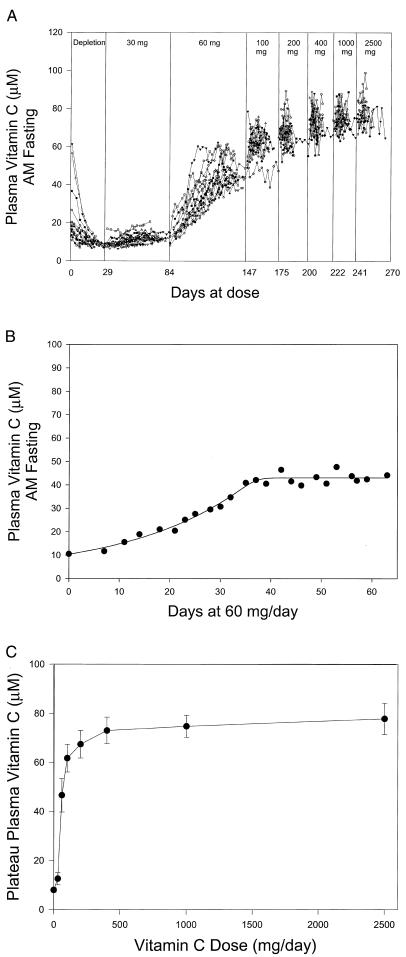
Figure 1
Figure 1
Vitamin C plasma concentration as a function of dose in women. See Experimental Methods for details. (A) Vitamin C concentrations as function of days at dose. Doses are indicated (Top). Each symbol represents a different subject. There is a 1-day gap between all doses for bioavailability sampling. Doses through 200 mg daily were received by 15 subjects, through 1,000 mg daily by 13 subjects, and through 2,500 mg by 10 subjects. (B) Steady-state vitamin C concentrations in plasma. Data show determination of steady state for one subject at 60 mg daily. (C) Steady-state vitamin C concentrations in plasma for subjects (in A) as a function of all doses, mean ± SD.
Figure 2
Figure 2
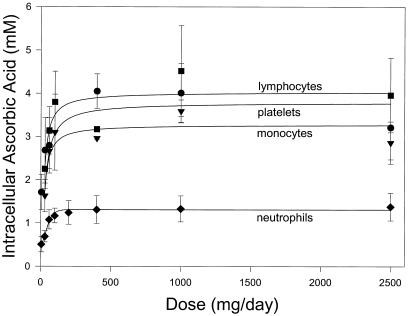
Intracellular vitamin C concentrations (millimolar) in circulating cells as function of dose. Neutrophils (⧫), monocytes (▾), platelets (●), and lymphocytes (■) were isolated when steady state was achieved for each dose. For neutrophils, samples were available from 13 subjects at doses 0–200 mg daily, from 11 subjects at doses 400 and 1,000 mg daily, and from 10 subjects at 2,500 mg daily. For lymphocytes, monocytes, and platelets, samples were available from 13 subjects at 30 mg daily, from 12 subjects at 60 mg daily, from 6 subjects at 100 mg daily, from 2 subjects at 400 and 1,000 mg daily, and from 9 subjects at 2,500 mg daily. Data are mean values ± SD.
Figure 3
Figure 3
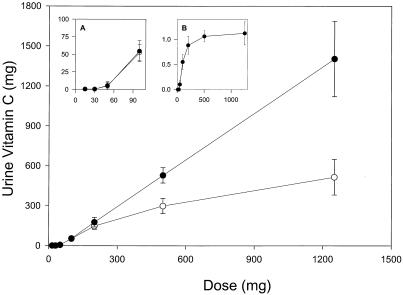
Urinary vitamin C excretion as a function of single vitamin C doses at steady state. Vitamin C excretion over 24 h was determined after administration of single doses given either orally (○) or intravenously (●). Data indicate mean values ± SD. (Inset A) Vitamin C excretion for single oral (○) or intravenous (●) doses of 15–100 mg. x axis indicates dose, and y axis indicates amount (milligrams) excreted in urine. (Inset B) Fractional excretion (the fraction of the dose excreted) after i.v. administration of single doses of vitamin C. x axis indicates dose, and y axis indicates fractional excretion (vitamin C excreted in urine in milligrams divided by the vitamin C dose in milligrams). Data from oral and i.v. administration were available from 11 subjects at doses 15, 30, 50, and 200 mg, from 10 subjects at 100 mg, from 8 subjects at 500 mg, and from 9 subjects at 1,250 mg.
Figure 4
Figure 4
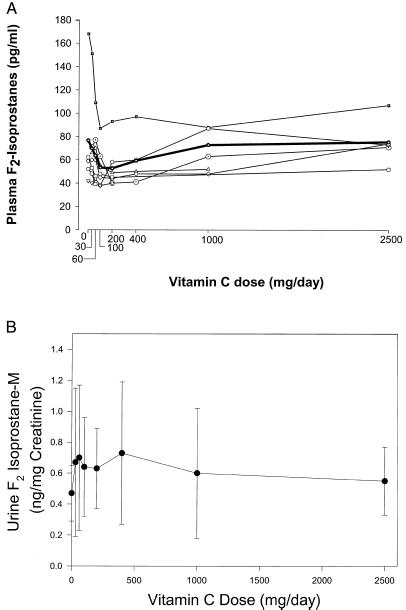
(A) Plasma F2-isoprostanes from all available subjects as a function of vitamin C doses at steady state. Plasma F2-isoprostanes were available in seven subjects. All available data are shown; each symbol represents a different subject, and the bold line/symbol indicate mean F2-isoprostanes. (B) Urine F2-isoprostane-M as a function of vitamin C dose at steady state. Samples at doses 0–200 mg daily were available from 15 subjects, at doses 400 and 1,000 mg daily from 13 subjects, and at 2,500 mg daily from 10 subjects. Data indicate mean values ± SD.

References

    1. Food and Nutrition Board and Panel on Dietary Antioxidants and Related Compounds. Vitamin C. 2000;5:95–185.
    1. Yates A A, Schlicker S A, Suitor C W. J Am Diet Assoc. 1998;98:699–706. - PubMed
    1. Levine M, Conry-Cantilena C, Wang Y, Welch R W, Washko P W, Dhariwal K R, Park J B, Lazarev A, Graumlich J, King J, Cantilena L R. Proc Natl Acad Sci USA. 1996;93:3704–3709. - PMC - PubMed
    1. Deutsche Gesellschaft für Ernährung (German Society of Nutrition); Österreichische Gesellschaft für Ernährung (Austrian Society of Nutrition); Schweizerische Gesellschaft für Ernährungsforschung (Swiss Society of Nutrition) & Schweizerische Vereinigung für Ernährung (Swiss Unit of Nutrition) Referenzwerte für die Nahrstoffzefuhr (Recommended Values for Nutritional Intake) (Umschau, Frankfurt), pp. 137–144. 2000.
    1. Health and Nutrition Information Society. Recommended Dietary Allowances (Dietary Reference Intakes) Tokyo: Daiichi Shuppan; 2000. pp. 112–127.

Publication types

MeSH terms