


Mediation of tubuloglomerular feedback by adenosine: evidence from mice lacking adenosine 1 receptors
- PMID: 11504952
- PMCID: PMC55564
- DOI: 10.1073/pnas.171317998
Mediation of tubuloglomerular feedback by adenosine: evidence from mice lacking adenosine 1 receptors
Abstract
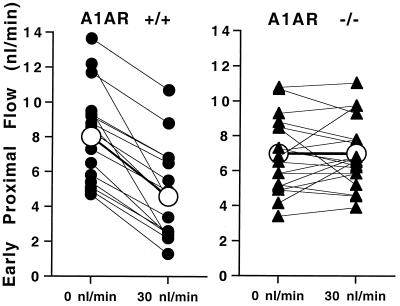
Adenosine is a determinant of metabolic control of organ function increasing oxygen supply through the A2 class of adenosine receptors and reducing oxygen demand through A1 adenosine receptors (A1AR). In the kidney, activation of A1AR in afferent glomerular arterioles has been suggested to contribute to tubuloglomerular feedback (TGF), the vasoconstriction elicited by elevations in [NaCl] in the macula densa region of the nephron. To further elucidate the role of A1AR in TGF, we have generated mice in which the entire A1AR coding sequence was deleted by homologous recombination. Homozygous A1AR mutants that do not express A1AR mRNA transcripts and do not respond to A1AR agonists are viable and without gross anatomical abnormalities. Plasma and urinary electrolytes were not different between genotypes. Likewise, arterial blood pressure, heart rates, and glomerular filtration rates were indistinguishable between A1AR(+/+), A1AR(+/-), and A1AR(-/-) mice. TGF responses to an increase in loop of Henle flow rate from 0 to 30 nl/min, whether determined as change of stop flow pressure or early proximal flow rate, were completely abolished in A1AR(-/-) mice (stop flow pressure response, -6.8 +/- 0.55 mmHg and -0.4 +/- 0.2 in A1AR(+/+) and A1AR(-/-) mice; early proximal flow rate response, -3.4 +/- 0.4 nl/min and +0.02 +/- 0.3 nl/min in A1AR(+/+) and A1AR(-/-) mice). Absence of TGF responses in A1AR-deficient mice suggests that adenosine is a required constituent of the juxtaglomerular signaling pathway. A1AR null mutant mice are a promising tool to study the functional role of A1AR in different target tissues.
Figures


References
-
- Conant A R, Jarvis S M. Biochem Pharmacol. 1994;48:873–880. - PubMed
-
- Van Calker D, Muller M, Hamprecht B. J Neurochem. 1979;33:999–1005. - PubMed
-
- Gerwins P, Fredholm B B. Naunyn-Schmiedeberg's Arch Pharmacol. 1995;351:186–193. - PubMed
-
- Olah M E, Stiles G L. Annu Rev Pharmacol Toxicol. 1995;35:581–606. - PubMed
Publication types
MeSH terms
Substances
Grants and funding
LinkOut - more resources
Full Text Sources
Other Literature Sources
Molecular Biology Databases
