Risk of adverse birth outcomes in populations living near landfill sites
- PMID: 11509424
- PMCID: PMC37394
- DOI: 10.1136/bmj.323.7309.363
Risk of adverse birth outcomes in populations living near landfill sites
Erratum in
- BMJ 2001 Nov 17;323(7322):1182
Abstract
Objective: To investigate the risk of adverse birth outcomes associated with residence near landfill sites in Great Britain.
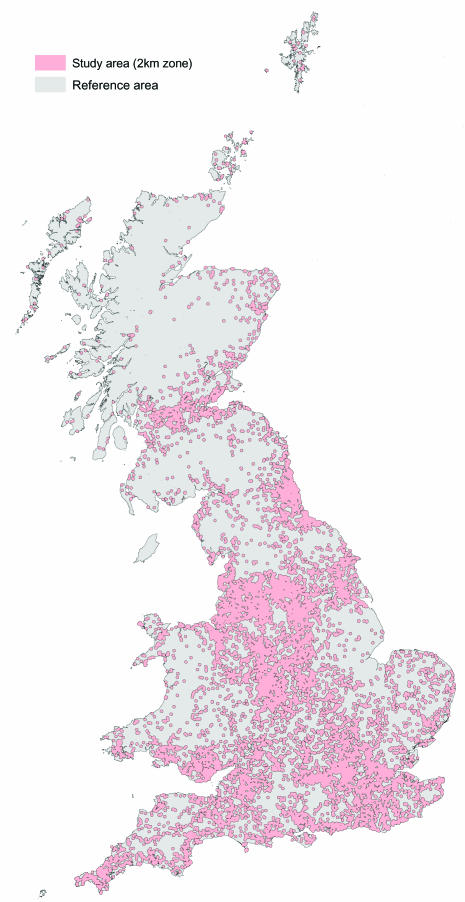
Design: Geographical study of risks of adverse birth outcomes in populations living within 2 km of 9565 landfill sites operational at some time between 1982 and 1997 (from a total of 19 196 sites) compared with those living further away.
Setting: Great Britain.
Subjects: Over 8.2 million live births, 43 471 stillbirths, and 124 597 congenital anomalies (including terminations).
Main outcome measures: All congenital anomalies combined, some specific anomalies, and prevalence of low and very low birth weight (<2500 g and <1500 g).
Results: For all anomalies combined, relative risk of residence near landfill sites (all waste types) was 0.92 (99% confidence interval 0.907 to 0.923) unadjusted, and 1.01 (1.005 to 1.023) adjusted for confounders. Adjusted risks were 1.05 (1.01 to 1.10) for neural tube defects, 0.96 (0.93 to 0.99) for cardiovascular defects, 1.07 (1.04 to 1.10) for hypospadias and epispadias (with no excess of surgical correction), 1.08 (1.01 to 1.15) for abdominal wall defects, 1.19 (1.05 to 1.34) for surgical correction of gastroschisis and exomphalos, and 1.05 (1.047 to 1.055) and 1.04 (1.03 to 1.05) for low and very low birth weight respectively. There was no excess risk of stillbirth. Findings for special (hazardous) waste sites did not differ systematically from those for non-special sites. For some specific anomalies, higher risks were found in the period before opening compared with after opening of a landfill site, especially hospital admissions for abdominal wall defects.
Conclusions: We found small excess risks of congenital anomalies and low and very low birth weight in populations living near landfill sites. No causal mechanisms are available to explain these findings, and alternative explanations include data artefacts and residual confounding. Further studies are needed to help differentiate between the various possibilities.
Figures
Comment in
-
Does exposure to landfill waste harm the fetus? Perhaps, but more evidence is needed.BMJ. 2001 Aug 18;323(7309):351-2. doi: 10.1136/bmj.323.7309.351. BMJ. 2001. PMID: 11509409 Free PMC article. No abstract available.
-
Risk of adverse birth outcomes near landfill sites. Evidence suggests that it is probably safe for fetuses to develop near landfill sites.BMJ. 2001 Dec 8;323(7325):1365. BMJ. 2001. PMID: 11776942 Free PMC article. No abstract available.
-
Risk of adverse birth outcomes near landfill sites. Risks from landfill sites can be presented in alternative ways.BMJ. 2001 Dec 8;323(7325):1365. BMJ. 2001. PMID: 11776943 No abstract available.
-
Risk of adverse birth outcomes near landfill sites. News stories were handled badly.BMJ. 2001 Dec 8;323(7325):1365-6. BMJ. 2001. PMID: 11776944 No abstract available.
-
Risk of adverse birth outcomes near landfill sites. Local registers provide more accurate information.BMJ. 2001 Dec 8;323(7325):1366. BMJ. 2001. PMID: 11776945 No abstract available.
References
-
- Digest of environmental statistics. London: Department of the Environment, Transport and the Regions; 2001.
-
- Ward RS, Williams GM, Hills CC. Changes in major and trace components of landfill gas during subsurface migration. Waste Manage Res. 1996;14:243–261.
-
- Johnson BL, DeRosa C. The toxicologic hazard of superfund hazardous-waste sites. Rev Environ Health. 1997;12:235–251. - PubMed
-
- Hamar GB, McGeehin MA, Phifer BL, Ashley DL. Volatile organic compound testing of a population living near a hazardous waste site. J Expo Anal Environ Epidemiol. 1996;6:247–255. - PubMed
-
- El-Fadel M, Findikakis AN, Leckie JO. Environmental impacts of solid waste landfilling. J Environ Manage. 1997;50:1–25.
Publication types
MeSH terms
LinkOut - more resources
Full Text Sources
Medical