. 2001 Sep;21(18):6210-21.
doi: 10.1128/MCB.21.18.6210-6221.2001.

Xenopus U3 snoRNA GAC-Box A' and Box A sequences play distinct functional roles in rRNA processing

Affiliations

Xenopus U3 snoRNA GAC-Box A' and Box A sequences play distinct functional roles in rRNA processing

A V Borovjagin et al. Mol Cell Biol. 2001 Sep.

Abstract

Mutations in the 5' portion of Xenopus U3 snoRNA were tested for function in oocytes. The results revealed a new cleavage site (A0) in the 3' region of vertebrate external transcribed spacer sequences. In addition, U3 mutagenesis uncoupled cleavage at sites 1 and 2, flanking the 5' and 3' ends of 18S rRNA, and generated novel intermediates: 19S and 18.5S pre-rRNAs. Furthermore, specific nucleotides in Xenopus U3 snoRNA that are required for cleavages in pre-rRNA were identified: box A is essential for site A0 cleavage, the GAC-box A' region is necessary for site 1 cleavage, and the 3' end of box A' and flanking nucleotides are required for site 2 cleavage. Differences between metazoan and yeast U3 snoRNA-mediated rRNA processing are enumerated. The data support a model where metazoan U3 snoRNA acts as a bridge to draw together the 5' and 3' ends of the 18S rRNA coding region within pre-rRNA to coordinate their cleavage.


Figures
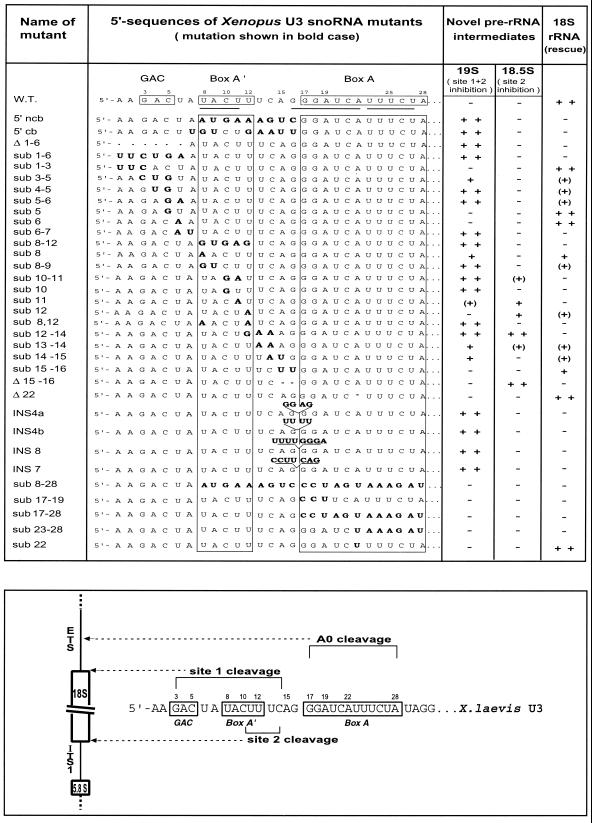
FIG. 1
FIG. 1
U3 snoRNA mutagenesis. (Top) Boldface letters indicate nucleotide substitutions or insertions. The amount of rRNA is shown: ++, much; +, some; (+), little; −, none. (Bottom) U3 nucleotides required for cleavage at site A0, 1, or 2 in pre-rRNA are bracketed.
FIG. 2
FIG. 2
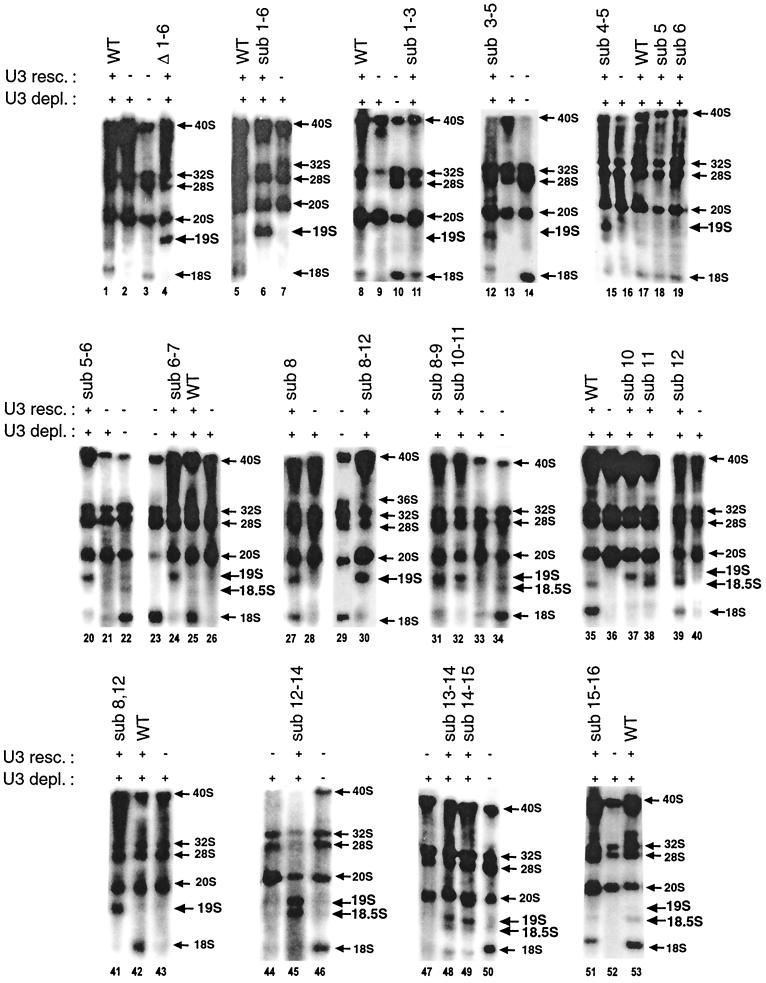
Mutations in the 5′ portion of Xenopus U3 snoRNA affect rRNA processing. Endogenous U3 snoRNA was not depleted (−) or was depleted (+) by injection into Xenopus oocytes of an antisense oligonucleotide complementary to nt 39 to 54. Subsequently, either wild-type (WT) or mutant (Fig. 1) synthetic U3 was injected into the oocytes for rescue. In vivo labeling was done by subsequent injection of 32P-UTP to trace changes in rRNA processing after U3 snoRNA depletion and rescue. The sizes of nuclear pre-rRNA and rRNA are indicated; note the novel 19S and 18.5S pre-rRNAs. Results of injection of additional U3 mutants not shown here are summarized in Fig. 1.
FIG. 3
FIG. 3
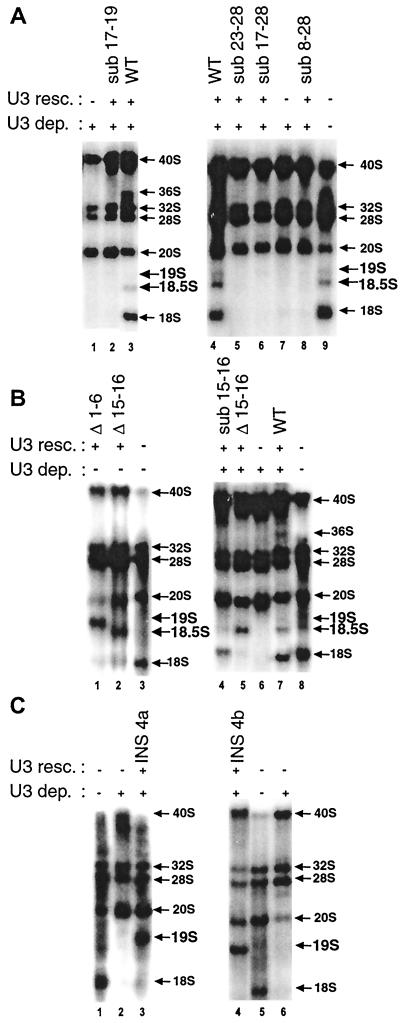
Effects on rRNA processing of substitutions in U3 box A (A), deletions (B), or insertions between box A′ and box A (C). Note that endogenous U3 snoRNA was not depleted in panel B, lanes 1 to 3. Other details are as described for Fig. 2. WT, wild type.
FIG. 4
FIG. 4
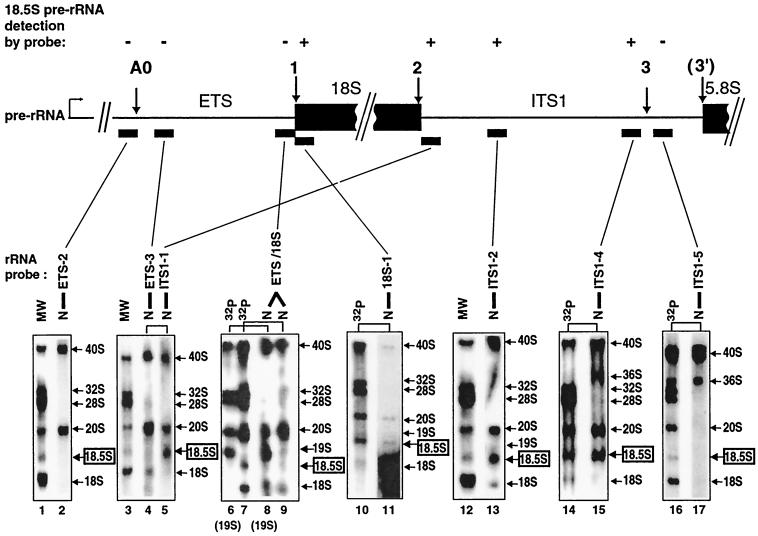
Identification of the novel 18.5S pre-rRNA by Northern blottings. Samples from in vivo labeling experiments (as described for Fig. 2) that showed strong accumulation of the novel 18.5S pre-rRNA (produced by rescue with Δ15-16 mutant U3) or 19S pre-rRNA (in lanes 6 and 8 and produced by rescue with Δ1-6 U3 mutant snoRNA) were resolved on denaturing agarose gels, electrotransferred onto Nytran Plus membranes, and exposed to X-ray film (lanes 32P). The filters were allowed to decay for up to 1 year and were hybridized with the radioactive probes shown by the bars under the map, derived from the ETS, 18S coding region, or ITS1. Lanes N, Northern blots of the 32P lane in the same panel after its radioactivity had decayed; the same lanes are linked by a bracket. Probes 18S-1 through ITS1-4 detected 18.5S pre-rRNA (+ above map of pre-rRNA). Lanes MW, in vivo-labeled pre-rRNA and rRNA from unperturbed oocytes as molecular weight markers.
FIG. 5
FIG. 5
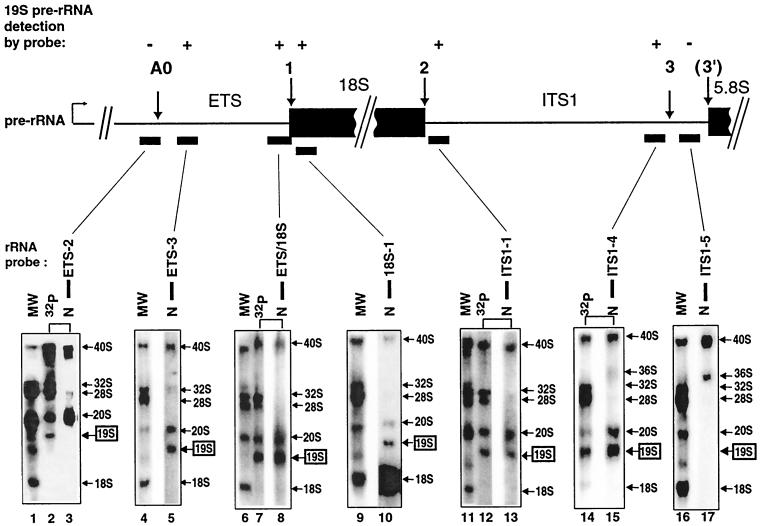
Identification of the novel 19S pre-rRNA by Northern blottings. Samples from in vivo labeling experiments (as described for Fig. 2) that showed strong accumulation of the novel 19S pre-rRNA (produced by rescue with 5′ cb, 5′ ncb, or Δ1-6 U3 mutant snoRNA) were allowed to decay and hybridized with probes from the ETS, 18S coding region, or ITS1 (see Fig. 4 for details). Note that 19S pre-rRNA was detected by probes from ETS-3 to ITS1-4 (+ above map of pre-rRNA).
FIG. 6
FIG. 6
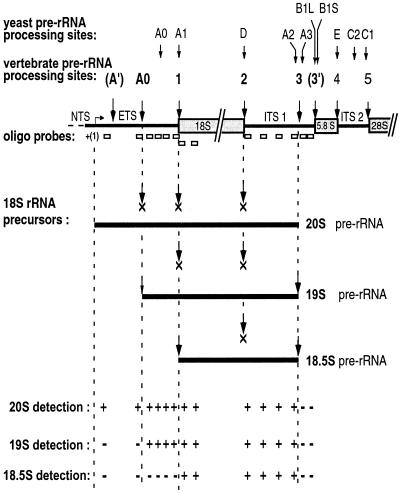
Summary of cleavages that produce 20S, 19S, and 18.5S pre-rRNA. Results of Northern blots shown in Fig. 4 and 5 and data not shown are summarized here. Xenopus 20S, 19S, and 18.5S pre-rRNA all share the same 3′ end (produced by cleavage at site 3 in the ITS1), but their 5′ ends vary as indicated. The 5′ end of 20S pre-rRNA is the same as the 5′ end of 40S pre-rRNA (26, 44). X indicates the inhibited cleavage sites, resulting in accumulation of 20S, 19S, or 18.5S pre-rRNAs. Cleavage sites in yeast pre-rRNA are indicated (reviewed in reference 52) for comparison to sites in vertebrate pre-rRNA.
FIG. 7
FIG. 7
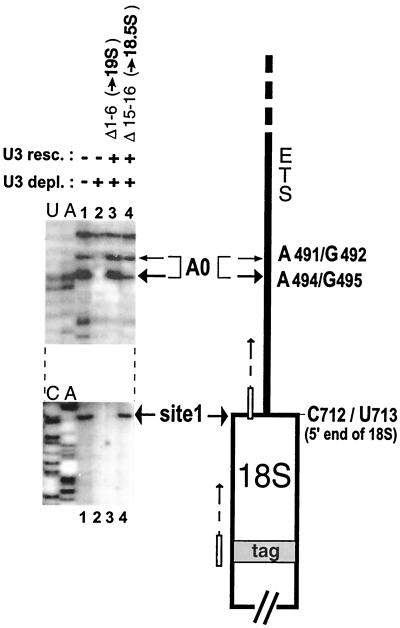
Mapping the novel A0 cleavage site in pre-rRNA by primer extension. RNA extracted from nuclei of unperturbed Xenopus oocytes (lane 1), oocytes depleted of endogenous U3 snoRNA (lane 2), or U3 depleted or rescued with U3 snoRNA mutants that promote strong accumulation of 19S pre-rRNA (lane 3) or 18.5S pre-rRNA (lane 4) was used as the template for primer extension; the 32P-labeled products of reverse transcription shown here next to sequencing lanes primed with the same primer were resolved on a 6% acrylamide denaturing gel. Site A0 cleavage was detected in pre-rRNA using a primer complementary to the 3′ end of the ETS (open box with arrow; same as ETS/18S probe in Fig. 4 to 6); site 1 cleavage was specifically detected in plasmid-expressing tag containing 18S rRNA using a primer complementary to the tag region near the 5′ end of 18S rRNA (open box with arrow).
FIG. 8
FIG. 8
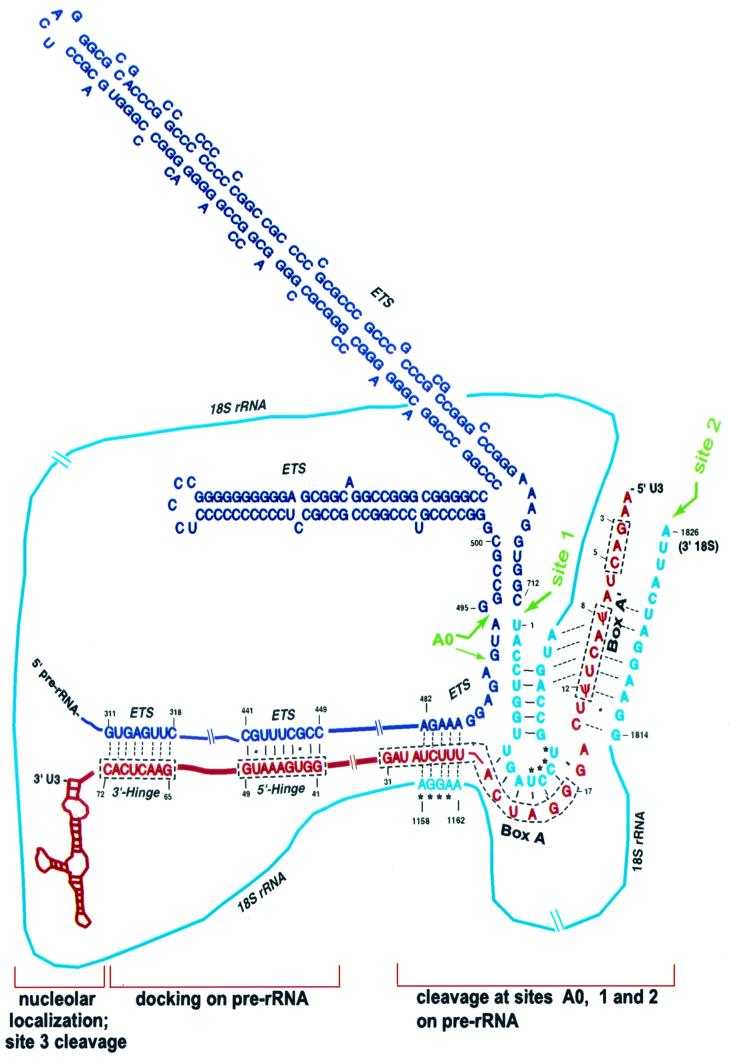
Model for vertebrate U3 snoRNA interactions with pre-rRNA. The ETS of Xenopus pre-rRNA is drawn in dark blue and the 18S rRNA coding region in light blue; U3-dependent cleavage sites A0, 1, and 2 are in green. Xenopus U3 snoRNA is in red. Domain II of U3 is required for nucleolar localization (28) and for site 3 cleavage (7). The 5′ hinge and 3′ hinge of U3 snoRNA are proposed to dock U3 on pre-rRNA by base pairing with sequences in the ETS (8). Putative base-pairing interactions between the 5′ region of U3 snoRNA and sequences in the ETS and 18S coding region of pre-rRNA are indicated (see text). U3 snoRNA is proposed to act as a bridge to draw together cleavage sites A0, 1, and 2. Solid lines indicate base pairs between U3 snoRNA and pre-rRNA confirmed by compensatory base changes in yeast (5, 46), and dotted lines denote putative base pairs deduced by sequence complementarity and phylogenetic comparisons. Alternative base pairing interactions between U3 box A′ and the 5′ or 3′ end of the 18S coding region are shown. ∗, nucleotides in 18S rRNA that base pair to form the central pseudoknot (19). A computer-based (M-fold 3.0) model is shown for the ETS between sites A0 and 1, but bars for base pairing are not included. Pseudouridine (ψ) has been mapped to nt 8 and 12 of vertebrate U3 snoRNA (14, 41), though not studied directly in Xenopus.

References

    1. Abou Elela S, Igel H, Ares M., Jr RNase III cleaves eukaryotic preribosomal RNA at a U3 snoRNP-dependent site. Cell. 1996;85:115–124. - PubMed
    1. Ajuh P M, Heeney P A, Maden B E H. Xenopus borealis and Xenopus laevis 28S ribosomal DNA and the complete 40S ribosomal precursor RNA coding units of both species. Proc R Soc Lond B. 1991;245:65–71. - PubMed
    1. Allmang C, Henry Y, Morrissey J P, Wood H, Petfalski E, Tollervey D. Processing of the yeast pre-rRNA at sites A2 and A3 is linked. RNA. 1996;2:63–73. - PMC - PubMed
    1. Beltrame M, Tollervey D. Identification and functional analysis of two U3 binding sites on yeast pre-ribosomal RNA. EMBO J. 1992;11:1531–1542. - PMC - PubMed
    1. Beltrame M, Tollervey D. Base pairing between U3 and the pre-ribosomal RNA is required for 18S rRNA synthesis. EMBO J. 1995;14:4350–4356. - PMC - PubMed

Publication types

LinkOut - more resources