


Gene cluster on pAO1 of Arthrobacter nicotinovorans involved in degradation of the plant alkaloid nicotine: cloning, purification, and characterization of 2,6-dihydroxypyridine 3-hydroxylase
- PMID: 11514508
- PMCID: PMC95407
- DOI: 10.1128/JB.183.18.5262-5267.2001
Gene cluster on pAO1 of Arthrobacter nicotinovorans involved in degradation of the plant alkaloid nicotine: cloning, purification, and characterization of 2,6-dihydroxypyridine 3-hydroxylase
Abstract
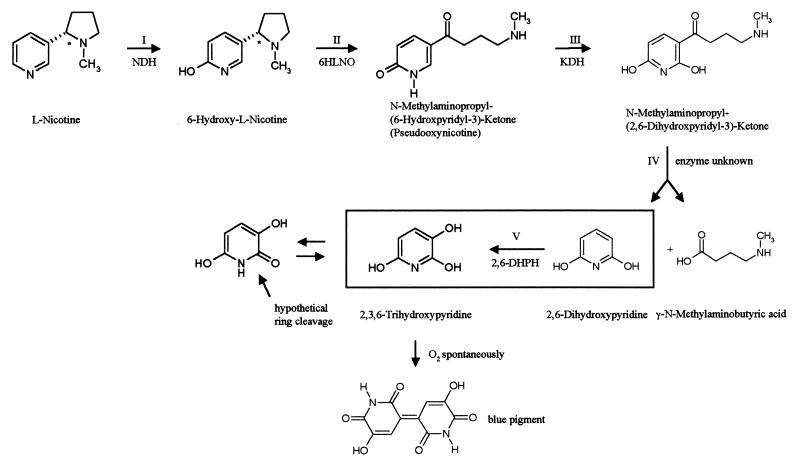
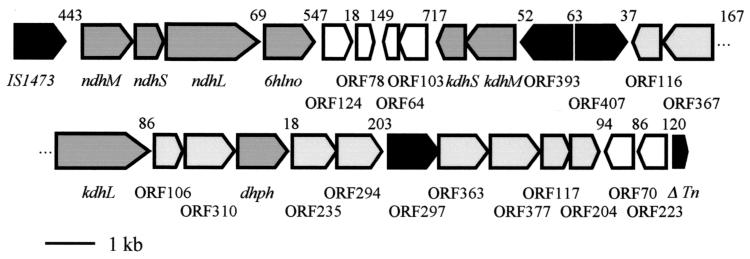
A 27,690-bp gene cluster involved in the degradation of the plant alkaloid nicotine was characterized from the plasmid pAO1 of Arthrobacter nicotinovorans. The genes of the heterotrimeric, molybdopterin cofactor (MoCo)-, flavin adenine dinucleotide (FAD)-, and [Fe-S] cluster-dependent 6-hydroxypseudooxynicotine (ketone) dehydrogenase (KDH) were identified within this cluster. The gene of the large MoCo subunit of KDH was located 4,266 bp from the FAD and [Fe-S] cluster subunit genes. Deduced functions of proteins encoded by open reading frames (ORFs) of the cluster were correlated to individual steps in nicotine degradation. The gene for 2,6-dihydroxypyridine 3-hydroxylase was cloned and expressed in Escherichia coli. The purified homodimeric enzyme of 90 kDa contained 2 mol of tightly bound FAD per mol of dimer. Enzyme activity was strictly NADH-dependent and specific for 2,6-dihydroxypyridine. 2,3-Dihydroxypyridine and 2,6-dimethoxypyridine acted as irreversible inhibitors. Additional ORFs were shown to encode hypothetical proteins presumably required for holoenzyme assembly, interaction with the cell membrane, and transcriptional regulation, including a MobA homologue predicted to be specific for the synthesis of the molybdopterin cytidine dinucleotide cofactor.
Figures
References
-
- Altschul S F, Gisg W, Miller W, Myers E W, Lipman D J. Basic local alignment search tool. J Mol Biol. 1990;215:403–410. - PubMed
-
- Berthold H, Scanarini M, Abney C C, Frorath B, Northemann W. Purification of recombinant antigenic epitopes on the human 68-kDa (U1) ribonucleoprotein antigen using the expression system pH6EX3 followed by metal chelating affinity chromatography. Protein Expr Purif. 1992;3:50–56. - PubMed
-
- Brandsch R, Decker K. Isolation and partial characterization of plasmid DNA from Arthrobacter oxydans. Arch Microbiol. 1984;138:15–17. - PubMed
Publication types
MeSH terms
Substances
Associated data
- Actions
LinkOut - more resources
Full Text Sources
Molecular Biology Databases
Miscellaneous
