. 2001 Sep;183(18):5343-51.
doi: 10.1128/JB.183.18.5343-5351.2001.

The Brucella suis homologue of the Agrobacterium tumefaciens chromosomal virulence operon chvE is essential for sugar utilization but not for survival in macrophages

Affiliations

The Brucella suis homologue of the Agrobacterium tumefaciens chromosomal virulence operon chvE is essential for sugar utilization but not for survival in macrophages

M T Alvarez-Martinez et al. J Bacteriol. 2001 Sep.

Abstract

Brucella strains possess an operon encoding type IV secretion machinery very similar to that coded by the Agrobacterium tumefaciens virB operon. Here we describe cloning of the Brucella suis homologue of the chvE-gguA-gguB operon of A. tumefaciens and characterize the sugar binding protein ChvE (78% identity), which in A. tumefaciens is involved in virulence gene expression. B. suis chvE is upstream of the putative sugar transporter-encoding genes gguA and gguB, also present in A. tumefaciens, but not adjacent to that of a LysR-type transcription regulator. Although results of Southern hybridization experiments suggested that the gene is present in all Brucella strains, the ChvE protein was detected only in B. suis and Brucella canis with A. tumefaciens ChvE-specific antisera, suggesting that chvE genes are differently expressed in different Brucella species. Analysis of cell growth of B. suis and of its chvE or gguA mutants in different media revealed that ChvE exhibited a sugar specificity similar to that of its A. tumefaciens homologue and that both ChvE and GguA were necessary for utilization of these sugars. Murine or human macrophage infections with B. suis chvE and gguA mutants resulted in multiplication similar to that of the wild-type strain, suggesting that virB expression was unaffected. These data indicate that the ChvE and GguA homologous proteins of B. suis are essential for the utilization of certain sugars but are not necessary for survival and replication inside macrophages.


Figures
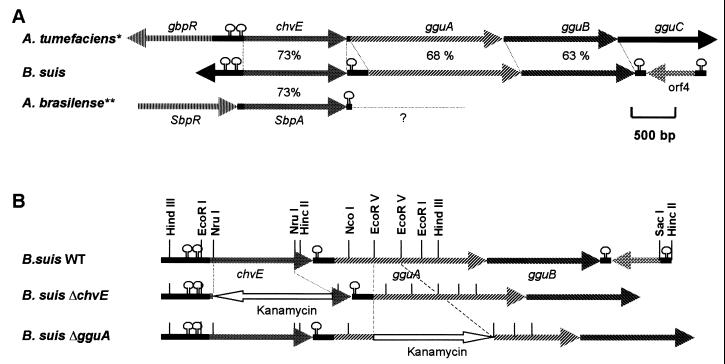
FIG. 1
FIG. 1
Physical and genetic map of the B. suis region similar to the A. tumefaciens chvE operon. (A) B. suis DNA sequence with genes similar to A. tumefaciens chvE, gguA, and gguB and to A. brasilense sbpA. Percentage values indicate DNA sequence identity. The differences in the B. suis operon include (i) the absence of genes encoding the regulator GbpR and GguC and (ii) an additional intergenic palindromic sequence preceded by the putative RNase E cleavage site. ∗, gene organization from reference ; ∗∗, gene organization from reference . (B) Mapping of the main restriction sites of the B. suis chvE operon and schematic representation of the deletion or insertion of the kanamycin resistance gene into the chvE and gguA genes. The loops along the lines representing gene organization symbolize the presence of palindromic sequences which might adopt hairpin loop structures. WT, wild type.
FIG. 2
FIG. 2
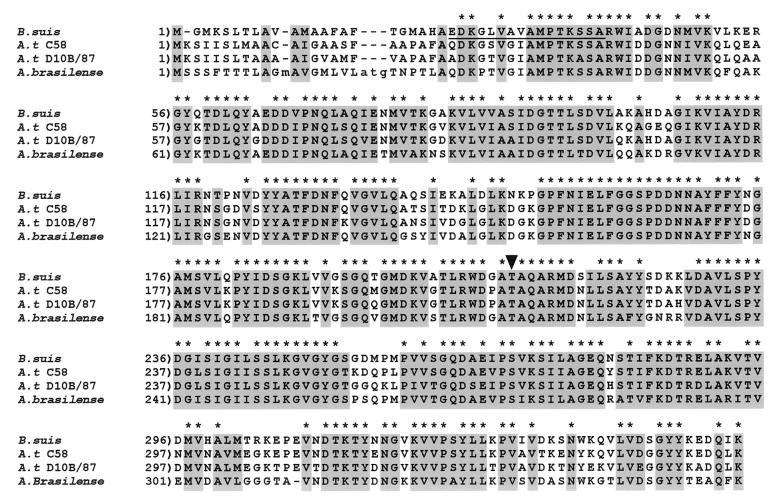
Alignment of amino acid sequences deduced from nucleotide sequences. Sequence alignment between ChvE proteins from B. suis, A. tumefaciens, and A. brasilense reveals a high degree of identity within many regions. The underlined N-terminal amino acids from B. suis ChvE resulted from the microsequencing of the purified protein. The inverted solid triangle points to threonine 211, an amino acid crucial for A. tumefaciens ChvE-VirA interaction, which is conserved in all sequences. Shaded blocks include amino acid identities (∗) and conservative substitutions (no asterisk) (S-T-A, L-V-I-M, K-R, D-E, Q-N, F-Y-W). A. t, A. tumefaciens.
FIG. 3
FIG. 3
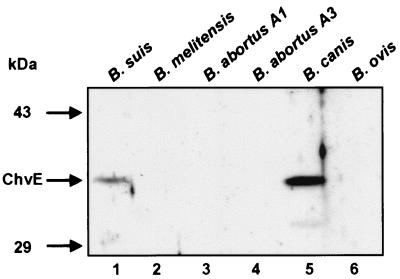
Presence of ChvE in various Brucella spp. Brucella strains were grown for 16 h in TS and equal amounts of proteins were analyzed by SDS-PAGE and immunoblotting using an A. tumefaciens ChvE-specific antiserum. ChvE cross-reactive proteins could only be detected in B. suis and B. canis even when bacteria were grown in minimal medium supplemented with galactose at pH 7.0 or 4.5.
FIG. 4
FIG. 4
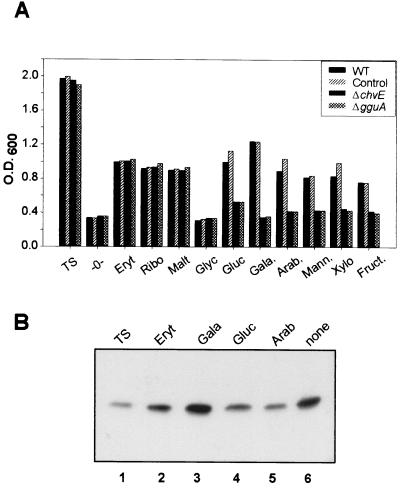
Effect of different sugars on B. suis and chvE or gguA mutant growth and ChvE production. (A) B. suis wild type, the nikA control mutant, and the chvE or gguA mutant were grown for 24 h in TS or in minimal medium at pH 7.0 containing no sugar (-0-) or 10 mM meso-erythritol, d-(+)-ribose, d-(+)-maltose, glycerol, d-(+)-glucose, d-(+)-galactose, l-(+)-arabinose, d-(+)-mannose, d-(+)-xylose, or d-(+)-fructose. (B) The level of ChvE immunoreactive protein was assessed by loading about 4 × 10⁸ bacteria of the B. suis wild type onto an SDS-PAGE gel after 24 h of growth in TS (lane 1) or in minimal medium at pH 7.0 in the presence of erythritol (lane 2), galactose (lane 3), glucose (lane 4), or arabinose (lane 5) or without sugar (lane 6). Data shown are from one representative experiment out of the three performed. WT, wild type.
FIG. 5
FIG. 5
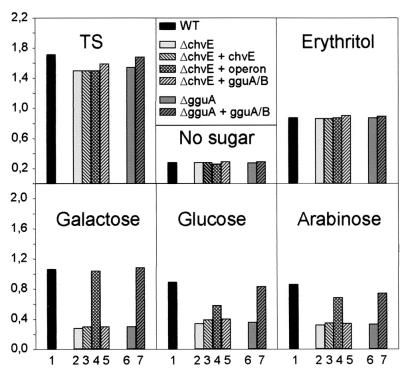
Effect of cross-complementation of B. suis chvE or gguA mutants on bacterial growth. Comparison of bacterial growth was carried out on B. suis wild type (column 1) and on the chvE mutant itself (column 2) or complemented with chvE alone (pBBR1::chvEbs; column 3), the three genes (chvE, gguA, and gguB) of the chvE operon (pBBR1::chvEbsoperon; column 4), or the transporter genes gguA and gguB (pBBR1::gguAbs; column 5). Growth comparison also included the gguA mutant (column 6) and its complemented form with pBBR1::gguAbs (column 7). The growth of the various strains was assessed after 24 h in TS or in minimal medium alone (pH 7.0) or containing 10 mM erythritol, glucose, galactose, or arabinose. WT, wild type.
FIG. 6
FIG. 6
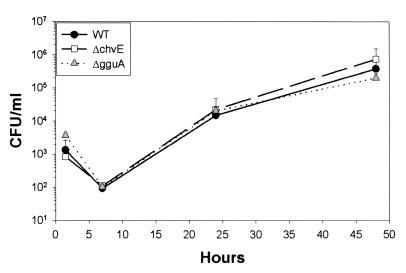
Comparison of the intracellular growth of B. suis wild type and its mutants during macrophage infection. Mouse J774 cells were infected for 30 min with B. suis wild type or the chvE or gguA mutant at a multiplicity of infection of 20. Cells were then washed and incubated for 1, 7, 24, and 48 h before lysis and analysis of intracellular survival and multiplication. Data shown are expressed as mean values ± standard errors of three experiments performed in duplicate. WT, wild type.

References

    1. Altschul S F, Gish W, Miller W, Myers E W, Lipman D J. Basic local alignment search tool. J Mol Biol. 1990;215:403–410. - PubMed
    1. Ankenbauer R G, Nester E W. Sugar-mediated induction of Agrobacterium tumefaciens virulence genes: structural specificity and activities of monosaccharides. J Bacteriol. 1990;172:6442–6446. - PMC - PubMed
    1. Ausubel S F, Brent R, Kingston R E, Moore D D, Seichman J G, Smith J A, Struhl K. Current protocols in molecular biology. New York, N.Y: John Wiley & Sons; 1989.
    1. Baker B, Zambryski P, Staskawicz B, Dinesh-Kumar S. Signaling in plant-microbe interactions. Science. 1997;276:726–733. - PubMed
    1. Burns D L. Biochemistry of type IV secretion. Curr Opin Microbiol. 1999;2:25–29. - PubMed

Publication types

MeSH terms

Substances

Associated data

LinkOut - more resources