. 2001 Sep 1;21(17):6512-21.
doi: 10.1523/JNEUROSCI.21-17-06512.2001.

Cell swelling and a nonselective cation channel regulated by internal Ca2+ and ATP in native reactive astrocytes from adult rat brain

Affiliations

Cell swelling and a nonselective cation channel regulated by internal Ca2+ and ATP in native reactive astrocytes from adult rat brain

M Chen et al. J Neurosci. .

Abstract

Hypoxia-ischemia and ATP depletion are associated with glial swelling and blebbing, but mechanisms involved in these effects remain incompletely characterized. We examined morphological and electrophysiological responses of freshly isolated native reactive astrocytes (NRAs) after exposure to NaN(3), which depletes cellular ATP. Here we report that NaN(3) caused profound and sustained depolarization attributable to activation of a novel 35 pS Ca(2+)-activated, [ATP](i)-sensitive nonselective cation (NC(Ca-ATP)) channel, found in >90% of excised membrane patches. The channel was impermeable to Cl(-), was nearly equally permeable to monovalent cations, with permeabilities relative to K(+) being P(Cs)+/P(K)+(1.06) approximately P(Na)+/P(K)+(1.04) approximately P(Rb)+/P(K)+(1.02) approximately P(Li)+/P(K)+(0.96), and was essentially impermeable to Ca(2+) and Mg(2+) (P(Ca)2+/P(K)+ approximately P(Mg)2+/P(K)+ < 0.001), with intracellular Mg(2+) (100 microm to 1 mm) causing inward rectification. Pore radius, estimated by fitting relative permeabilities of organic cations to the Renkin equation, was 0.41 nm. This channel exhibited significantly different properties compared with previously reported NC(Ca-ATP) channels, including different sensitivity to block by various adenine nucleotides (EC(50) of 0.79 microm for [ATP](i), with no block by AMP or ADP), and activation by submicromolar [Ca](i). The apparent dissociation constant for Ca(2+) was voltage dependent (0.12, 0.31, and 1.5 microm at -40, -80, and -120 mV, respectively), with a Hill coefficient of 1.5. Channel opening by [ATP](i) depletion was accompanied by and appeared to precede blebbing of the cell membrane, suggesting participation of this channel in cation flux involved in cell swelling. We conclude that NRAs from adult rat brain express a 35 pS NC(Ca-ATP) channel that may play an important role in the pathogenesis of brain swelling.


Figures
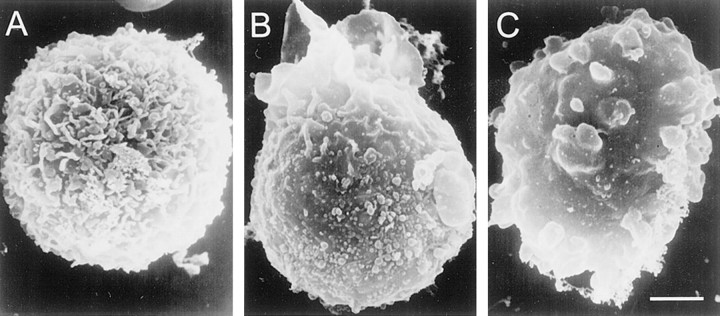
Fig. 1.
Fig. 1.
Cell blebbing and swelling after NaN3-induced ATP depletion. Scanning electron micrographs of freshly isolated native reactive astrocytes. Formaldehyde–glutaraldehyde fixation was initiated under control conditions (A), 5 min after exposure to 1 mm NaN3 (B), and 25 min after exposure to 1 mm NaN3(C). Scale bar, 12 μm.
Fig. 2.
Fig. 2.
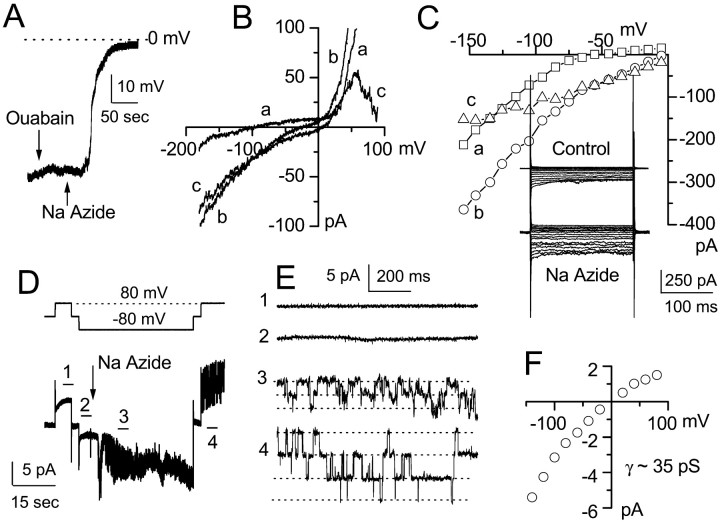
NaN3-induced ATP depletion elicits depolarizing inward current attributable to opening of 35 pS channel.A, Current-clamp recording showing resting potential near EK (≈60 mV, 10 mm KCl). One minute exposure to 1 mm ouabain (down arrow) depolarized the cell <5 mV, with recovery after washout; 3 min exposure to 1 mm NaN3 (up arrow) caused rapid depolarization to near 0 mV.B, Voltage-clamp recordings during ramp pulses before (a) and after (b) NaN3 show a net increase in inward current with drug; the difference current (c) indicates a reversal potential near 0 mV. C, Original records (inset) and current–voltage curves during step pulses before (a) and after (b) NaN3, with the difference current (c) also illustrated. D, Cell-attached patch recording of current (bottom panel) recorded at −80, 0, and 80 mV (top panel), before and after 1 mmNaN3 (drug added at arrow).E, Current records at higher temporal resolution obtained from the segments marked with the corresponding numbers inD. F, Single-channel current–voltage relationship for four cell-attached patches showing a 35 pS conductance with inward rectification that reverses near 0 mV.
Fig. 3.
Fig. 3.
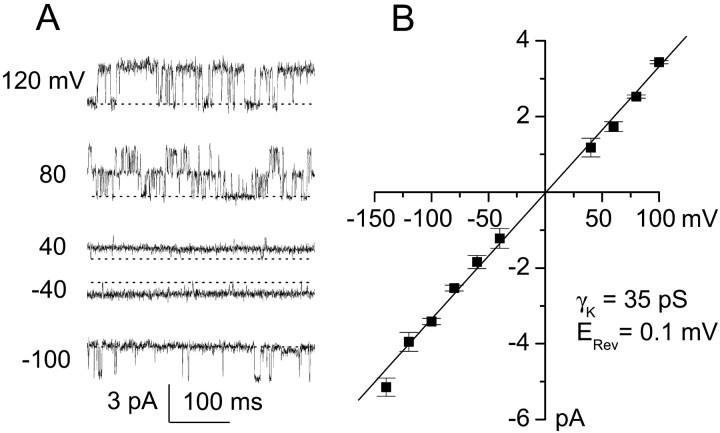
Single-channel currents recorded in an inside-out patch. A, Original records were obtained during test pulses to the potentials indicated, with equimolar K+ on both sides of the membrane. Broken line indicates channel closing; outward cationic current is plotted upward. B, Data (mean ± SD) on single-channel amplitudes at different potentials from four patches are plotted; fit of the data indicated a slope conductance of 35.2 pS and an extrapolated reversal potential (Erev) of +0.1 mV, with no apparent rectification.
Fig. 4.
Fig. 4.
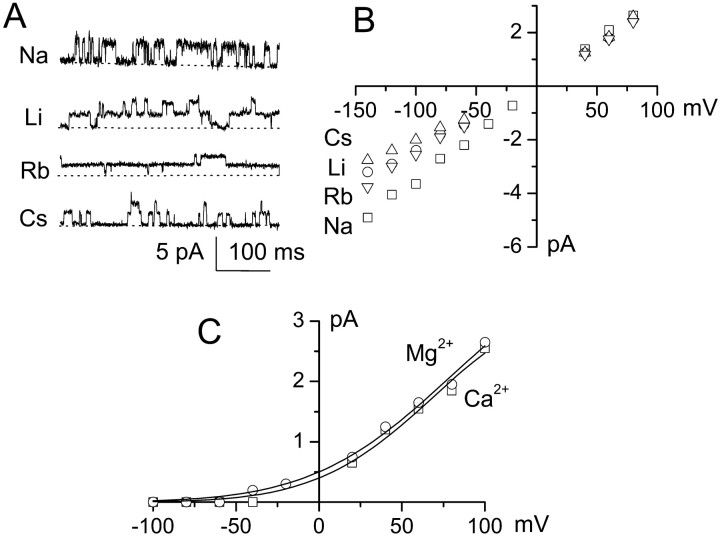
Relative permeabilities of 35 pS channel.A, Single-channel records obtained at Eof −100 mV, showing the 35 pS channel conducting the various alkaline ions indicated. Broken lines indicate channel closings; inward cationic current is plotted upward.B, Plot of single-channel amplitude versus voltage for various alkaline ions. Values of Erev were estimated by linear extrapolation. Permeabilities relative to K+, calculated using Equation 1 in Materials and Methods, were PCs+/PK+(1.06) ≈ PNa+/PK+(1.04) ≈ PRb+/PK+(1.02) ≈ PLi+/PK+(0.96); data are mean values for five to seven patches for each cation.C, Plot of single-channel amplitude versus voltage for Ca2+ and Mg2+. Values ofErev, estimated from fits to an exponential function (lines), were more negative than −150 mV for both Ca2+ and Mg2+; permeabilities relative to K+, calculated using Equation 2 in Materials and Methods, were < 0.001. Data are mean values for four and six patches for Ca2+ and Mg2+, respectively.
Fig. 5.
Fig. 5.
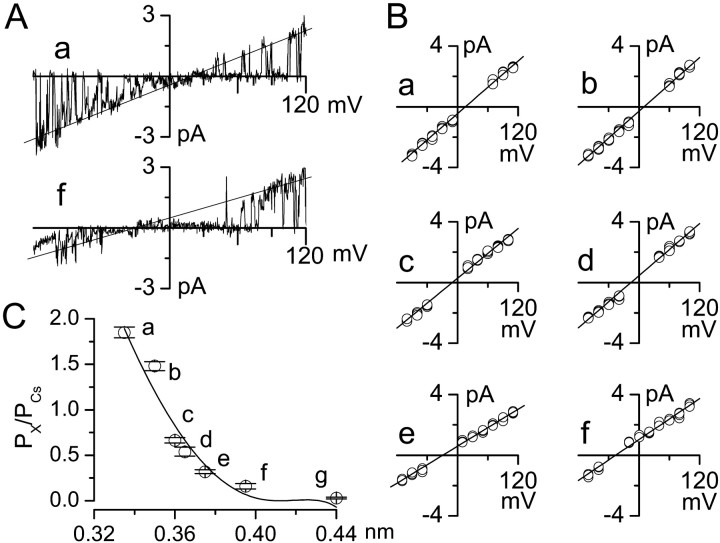
Pore size of 35 pS channel. A, Single-channel currents obtained in outside-out patches with Cs+ in the pipette and methanolamine (a) and Tris (f) in the bath. B, Current–voltage relationships obtained with methanolamine (a), guanidium (b), ethanolamine (c), diethylamine (d), piperazine (e), and Tris (f) in the bath. C, Channel pore size was estimated from the relationship between the permeability (relative to Cs+) and the molecular radius of a series of monovalent organic cations. Values marked a–f are from the same data as in B; the value marked gwas obtained with N-methylglucamine. The solid line is a least-squares fit to the Renkin equation (see Materials and Methods), with extrapolation to Px/PCs = 0 indicating an equivalent pore radius of 0.41 nm; data are mean ± SE values from four to five patches.
Fig. 6.
Fig. 6.
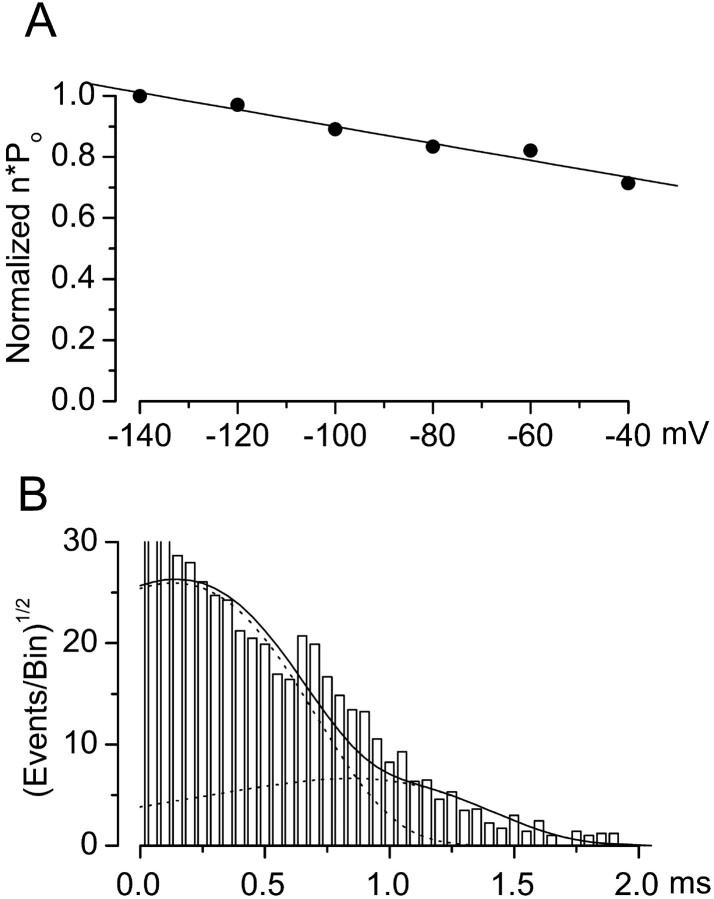
Voltage dependence of open-channel probability and open dwell times. A, Channel open probabilities (n · Po) at −140 mV ≤Vm ≤ −40 mV were normalized to values at −140 mV and plotted (filled circles); linear regression gave a slope of −2.87 × 10⁻³mV−1, which was not significantly different from zero (p = 0.09). Data are mean values from five patches. B, Open channel events from 1-min-long continuous records obtained at −80 mV were compiled into a probability density histogram with a square root axis for the ordinate and a logarithmic axis for the abscissa; the solid linerepresents the probability density function (Eq. 4 in Materials and Methods) with values of τ1 = 2.7 msec, τ2 = 8.3 msec, a1 = 1493, and a2 = 580, with broken lines denoting each of the two components individually.
Fig. 7.
Fig. 7.
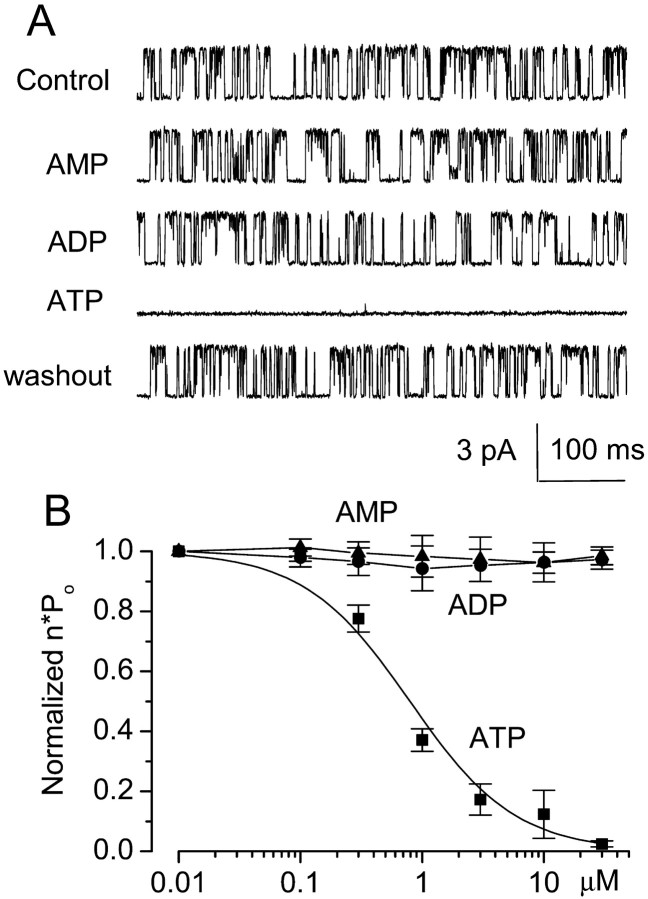
Cytoplasmic ATP but not AMP or ADP inhibits 35 pS channel opening. A, Openings of the 35 pS channel in an inside-out patch under control conditions and after successive addition and subsequent washout of 1 mm AMP, 1 mm ADP, and 1 mm ATP; inward cationic current is plottedupward. B, Normalized open channel probability (n · Po) with different concentrations of adenine nucleotides; data with ATP were fit to a standard logistic equation, with a Hill coefficient of 1 and half-maximum inhibition of 0.79 μm. Values plotted are means ± SE from five, five, and six patches for AMP, ADP, and ATP, respectively.
Fig. 8.
Fig. 8.
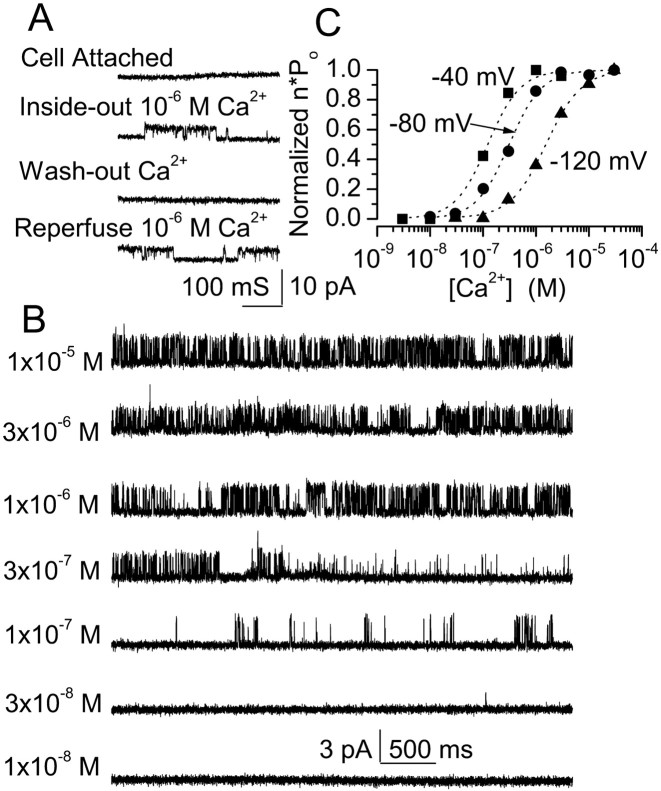
Ca2+ dependence of the 35 pS channel. A, Cell-attached patch shows no activity when recorded for >10 min; conversion from a cell-attached to an inside-out configuration in a bath solution containing 1 μmCa2+ resulted in activation of a 35 pS channel. Channel activity was lost in Ca2+-free solution and was restored with 1 μm Ca2+; inward cationic current is plotted upward. B, Original current records obtained from one patch in an inside-out configuration at Em of −80 mV. [Ca2+] in the bath was changed as indicated; inward cationic current is plotted upward.C, Values of n · Pomeasured in 1 min continuous recordings from four to nine patches at the potentials and [Ca2+] indicated; for each patch, data were normalized to the values obtained at 3 μm [Ca2+]. Average data were fit to a standard logistic equation with a Hill coefficient of 1.5 and half-maximum values of 0.12, 0.31, and 1.5 μm at −40, −80, and −120 mV, respectively.
Fig. 9.
Fig. 9.
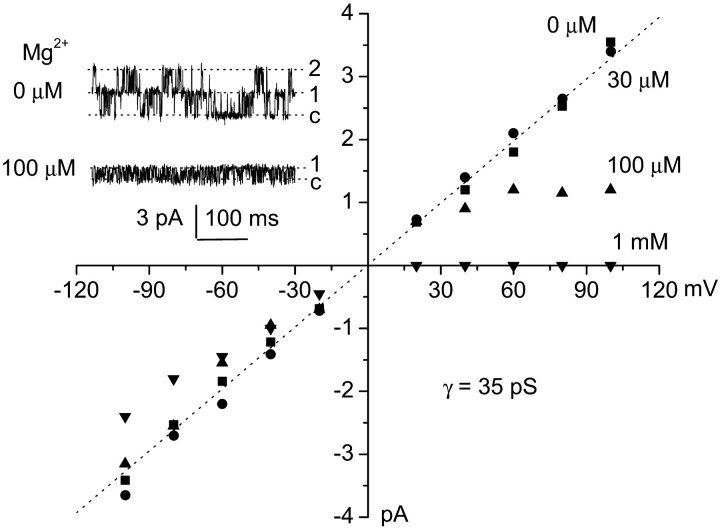
Intracellular Mg2+ causes inward rectification. Single-channel records obtained in an inside-out configuration with 0 μm (inset,top) and 100 μm (inset,bottom) Mg2+ on the cytoplasmic side;Em of +80 mV. c denotes channel closing; outward cationic current is plottedupward. Plot of mean single channel amplitude at different potentials studied with equimolar K+ on both sides of the membrane and 0 μm, 30 μm, 100 μm, and 1 mm Mg2+ on the cytoplasmic side; broken line indicates 35 pS conductance. All data are from the same patch as Figure3A.

References

    1. Adams DJ, Dwyer TM, Hille B. The permeability of endplate channels to monovalent and divalent metal cations. J Gen Physiol. 1980;75:493–510. - PMC - PubMed
    1. Bordey A, Sontheimer H. Properties of human glial cells associated with epileptic seizure foci. Epilepsy Res. 1998;32:286–303. - PubMed
    1. Brismar T, Collins VP. Effect of external cation concentration and metabolic inhibitors on membrane potential of human glial cells. J Physiol (Lond) 1993;460:365–383. - PMC - PubMed
    1. Champigny G, Verrier B, Lazdunski M. A voltage, calcium, and ATP sensitive non selective cation channel in human colonic tumor cells. Biochem Biophys Res Commun. 1991;176:1196–1203. - PubMed
    1. Christensen O, Hoffmann EK. Cell swelling activates K+ and Cl- channels as well as nonselective, stretch-activated cation channels in Ehrlich ascites tumor cells. J Membr Biol. 1992;129:13–36. - PubMed

Publication types

MeSH terms

LinkOut - more resources