. 2001 Sep 11;98(19):10924-9.
doi: 10.1073/pnas.181342098. Epub 2001 Aug 21.

Heterosynaptic metaplasticity in the hippocampus in vivo: a BCM-like modifiable threshold for LTP

Affiliations

Heterosynaptic metaplasticity in the hippocampus in vivo: a BCM-like modifiable threshold for LTP

W C Abraham et al. Proc Natl Acad Sci U S A. .

Abstract

The homeostatic maintenance of the "modification threshold" for inducing long-term potentiation (LTP) is a fundamental feature of the Bienenstock, Cooper, and Munro (BCM) model of synaptic plasticity. In the present study, two key features of the modification threshold, its heterosynaptic expression and its regulation by postsynaptic neural activity, were tested experimentally in the dentate gyrus of awake, freely moving rats. Conditioning stimulation ranging from 10 to 1,440 brief 400-Hz trains, when applied to medial perforant path afferents, raised the threshold for LTP induction heterosynaptically in the neighboring lateral perforant path synapses. This effect recovered slowly over a 7- to 35-day period. The same conditioning paradigms, however, did not affect the reversal of long-term depression. The inhibition of LTP by medial-path conditioning stimulation was N-methyl-D-aspartate (NMDA) receptor-dependent, but antidromic stimulation of the granule cells could also inhibit lateral path LTP induction, independently of NMDA receptor activation. Increased calcium buffering is a potential mechanism underlying the altered LTP threshold, but the levels of two important calcium-binding proteins did not increase after conditioning stimulation, nor was de novo protein synthesis required for generating the threshold shift. These data confirm, in an in vivo model, two key postulates of the BCM model regarding the LTP threshold. They also provide further evidence for the broad sensitivity of synaptic plasticity mechanisms to the history of prior activity, i.e., metaplasticity.


Figures
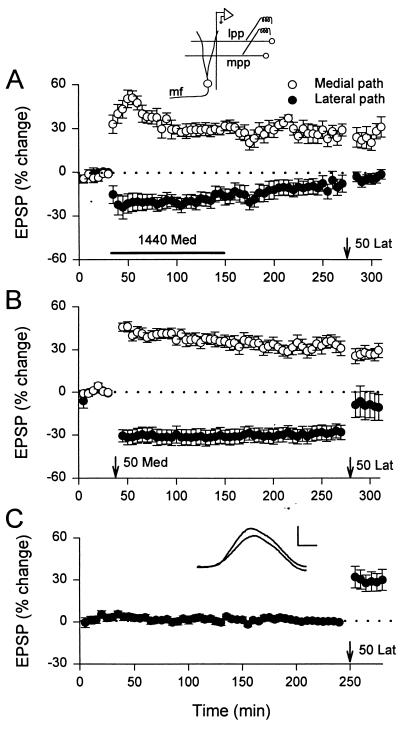
Figure 1
Figure 1
CS causes heterosynaptic inhibition of LTP. CS consisting of 1,440 (n = 9; A) or 50 (n = 11, B) trains was delivered to the medial path (1,440 Med or 50 Med), and then the lateral path was probed with high-frequency stimulation (HFS) (50 Lat) for LTP induction, 4 h after commencement of the CS. HFS failed to cause LTP above the original baseline (dotted line), although it did reverse much of the LTD induced by medial path CS. This lack of LTP contrasts with LTP that is readily induced on the lateral path in naïve pathways (n = 9, C). Data are mean ± SEM. Waveforms represent averages of 10 sweeps, taken just before and 30 min after HFS to the lateral path, showing LTP from an animal that did not receive prior CS. (Scale bars: 2 mV, 2 ms.) (A Inset) The experimental preparation, including stimulating electrodes in the medial (mpp) and lateral (lpp) perforant paths and a recording electrode in the hilus near the granule cell bodies. mf, Mossy fiber axons of the granule cells.
Figure 2
Figure 2
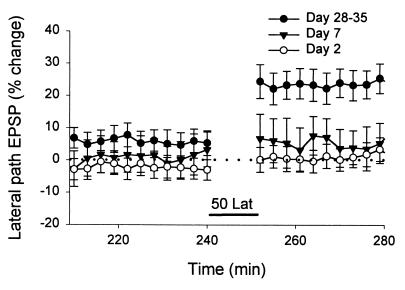
Time course of LTP recovery. For 19 of 32 rats given medial path CS, lateral path HFS (50 Lat) was given on days 2, 7, and/or 28–35 after CS to track the recovery of LTP. Even though the lateral path responses were near the original baseline on day 2 (n = 15) and day 7 (n = 10), virtually no LTP was observed on either day. Significant LTP was observed when HFS was given between 28 and 35 days after CS (n = 14). The time values on the x axis represent the time since the start of baseline recording on the day. Whenever HFS was given, a 4-h baseline recording period was used to match the recording time before HFS on the day of CS.
Figure 3
Figure 3
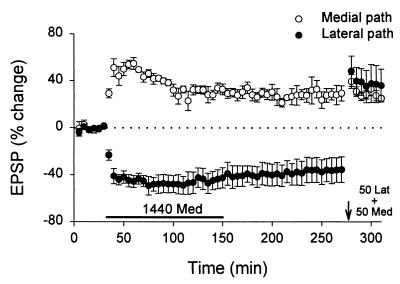
CS does not completely prevent LTP. When combined HFS of the medial and lateral paths (50 Lat + 50 Med) was given after CS (1,440 Med, n = 5), robust LTP on the lateral path was generated. Thus, CS did not block LTP induction completely, but raised its threshold.
Figure 4
Figure 4
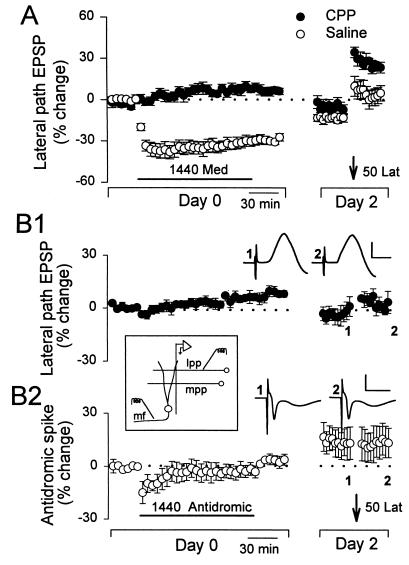
(A) CS of the medial path was delivered after an injection of the NMDA receptor antagonist CPP (n = 5) or the saline vehicle (n = 8). CPP blocked the lateral path LTD induced by CS on the day of stimulation (left side). It also prevented the inhibition of LTP 2 days after CS (right side). LTP, but not dedepression, was blocked in the saline-treated animals. Even taking into account the slight difference in baseline levels, the CPP-treated group showed significantly greater LTP than the saline group. (B) Antidromic stimulation of the mossy fibers (1,440 antidromic), in the presence of CPP, produced only minor changes in either the lateral EPSP slope (B1) or the antidromic spike amplitude (B2). LTP of the lateral path responses was nonetheless inhibited 2 days after CS (right side of figure). Inset waveforms from a representative animal depict averages of 10 sweeps for the lateral path response (B1) and the antidromic spike (B2), obtained at the times indicated. (Bars = B1, 2 mV, 5 ms; B2, 3 mV, 5 ms.) Inset diagram depicts the experimental preparation using separate orthodromic stimulation of the lateral path (lpp) and antidromic stimulation of the mossy fibers (mf).
Figure 5
Figure 5
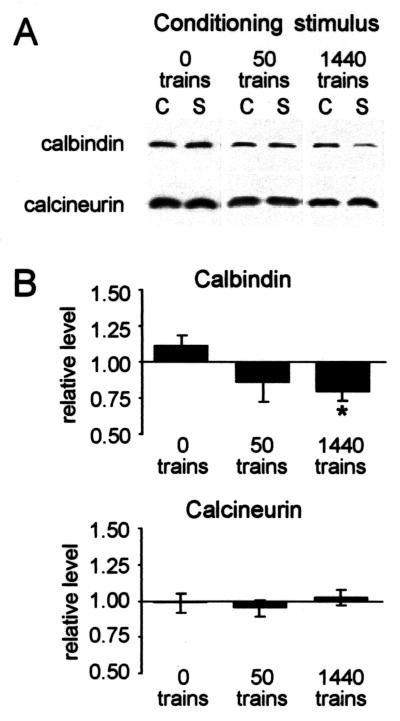
Changes in calbindin D28k and calcineurin protein levels in the dentate gyrus in response to CS of the medial path. (A) Western blot showing the change in soluble calbindin and calcineurin protein in the dentate gyrus of single animals in response to 0, 50, or 1,440 trains to the medial path. Calbindin and calcineurin levels from the same blot are pictured. C, control dentate gyrus, contralateral to the stimulated hemisphere; S, stimulated dentate gyrus. (B) Average change in soluble calbindin and calcineurin protein levels in the dentate gyrus in response to 0, 50, or 1,440 trains to the medial path. For each animal, the level of calbindin or calcineurin protein in the stimulated dentate gyrus is expressed relative to the control dentate gyrus. Data are means ± SEM. *, P < 0.05 compared with 0 trains (Student's unpaired t test).

References

    1. Bear M F. Proc Natl Acad Sci USA. 1996;93:13453–13459. - PMC - PubMed
    1. Milner B, Squire L R, Kandel E R. Neuron. 1998;20:445–468. - PubMed
    1. Bienenstock E L, Cooper L N, Munro P W. J Neurosci. 1982;2:32–48. - PMC - PubMed
    1. Abraham W C, Bear M F. Trends Neurosci. 1996;19:126–130. - PubMed
    1. Abraham W C, Tate W P. Prog Neurobiol. 1997;52:303–323. - PubMed

Publication types

Substances