


The frequency of hereditary defective mismatch repair in a prospective series of unselected colorectal carcinomas
- PMID: 11524701
- PMCID: PMC1226064
- DOI: 10.1086/323658
The frequency of hereditary defective mismatch repair in a prospective series of unselected colorectal carcinomas
Erratum in
- Am J Hum Genet 2001 Nov;69(5):1160
Abstract
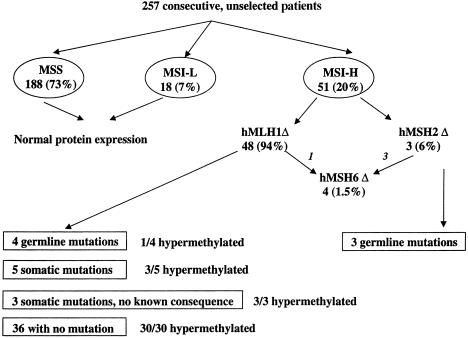
A comprehensive analysis of somatic and germline mutations related to DNA mismatch-repair (MMR) genes can clarify the prevalence and mechanism of inactivation in colorectal carcinoma (CRC). In the present study, 257 unselected patients referred for CRC resection were examined for evidence of defective DNA MMR. In particular, we sought to determine the frequency of hereditary defects in DNA MMR in this cohort of patients. MMR status was assessed by testing of tumors for the presence or absence of hMLH1, hMSH2, and hMSH6 protein expression and for microsatellite instability (MSI). Of the 257 patients, 51 (20%) had evidence of defective MMR, demonstrating high levels of MSI (MSI-H) and an absence of either hMLH1 (n=48) or hMSH2 (n=3). All three patients lacking hMSH2, as well as one patient lacking hMLH1, also demonstrated an absence of hMSH6. DNA sequence analysis of the 51 patients with defective MMR revealed seven germline mutations-four in hMLH1 (two truncating and two missense) and three in hMSH2 (all truncating). A detailed family history was available for 225 of the 257 patients. Of the seven patients with germline mutations, only three had family histories consistent with hereditary nonpolyposis colorectal cancer. Of the remaining patients who had tumors with defective MMR, eight had somatic mutations in hMLH1. In addition, hypermethylation of the hMLH1 gene promoter was present in 37 (88%) of the 42 hMLH1-negative cases available for study and in all MSI-H tumors that showed loss of hMLH1 expression but no detectable hMLH1 mutations. Our results suggest that, although defective DNA MMR occurs in approximately 20% of unselected patients presenting for CRC resection, hereditary CRC due to mutations in the MMR pathway account for only a small proportion of patients. Of the 257 patients, only 5 (1.9%) appear to have unequivocal evidence of hereditary defects in MMR. The epigenetic (nonhereditary) mechanism of hMLH1 promoter hypermethylation appears to be responsible for the majority of the remaining patients whose tumors are characterized by defective DNA MMR.
Figures
References
Electronic-Database Information
-
- Berkeley Drosophila Genome Project, http://www.fruitfly.org/ (for splice-predictor program)
-
- International Collaborative Group on Hereditary Non-Polyposis Colorectal Cancer, http://www.nfdht.nl/ (for listing of published and unpublished mutations and polymorphisms)
-
- Online Mendelian Inheritance in Man (OMIM), http://www.ncbi.nlm.nih.gov/Omim/ (for HNPCC [MIM 114500] and APC [MIM 175100])
References
-
- Aaltonen LA, Peltomaki P, Leach FS, Sistonen P, Pylkkanen L, Mecklin JP, Jarvinen H, Powell SM, Jen J, Hamilton SR, Petersen G, Kinzler K, Vogelstein B, de la Chapelle A (1993) Clues to the pathogenesis of familial colorectal cancer. Science 260:812–816 - PubMed
-
- Aaltonen LA, Peltomaki P, Mecklin JP, Jarvinen H, Jass JR, Green JS, Lynch HT, Watson P, Tallqvist G, Juhola M (1994a) Replication errors in benign and malignant tumors from hereditary nonpolyposis colorectal cancer patients. Cancer Res 54:1645–1648 - PubMed
-
- Aaltonen LA, Salovaara R, Kristo P, Canzian F, Hemminki A, Peltomaki P, Chadwick RB, Kaariainen H, Eskelinen M, Jarvinen H, Mecklin JP, de la Chapelle A (1998) Incidence of hereditary nonpolyposis colorectal cancer and the feasibility of molecular screening for the disease. N Engl J Med 338:1481–1487 - PubMed
-
- Aaltonen LA, Sankila R, Mecklin JP, Jarvinen H, Pukkala E, Peltomaki P, de la Chapelle A (1994b) A novel approach to estimate the proportion of hereditary nonpolyposis colorectal cancer of total colorectal cancer burden. Cancer Detect Prev 18:57–63 - PubMed
Publication types
MeSH terms
Substances
Associated data
- Actions
- Actions
Grants and funding
LinkOut - more resources
Full Text Sources
Molecular Biology Databases
