Comparative Study
. 2001 Sep;39(9):3135-9.
doi: 10.1128/JCM.39.9.3135-3139.2001.

Reliable detection of respiratory syncytial virus infection in children for adequate hospital infection control management

Affiliations
Comparative Study

Reliable detection of respiratory syncytial virus infection in children for adequate hospital infection control management

S Abels et al. J Clin Microbiol. 2001 Sep.

Abstract

By using a rapid test for respiratory syncytial virus (RSV) detection (Abbott TestPack RSV), a number of patients were observed, showing repeatedly positive results over a period of up to 10 weeks. A prospective study was initiated to compare the rapid test with an antigen capture enzyme immunoassay (EIA) and a nested reverse transcriptase PCR (RT-PCR) protocol for detection of RSV serotypes A and B. Only respiratory samples from children exhibiting the prolonged presence of RSV (> or =5 days) as determined by the rapid test were considered. A total of 134 specimens from 24 children was investigated by antigen capture EIA and nested RT-PCR. Using RT-PCR as the reference method, we determined the RSV rapid test to have a specificity of 63% and a sensitivity of 66% and the antigen capture EIA to have a specificity of 96% and a sensitivity of 69% for acute-phase samples and the homologous virus serotype A. In 7 (29%) of 24 patients, the positive results of the RSV rapid test could not be confirmed by either nested RT-PCR or antigen capture EIA. In these seven patients a variety of other respiratory viruses were detected. For general screening the RSV rapid test was found to be a reasonable tool to get quick results. However, its lack of specificity in some patients requires confirmation by additional tests to rule out false-positive results and/or detection of other respiratory viruses.


Figures
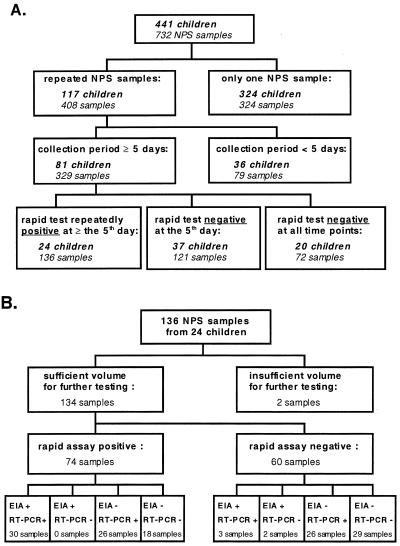
FIG. 1
FIG. 1
Study algorithm and sample distribution. (A) The rapid test (Abbott TestPack RSV) was executed with all NPS obtained. Depending on the results, the children were distributed into those with repeated samples and those with only one sample; the latter were excluded from further investigation. Children whose samples were collected over a period of 5 days or more were segregated into those with repeatedly positive results in the rapid assay on the 5th day or later, those who converted to negative results within 5 days and remained negative, and those who never showed a positive result in the rapid assay. Samples of children who showed positive results over a period of at least 5 days were further investigated by antigen capture EIA and nested RT-PCR. (B) One hundred and thirty-four samples of the children that were included in the study were further investigated by nested RT-PCR and antigen capture EIA. Two samples had to be excluded due to insufficient volume to execute all assays. The 134 samples were divided into 74 with a positive result in the rapid assay and 60 with a negative result. These two groups were further segregated into those varying or confirming results in the antigen capture EIA and the nested RT-PCR.
FIG. 2
FIG. 2
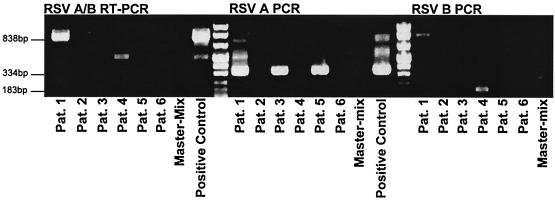
RSV typing by RT-PCR. Reverse transcription and a first run of PCR are executed in a one-step protocol using primers that allow amplification of RSV A as well as RSV B (RSV A/B RT-PCR). These amplification products are used in a second PCR (nested PCR) with serotype A (RSV A PCR)- and B (RSV B PCR)-specific primer sets. A positive control (RSV A) and a negative control (master mix) are included. For detection, gel electrophoresis on a 1.5% agarose gel is executed.
FIG. 3
FIG. 3
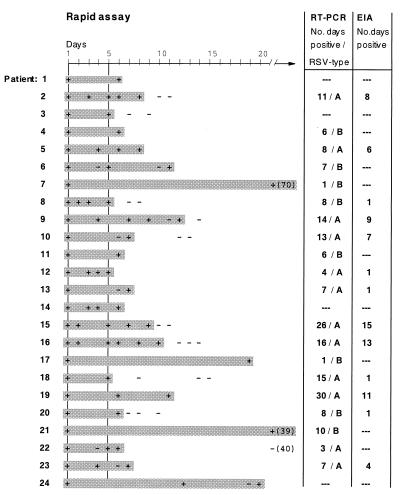
Duration of RSV presence using different detection assays. The results in the rapid assay of the 24 children included in the study are given in context to the time when the samples were obtained. The 5th day is marked since it represents the main inclusion criteria of the study. The periods in which positive results in the rapid assay were obtained are shaded gray. The number of days in which a positive result was found in the antigen capture EIA and in the nested RT-PCR is given at the right; serotypes as determined by PCR are included. – – –, no positive result was found.

References

    1. Dominguez E A, Taber L H, Couch R B. Comparison of rapid diagnostic techniques for respiratory syncytial and influenza A virus respiratory infections in young children. J Clin Microbiol. 1993;31:2286–2290. - PMC - PubMed
    1. Engler H D, Preuss J. Laboratory diagnosis of respiratory virus infections in 24 hours by utilizing shell vial cultures. J Clin Microbiol. 1997;35:2165–2167. - PMC - PubMed
    1. Fan J, Henrickson K J, Savatski L L. Rapid simultaneous diagnosis of infections with respiratory syncytial viruses A and B, influenza viruses A and B, and human parainfluenza virus type 1, 2, and 3 by multiplex quantitative reverse transcription-polymerase chain reaction-enzyme hybridization assay (Hexaplex) Clin Infect Dis. 1998;26:1397–1402. - PubMed
    1. Hall C B, Douglas R G, Geiman J M. Quantitative shedding patterns of respiratory syncytial virus in infants. J Infect Dis. 1975;132:151–156. - PubMed
    1. Krilov L R, Lipson S M, Barone S R, Kaplan M H, Ciamician Z, Harkness S H. Evaluation of a rapid diagnostic test for respiratory syncytial virus (RSV): potential for bedside diagnosis. Pediatrics. 1994;93:903–906. - PubMed

MeSH terms

Substances