


doi: 10.1128/JCM.39.9.3204-3212.2001.
Novel method for detection, typing, and quantification of human papillomaviruses in clinical samples
Affiliations
- PMID: 11526152
- PMCID: PMC88320
- DOI: 10.1128/JCM.39.9.3204-3212.2001
Item in Clipboard
Novel method for detection, typing, and quantification of human papillomaviruses in clinical samples
J Clin Microbiol.
2001 Sep.
Abstract
We report the development of a novel detection and typing methodology for human papillomaviruses (HPV) based on real-time PCR with the self-probing fluorescent primers known as Scorpions. This technique is quick, simple, specific, sensitive, and capable of estimating viral load per cell. We report the results of over 100 typing reactions performed on cell lines, biopsies, and cervical cytobrush samples which, when compared to the current reference HPV detection and typing technique, present a kappa value of 0.89. We further report preliminary data suggesting a relationship between viral load per cell and grade of cervical disease.
Figures
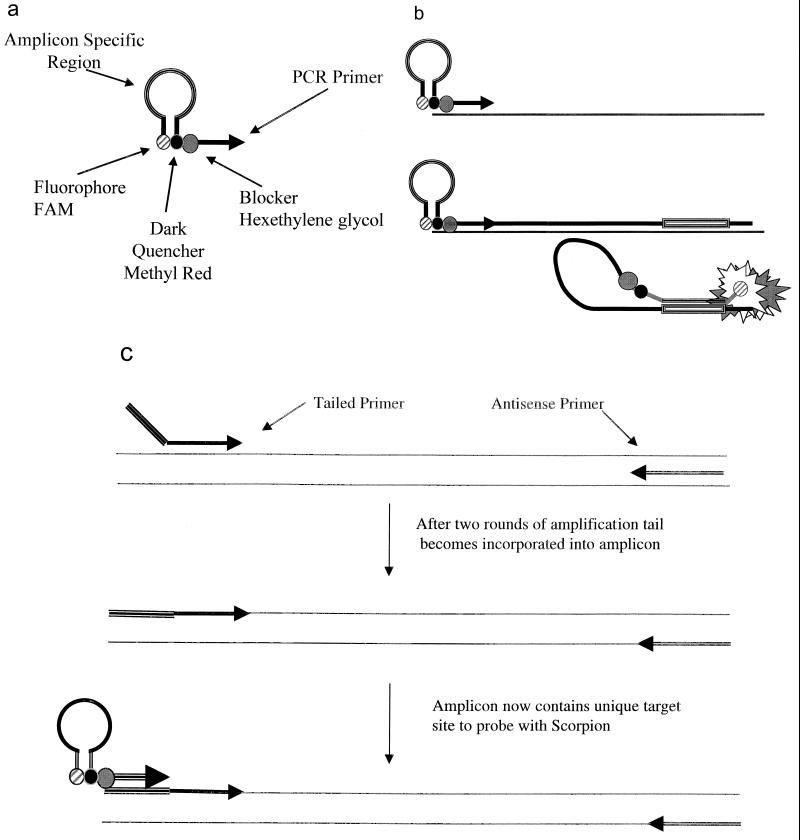
(a) Structure of Scorpion primer. (b) Mode of action of Scorpion primers. The Scorpion primer consists of a conventional PCR primer attached to a looped tail. The tail consists of a stem region in which the DNA is self complementary and a single-stranded loop section, or probe, contains a sequence that is complementary to a section up to 80 bp downstream of the primer binding site. The stem section keeps a fluorophore and dark quencher in close proximity. If the primer finds a binding site and amplification proceeds, a probe binding site is produced. When the probe binds to this site, the loop is opened thus removing the fluorophore from the dark quencher. An increase in fluorescence results. A PCR blocker prevents read-through of the looped tail in subsequent rounds of amplification. (c) Mode of action of degenerate Scorpions. With a tailed primer containing a designer sequence in the tail, it is possible to introduce a unique target sequence into the amplicon after the second round of amplification. This sequence can then provide the sole target for a single Scorpion mixture (ScDGi and ScDGii) theoretically capable of detecting over 40 HPV types.
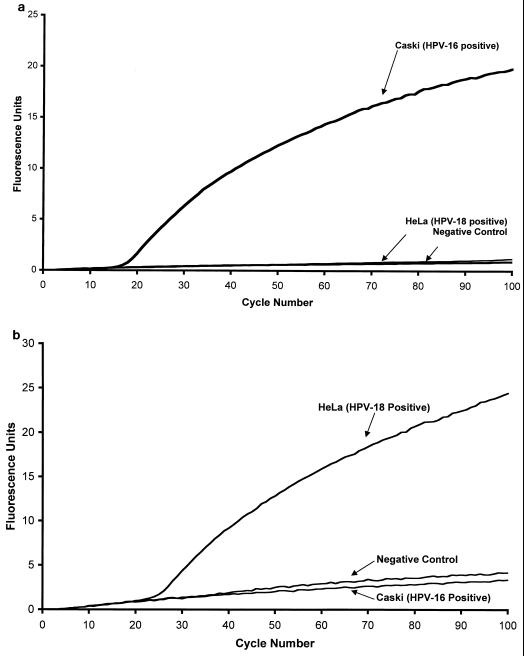
(a) HPV-16 detection. The results of HPV typing reactions using the Scorpion primers specific for HPV-16 (Sc16), HPV-18 (Sc18), a negative control (no DNA), and DNA extracted from a HPV-16-specific cell line (Caski) are shown. (b) The results of HPV typing reactions using the Scorpion primers specific for HPV-16 (Sc16), HPV-18 (Sc18), a negative control (no DNA), and DNA extracted from an HPV-18-specific cell line (HeLa) are shown.
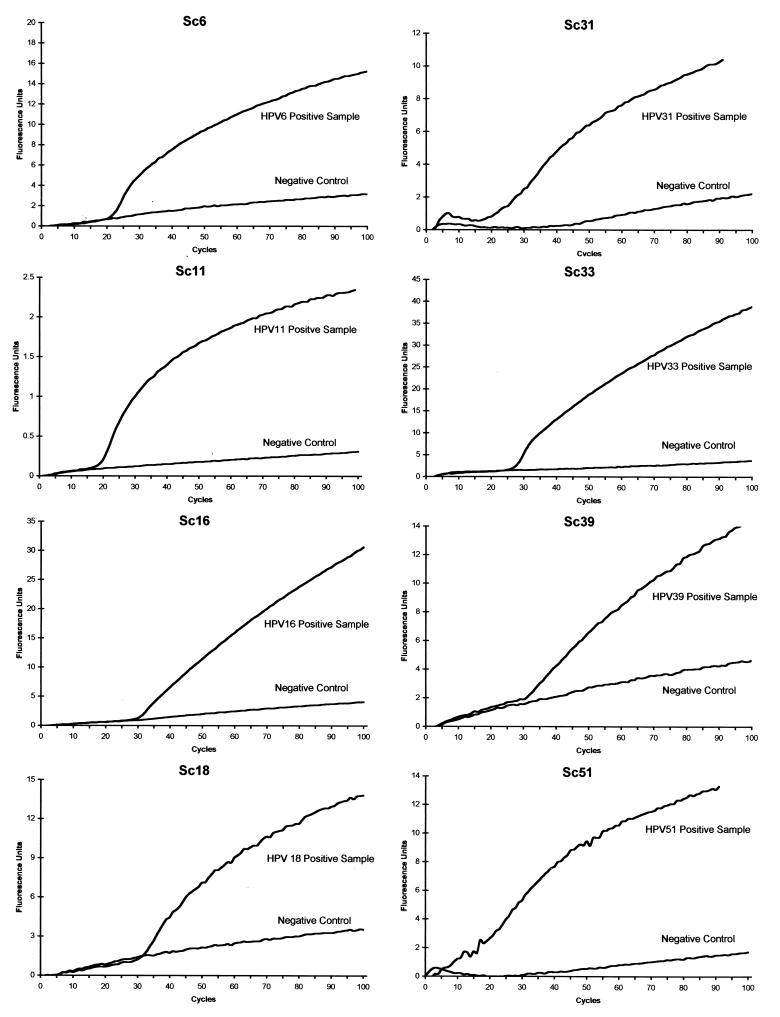
Examples of positive traces produced by VESPA. The results of HPV typing experiments using clinical samples previously typed using PCR-EIA are shown. Primers specific for HPV-6 (Sc6), HPV-11 (Sc11), HPV-16 (Sc16), HPV-18 (Sc18), HPV-31 (Sc31), HPV-33 (Sc33), HPV-39 (Sc39), and HPV-51 (Sc51) are shown.
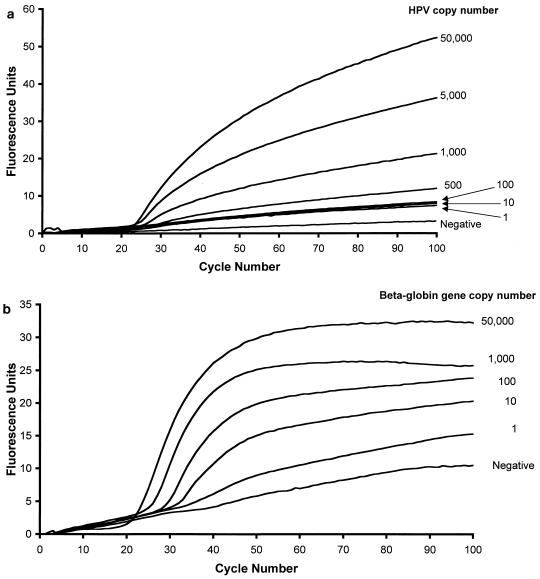
Demonstration of quantitative nature of VESPA. (a) HPV-16 dilution series with Sc16. A dilution series of SiHa cells was made from 50,000 cells per reaction mixture to 1 cell per reaction mixture. (b) Beta-globin gene detection using ScBG and the dilution series described in the legend to panel a.
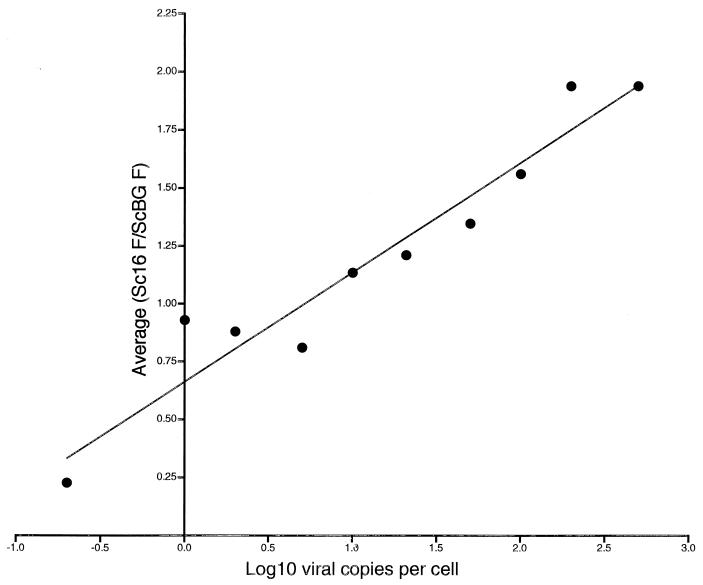
Estimation of viral load Graph. Data were calculated as described in the text.
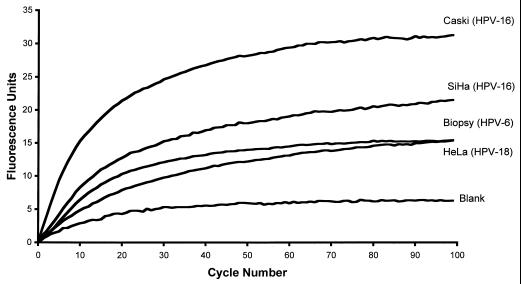
Degenerate HPV detection using VESPA. Reactions were performed as described in the text using samples preamplified with a tailed primer to introduce a unique primer target site.
References
-
- Armitage, P., and G. Berry. Statistical methods in medical research, 3rd ed. Blackwell Scientific Publications, Oxford, United Kingdom.
-
- Bible J M, Mant C, Best J M, Kell B, Starkey W G, Shanti Raju K, Seed P, Biswas C, Muir P, Banatvala J E, Cason J. Cervical lesions are associated with human papillomavirus type 16 intratypic variants that have high transcriptional activity and increased usage of common mammalian codons. J Gen Virol. 2000;81:1517–1527. - PubMed
-
- Costa S, Sideri M, Syrjanen K, Terzano P, De Nuzzo M, De Simone P, Cristiani P, Finarelli A C, Bovicelli A, Zamparelli A, Bovicelli L. Combined Pap smear, cervicography and HPV DNA testing in the detection of cervical intraepithelial neoplasia and cancer. Acta Cytol. 2000;44:310–318. - PubMed
-
- Cuzick J. Human papillomavirus testing for primary cervical cancer screening. JAMA. 2000;283:108–109. - PubMed
-
- Cuzick J, Meijer C J, Walboomers J M. Screening for cervical cancer. Lancet. 1998;351:1439–1440. - PubMed
Publication types
MeSH terms
Substances
Grants and funding
LinkOut - more resources
Full Text Sources
Other Literature Sources
