Molecular identification of microorganisms from endodontic infections
- PMID: 11526164
- PMCID: PMC88332
- DOI: 10.1128/JCM.39.9.3282-3289.2001
Molecular identification of microorganisms from endodontic infections
Abstract
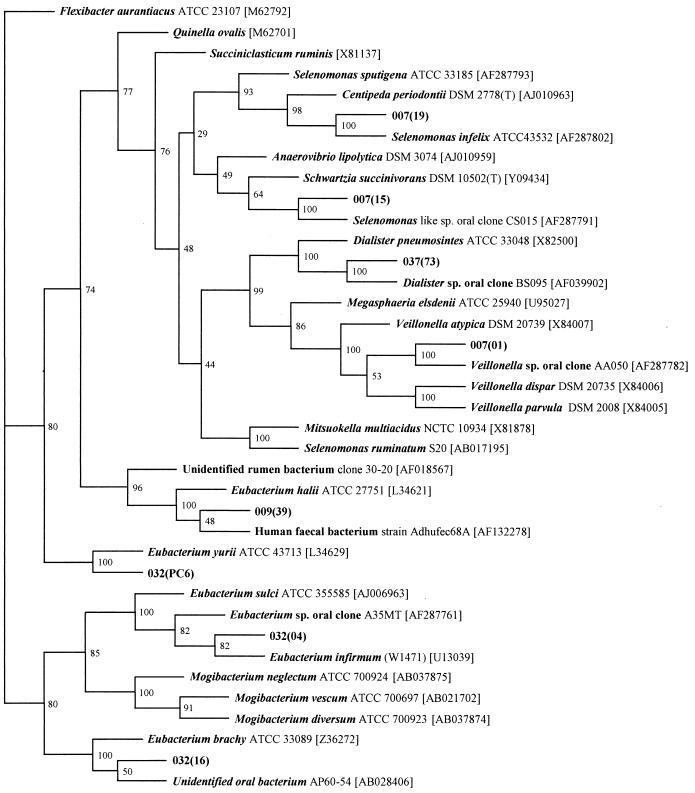
A relatively wide range of bacteria have been isolated from root canals using standard culture techniques. However, only 50% of the bacteria in the oral cavity are cultivable (S. S. Socransky et al., Arch. Oral Biol. 8:278-280, 1963); hence, bacterial diversity in endodontic infections is underestimated. This study used a PCR-based 16S rRNA gene assay, followed by cloning and sequencing of 16S rRNA amplicons from a small subset of samples to assess the diversity of bacteria present in infected root canals. A total of 41 clinical samples from 15 de novo and 26 refractory cases of endodontic infections were assessed. Of these samples, 44% were positive by culture and 68% were positive by PCR. Eight samples were selected for further analysis. Of these, the two de novo cases yielded sequences related to those of the genera Enterococcus, Lactobacillus, Propionibacterium, and Streptococcus and two clones were related to previously uncultivated bacteria, while the sinus-associated, de novo case yielded sequences related to those of the genera Lactobacillus, Pantoea, Prevotella, and Selenomonas. The five refractory cases produced clones which were related to the genera Capnocytophaga, Cytophaga, Dialister, Eubacterium, Fusobacterium, Gemella, Mogibacterium, Peptostreptococcus, Prevotella, Propionibacterium, Selenomonas, Solobacterium, Streptococcus, and Veillonella and two clones representing previously uncultivated bacteria. The phylogenetic positions of several clones associated with the Clostridiaceae and Sporomusa subgroups of the Firmicutes grouping are also shown. This study demonstrates that molecular techniques can detect the presence of bacteria in endodontic infections when culture techniques yield a negative result and can be used to identify a wider range of endodontic-infection-related bacteria including the presence of previously unidentified or unculturable bacteria.
Figures
References
-
- Altschul S F, Gish W, Miller W, Myers E W, Lipman D J. Basic local alignment search tool. J Mol Biol. 1990;215:403–410. - PubMed
-
- Byström A, Sundqvist G. Bacteriologic evaluation of the efficacy of mechanical root canal instrumentation in endodontic therapy. Scand J Dent Res. 1981;89:321–328. - PubMed
-
- Conrads G, Gharbia S E, Gulabivala K, Lampert F, Shah H N. The use of 16S rDNA directed PCR for the detection of endodontopathogenic bacteria. J Endod. 1997;23:433–438. - PubMed
Publication types
MeSH terms
Substances
LinkOut - more resources
Full Text Sources
Molecular Biology Databases