


Prediction of cognitive decline in normal elderly subjects with 2-[(18)F]fluoro-2-deoxy-D-glucose/poitron-emission tomography (FDG/PET)
- PMID: 11526211
- PMCID: PMC58582
- DOI: 10.1073/pnas.191044198
Prediction of cognitive decline in normal elderly subjects with 2-[(18)F]fluoro-2-deoxy-D-glucose/poitron-emission tomography (FDG/PET)
Abstract
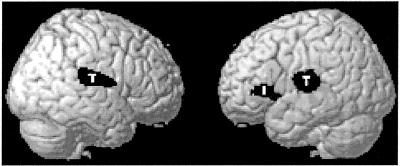
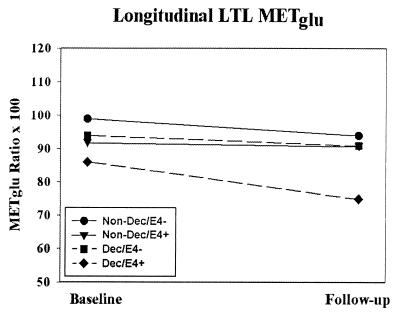
Neuropathology studies show that patients with mild cognitive impairment (MCI) and Alzheimer's disease typically have lesions of the entorhinal cortex (EC), hippocampus (Hip), and temporal neocortex. Related observations with in vivo imaging have enabled the prediction of dementia from MCI. Although individuals with normal cognition may have focal EC lesions, this anatomy has not been studied as a predictor of cognitive decline and brain change. The objective of this MRI-guided 2-[(18)F]fluoro-2-deoxy-d-glucose/positron-emission tomography (FDG/PET) study was to examine the hypothesis that among normal elderly subjects, EC METglu reductions predict decline and the involvement of the Hip and neocortex. In a 3-year longitudinal study of 48 healthy normal elderly, 12 individuals (mean age 72) demonstrated cognitive decline (11 to MCI and 1 to Alzheimer's disease). Nondeclining controls were matched on apolipoprotein E genotype, age, education, and gender. At baseline, metabolic reductions in the EC accurately predicted the conversion from normal to MCI. Among those who declined, the baseline EC predicted longitudinal memory and temporal neocortex metabolic reductions. At follow-up, those who declined showed memory impairment and hypometabolism in temporal lobe neocortex and Hip. Among those subjects who declined, apolipoprotein E E4 carriers showed marked longitudinal temporal neocortex reductions. In summary, these data suggest that an EC stage of brain involvement can be detected in normal elderly that predicts future cognitive and brain metabolism reductions. Progressive E4-related hypometabolism may underlie the known increased susceptibility for dementia. Further study is required to estimate individual risks and to determine the physiologic basis for METglu changes detected while cognition is normal.
Figures
References
-
- Larrabee G J, Crook T H. Int Psychogeriatr. 1994;6:95–104. - PubMed
-
- Berg L, McKeel D W, Miller P J, Storandt M, Rubin E H, Morris J C, Baty J, Coats M, Norton J, Goate A M, et al. Arch Neurol (Chicago) 1998;55:326–335. - PubMed
-
- Braak H, Braak E. Acta Neuropathol. 1991;82:239–259. - PubMed
-
- Arriagada P V, Marzloff K, Hyman B T. Neurology. 1992;42:1681–1688. - PubMed
Publication types
MeSH terms
Substances
Grants and funding
LinkOut - more resources
Full Text Sources
Other Literature Sources
Medical
