


Dietary n-3 polyunsaturated fatty acids modulate purified murine T-cell subset activation
- PMID: 11531960
- PMCID: PMC1906146
- DOI: 10.1046/j.1365-2249.2001.01627.x
Dietary n-3 polyunsaturated fatty acids modulate purified murine T-cell subset activation
Abstract
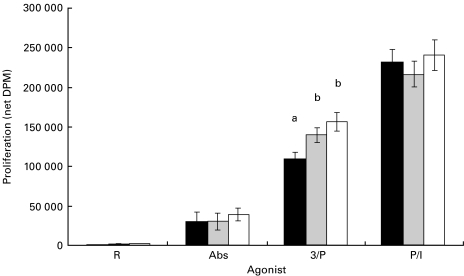
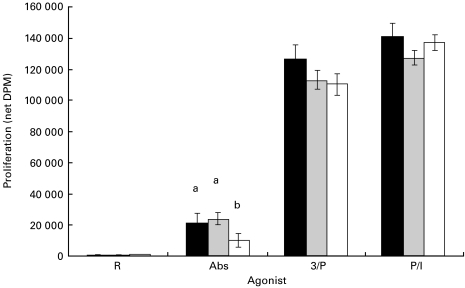
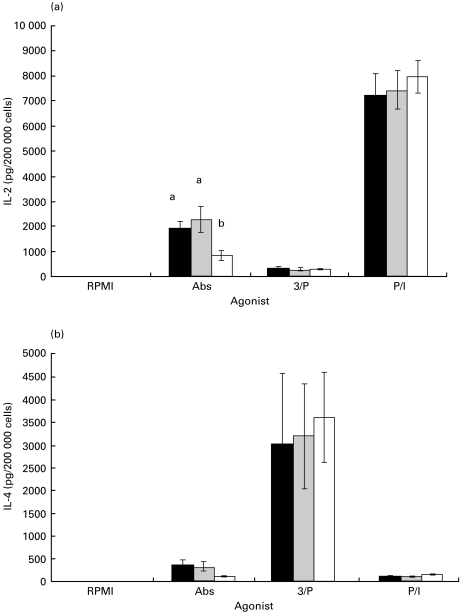
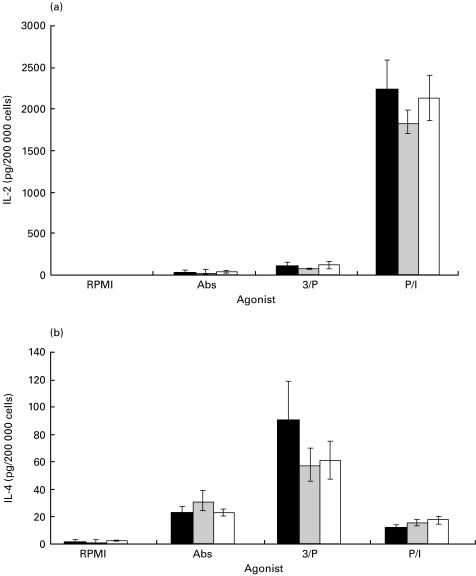
Studies in humans and murine disease models have clearly shown dietary fish oil to possess anti-inflammatory properties, apparently mediated by the n-3 polyunsaturated fatty acids, eicosapentaenoic acid (EPA) and docosahexaenoic acid (DHA). To determine the mechanisms by which dietary EPA and DHA modulate mouse T-cell activation, female C57BL/6 mice were fed diets containing either 2% safflower oil (SAF), 2% fish oil (FO), or a 2% purified EPA/DHA ethyl ester mixture for 14 days. Splenic CD4 T cells ( approximately 90% purity) or CD8 T cells ( approximately 85% purity) were incubated with agonists which act at the plasma membrane receptor level [anti(alpha)-CD3/anti(alpha)-CD28], the intracellular level (PMA/Ionomycin), or at both the receptor and intracellular levels (alphaCD3/PMA). CD4 T cells stimulated with alphaCD3/alphaCD28 or PMA/Ionomycin proliferated and produced principally IL-2 (i.e. a Th1 phenotype), whereas the proliferation of CD4 T cells stimulated with alphaCD3/PMA was apparently driven principally by IL-4 (i.e. a Th2 phenotype). The IL-4 driven proliferation of putative Th2 CD4 cells was enhanced by dietary n-3 fatty acids (P = 0.02). Conversely, IL-2 production by alphaCD3/alpha CD28-stimulated CD4 T cells was reduced in FO-fed animals (P < 0.0001). The alphaCD3/alphaCD28-stimulated CD8 cells cultured from FO-fed animals exhibited a significant decrease (P < 0.05) in proliferation. There were no dietary effects seen in alphaCD3/PMA-stimulated CD8 cells, which produced both IL-2 and IL-4, or in PMA/Ionomycin-stimulated CD8 cells, which produced principally IL-2. These data suggest that dietary n-3 fatty acids down-regulated IL-2 driven CD4 and CD8 activation, while up-regulating the activation of the Th2 CD4 T-cell subset. Thus, the anti-inflammatory effects of n-3 fatty acids may result in both the direct suppression of IL-2-induced Th1 cell activation and the indirect suppression of Th1 cells by the enhanced cross-regulatory function of Th2 cells.
Figures
References
-
- Simopoulos AP. Omega-3 fatty acids in health and disease and in growth and development. Am J Clin Nutr. 1991;54:438. - PubMed
-
- Kromann N, Green A. Epidemiological studies in the Upernavik District. Greenland Acta Med Scand. 1980;208:401–6. - PubMed
-
- Cleland LG, French JK, Betts WH, et al. Clinical and biochemical effects of dietary fish oil supplements in rheumatoid arthritis. J Rheumatol. 1988;15:1471–5. - PubMed
-
- Esperson GT, Grunnet N, Lerang HH, et al. Decreased interleukin-1 beta levels in plasma from rheumatoid arthritis patients after dietary supplementation with n-3 polyunsaturated fatty acids. Clin Rheum. 1992;11:393–5. - PubMed
-
- Kremer JM, Bigauoetta J, Michalek AU, et al. Effects of manipulating dietary fatty acids on clinical manifestations of rheumatoid arthritis. Lancet. 1985;1:184–7. - PubMed
Publication types
MeSH terms
Substances
Grants and funding
LinkOut - more resources
Full Text Sources
Research Materials
