. 2001 Oct;75(19):8968-76.
doi: 10.1128/JVI.75.19.8968-8976.2001.

Adeno-associated virus type 2-mediated gene transfer: role of cellular FKBP52 protein in transgene expression

Affiliations

Adeno-associated virus type 2-mediated gene transfer: role of cellular FKBP52 protein in transgene expression

K Qing et al. J Virol. 2001 Oct.

Abstract

Although adeno-associated virus type 2 (AAV) has gained attention as a potentially useful vector for human gene therapy, the transduction efficiencies of AAV vectors vary greatly in different cells and tissues in vitro and in vivo. We have documented that a cellular tyrosine phosphoprotein, designated the single-stranded D-sequence-binding protein (ssD-BP), plays a crucial role in AAV-mediated transgene expression (K. Y. Qing, X.-S. Wang, D. M. Kube, S. Ponnazhagan, A. Bajpai, and A. Srivastava, Proc. Natl. Acad. Sci. USA 94:10879-10884, 1997). We have documented a strong correlation between the phosphorylation state of ssD-BP and AAV transduction efficiency in vitro as well as in vivo (K. Y. Qing, B. Khuntrirat, C. Mah, D. M. Kube, X.-S. Wang, S. Ponnazhagan, S. Z. Zhou, V. J. Dwarki, M. C. Yoder, and A. Srivastava, J. Virol. 72:1593-1599, 1998). We have also established that the ssD-BP is phosphorylated by epidermal growth factor receptor protein tyrosine kinase and that the tyrosine-phosphorylated form, but not the dephosphorylated form, of ssD-BP prevents AAV second-strand DNA synthesis and, consequently, results in a significant inhibition of AAV-mediated transgene expression (C. Mah, K. Y. Qing, B. Khuntrirat, S. Ponnazhagan, X.-S. Wang, D. M. Kube, M. C. Yoder, and A. Srivastava, J. Virol. 72:9835-9841, 1998). Here, we report that a partial amino acid sequence of ssD-BP purified from HeLa cells is identical to a portion of a cellular protein that binds the immunosuppressant drug FK506, termed the FK506-binding protein 52 (FKBP52). FKBP52 was purified by using a prokaryotic expression plasmid containing the human cDNA. The purified protein could be phosphorylated at both tyrosine and serine or threonine residues, and only the phosphorylated forms of FKBP52 were shown to interact with the AAV single-stranded D-sequence probe. Furthermore, in in vitro DNA replication assays, tyrosine-phosphorylated FKBP52 inhibited AAV second-strand DNA synthesis by greater than 90%. Serine- or threonine-phosphorylated FKBP52 caused approximately 40% inhibition, whereas dephosphorylated FKBP52 had no effect on AAV second-strand DNA synthesis. Deliberate overexpression of FKBP52 effectively reduced the extent of tyrosine phosphorylation of the protein, resulting in a significant increase in AAV-mediated transgene expression in human and murine cell lines. These studies corroborate the idea that the phosphorylation status of the cellular FKBP52 protein correlates strongly with AAV transduction efficiency, which may have important implications for the optimal use of AAV vectors in human gene therapy.


Figures

FIG. 1
FIG. 1
(A) Purification of ssD-BP from HeLa cells. SDS-polyacrylamide gel electrophoretic pattern of purified ssD-BP. Lane 1, protein molecular size markers; lane 2, WCE of HeLa S3 cells (20 μg of total protein); lane 3, Oct2A factor, included as a positive control, purified according to the standard protocol using the protein purification kit supplied by the vendor (Boehringer Mannheim); lane 4, purified ssD-BP. The arrow indicates the ≈52-kDa ssD-BP. (B) Deduced amino acid sequence of the human FKBP52 protein. The boldface underlined amino acids represent the identified homology between ssD-BP and FKBP52 (GenBank accession no. M88279).
FIG. 2
FIG. 2
Electrophoretic mobility supershift assays and immunoprecipitation of WCEs with anti-FKBP52 antibody. The AAV D-sequence probe (lane 1) was incubated with WCEs prepared from HeLa cells to yield a slower-migrating complex (lane 2; solid arrow) and with those from 293 cells to form a faster-migrating complex (lane 3; solid arrowhead). These complexes were supershifted by incubation with antiFKBP52 antibody with HeLa (lane 4; open arrow) and 293 (lane 5; open arrowhead) WCEs, respectively, but not with anti-β1 integrin antibody (lanes 6 and 7). No complex formation occurred between the AAV D-sequence probe and either anti-FKBP52 antibody (lane 8) or anti-β1 integrin antibody (lane 9). When WCEs from HeLa and 293 cells were immunoprecipitated with anti-FKBP52 antibody and supernatants and pellets, following resuspension, were used in EMSA, prior immunoprecipitation with anti-FKBP52 antibody eliminated ssD-BP from WCEs from both HeLa and 293 cells (lanes 10 and 11), and it could be recovered from the pellets (lanes 12 and 13).
FIG. 3
FIG. 3
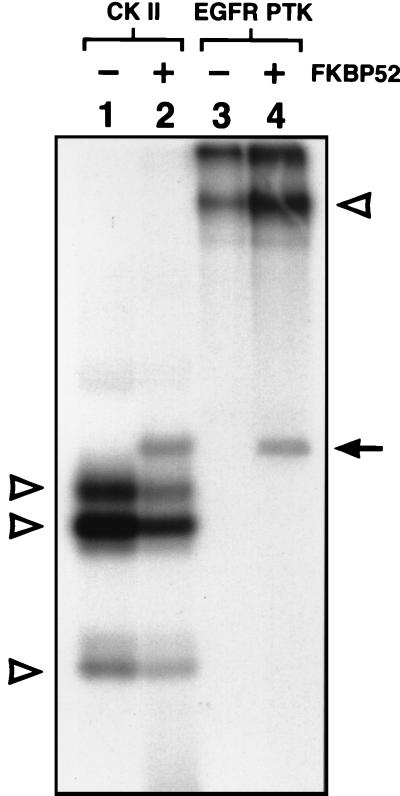
In vitro phosphorylation of purified FKBP52 protein by CK II and EGFR-PTK. CK II was incubated in the absence (−; lane 1) or presence (+; lane 2) of 1 μg of FKBP52. Similarly, EGFR-PTK was incubated in the absence (lane 3) or presence (lane 4) of FKBP52 as described in Materials and Methods. The arrow indicates the phosphorylated FKBP52 protein, and the arrowheads denote the autophosphorylated CK II and EGFR-PTK proteins.
FIG. 4
FIG. 4
Electrophoretic mobility shift assays for the AAV D(−) sequence (lane 1) interaction with human FKBP52 purified from bacterial cells without (lane 2) and with prior in vitro phosphorylation with CK II (lane 3) and EGFR-PTK (lane 5), respectively. These assays were performed as described in Materials and Methods. No interaction between the probe and CK II alone (lane 4) or EGFR-PTK alone (lane 6) was observed. Complexes presumed to contain the phosphorylated forms of the FKBP52 protein are denoted by the solid arrows and arrowhead, and the unphosphorylated form is denoted by the open arrowhead.
FIG. 5
FIG. 5
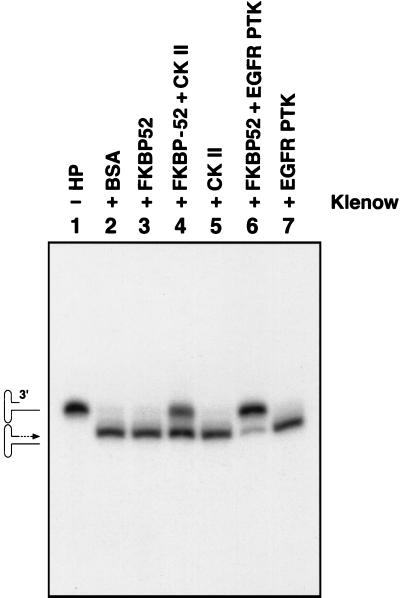
In vitro replication assays for the effects of the purified FKBP52 protein, with and without phosphorylation by CK II or EGFR-PTK, on AAV second-strand DNA synthesis. These assays were carried out as described in Materials and Methods. The radiolabeled AAV hairpin (HP) DNA template (lane 1) (shown schematically as the upper figure on the left) was readily converted into its duplex counterpart (shown schematically as the lower figure on the left) following second-strand DNA synthesis by the Klenow enzyme (lane 2). Prior incubation with the dephosphorylated FKBP52 protein had no effect (lane 3), while CK II-phosphorylated FKBP52 inhibited second-strand DNA synthesis by ≈40% (lane 4). CK II in the absence of FKBP52 had no effect (lane 5). FKBP52 phosphorylated by EGFR-PTK inhibited viral second-strand DNA synthesis by >90% (lane 6), and EGFR-PTK alone had no effect (lane 7). BSA, bovine serum albumin; +, present; −, absent.
FIG. 6
FIG. 6
Western blot analysis for expression of human FKBP52 in human 293 and HeLa cells and murine NIH 3T3 cells. Mock-transfected cells (lanes 1, 3, and 5) and cells stably transfected with a human FKBP52 expression plasmid (lanes 2, 4, and 6) were analyzed using human anti-FKBP52 antibody as described in Materials and Methods. The arrow indicates the 52-kDa human FKBP52 protein. +, present; −, absent.
FIG. 7
FIG. 7
Electrophoretic mobility shift assays for the AAV D(−) sequence interaction with FKBP52 in mock-transfected NIH 3T3, 293, and HeLa cells (lanes 2, 4, and 6) or cells stably transfected with the human FKBP52 expression plasmid (lanes 3, 5, and 7). These assays were carried out as described in the legend to Fig. 4. The tyrosine-phosphorylated form of the FKBP52 protein is denoted by the arrow, and the serine- or threonine-phosphorylated form is denoted by the arrowhead. +, present; −, absent.
FIG. 8
FIG. 8
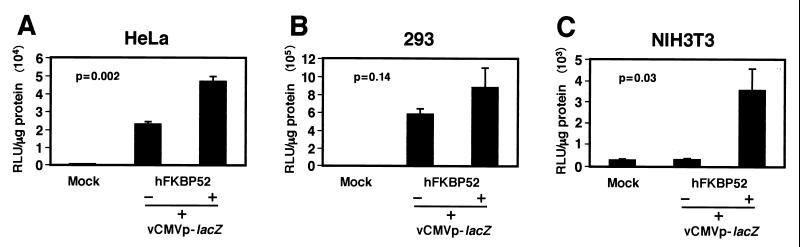
Comparative analyses of AAV-mediated transduction efficiency in cells overexpressing the FKBP52 protein. Mock-transfected or FKBP52 expression plasmid-transfected HeLa (A), 293 (B), and NIH 3T3 (C) cells were either mock infected or infected with a recombinant AAV-lacZ vector under identical conditions. Transgene expression was evaluated 48 h postinfection as described in Materials and Methods. These data represent results from experiments performed in triplicate with the standard error of the mean. Statistical differences were determined by using an unpaired Student t test. +, present; −, absent.
FIG. 9
FIG. 9
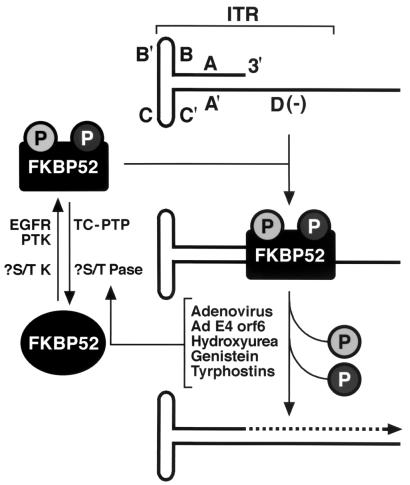
Revised model for the role of the cellular FKBP52 protein in AAV second-strand DNA synthesis. See the text for details. Shaded circles represent phosphorylated serine (or threonine) and tyrosine residues. The broken-lined arrow indicates the viral second-strand DNA synthesis.

References

    1. Berns K I, Giraud C. Biology of adeno-associated virus. Curr Top Microbiol Immunol. 1996;218:1–23. - PubMed
    1. Carter B J, Flotte T R. Development of adeno-associated virus vectors for gene therapy of cystic fibrosis. Curr Top Microbiol Immunol. 1996;218:119–144. - PubMed
    1. Chatterjee S, Lu D, Podsakoff G, Wong K K., Jr Strategies for efficient gene transfer into hematopoietic cells: the use of adeno-associated virus vectors in gene therapy. Ann N Y Acad Sci. 1995;770:79–90. - PubMed
    1. Cybulsky A V, Goodyer P R, McTavish A J. Epidermal growth factor receptor activation in developing rat kidney. Am J Physiol. 1994;267:F428–F436. - PubMed
    1. Czar M J, Lyons R H, Welsh M J, Renoir J-M, Pratt W B. Evidence that the FK506-binding protein 56 is required for trafficking of the glucocorticoid receptor from the cytoplasm to the nucleus. Mol Endocrinol. 1995;9:1549–1560. - PubMed

Publication types

Substances

LinkOut - more resources