


Gene conversion and different population histories may explain the contrast between polymorphism and linkage disequilibrium levels
- PMID: 11533915
- PMCID: PMC1226068
- DOI: 10.1086/323612
Gene conversion and different population histories may explain the contrast between polymorphism and linkage disequilibrium levels
Abstract
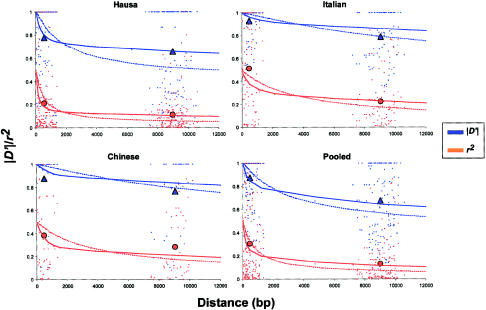
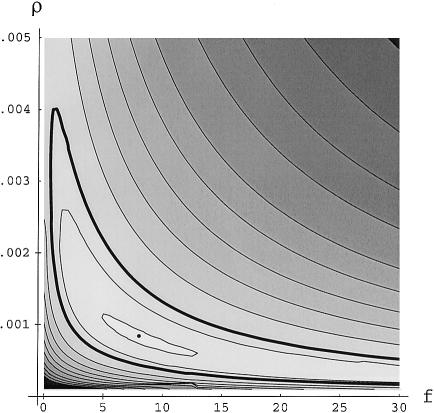
To characterize linkage disequilibrium (LD) levels in human populations, we have analyzed 10 independent noncoding segments in three population samples from the major ethnic groups--that is, Africans, Asians, and Europeans. Descriptive statistics show that LD decays much faster in the African samples than in the non-African ones. With the assumption of an equilibrium model, we estimated the population crossing-over parameter (4N(e)r(bp), where N(e) is the effective population size and r(bp) is the crossing-over rate per generation between adjacent base pairs) in the presence of gene conversion. In the African sample, LD and polymorphism levels lead to similar estimates of effective population size, as expected under an equilibrium model. Conversely, in both non-African samples, LD levels suggest a smaller effective population size than that implied by polymorphism levels. This observation is paralleled by significant departures from an equilibrium model in the spectrum of allele frequencies of the non-African samples. Besides ruling out the possibility that non-African populations are at equilibrium, these results suggest different demographic history (temporal and spatial) of these groups. Interestingly, the African sample fits the expectations of an equilibrium model based on polymorphism and divergence levels and on frequency spectrum. For this sample, the estimated ratio of gene conversion to crossing-over rates is 7.3 for a mean tract length of 500 bp, suggesting that gene conversion may be more frequent than previously thought. These findings imply that disease-association studies will require a much denser map of polymorphic sites in African than in non-African populations.
Figures
References
Electronic-Database Information
-
- BLAST, http://www.ncbi.nlm.nih.gov/BLAST/ (for STS and homology searches)
-
- Di Rienzo Laboratory, http://genes.uchicago.edu/ (for sequence data)
-
- F-genes, http://genomic.sanger.ac.uk/gf/gf.shtml (for gene prediction)
-
- GenBank, http://www.ncbi.nlm.nih.gov (for BAC clone sequences)
-
- Genscan, http://genes.mit.edu/GENSCAN.html (for gene prediction)
References
-
- Collins FS, Guyer MS, Charkravarti A (1997) Variations on a theme: cataloging human DNA sequence variation. Science 278:1580–1581 - PubMed
-
- Cooper DN, Antonarakis SE, Krawczak M (1995) The nature and mechanism of human gene mutation. In: Scriver CR, Beaudet AL, Sly WS, Valle D (eds) The metabolic and molecular bases of inherited disease. McGraw-Hill, New York, pp 259–291
Publication types
MeSH terms
Grants and funding
LinkOut - more resources
Full Text Sources
Research Materials
