. 2001 Sep 11;98(19):10596-601.
doi: 10.1073/pnas.191159298. Epub 2001 Sep 4.

Searching sequence space for protein catalysts

Affiliations

Searching sequence space for protein catalysts

S V Taylor et al. Proc Natl Acad Sci U S A. .

Abstract

Genetic selection was used to explore the probability of finding enzymes in protein sequence space. Large degenerate libraries were prepared by replacing all secondary structure units in a dimeric, helical bundle chorismate mutase with simple binary-patterned modules based on a limited set of four polar and four nonpolar residues. Two-stage in vivo selection yielded catalytically active variants possessing biophysical and kinetic properties typical of the natural enzyme even though approximately 80% of the protein originates from the simplified modules and >90% of the protein consists of only eight different amino acids. This study provides a quantitative assessment of the number of sequences compatible with a given fold and implicates previously unidentified residues needed to form a functional active site. Given the extremely low incidence of enzymes in completely unbiased libraries, strategies that combine chemical information with genetic selection, like the one used here, may be generally useful in designing novel protein scaffolds with tailored activities.


Figures
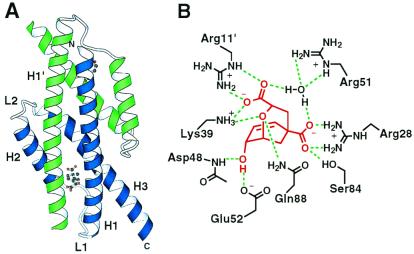
Figure 1
Figure 1
AroQ structure and active site. (A) The homodimeric enzyme is shown with a transition state analog inhibitor bound at the active sites (18); the two identical polypeptide chains are colored blue and green for clarity. (B) An array of polar active site residues (black) provides extensive hydrogen bonding and electrostatic interactions with bound inhibitor (red). Residues 11, 28, 39, 51, 52, and 88 were held constant in the randomization experiments.
Figure 2
Figure 2
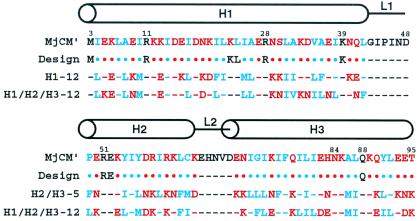
Library design and sequences of selected variants. The MjCM′ sequence comprises the N-terminal 93 aa of AroQf from M. jannaschii plus an appended Leu-Glu-(His)6 tag (not shown); residue numbers and secondary structural elements were assigned by comparison with EcCM (18). Binary patterned helical modules were designed according to the observed distribution of hydrophilic and hydrophobic residues in the MjCM′ H1, H2, and H3 helices. Large degenerate libraries were obtained by providing mixtures of Asn, Asp, Glu, and Lys at polar (red) positions and mixtures of Ile, Leu, Met, and Phe at apolar (blue) positions. The starting methionine, highly conserved active site amino acids, and loop residues (black) were held constant. Lys-23 and Leu-24 in the H1 helix were also retained for construction purposes (see Fig. 3). Sequences of representative clones (H1–12, H2/H3–5, and H1/H2/H3–12) obtained by selection from the libraries are shown below the imposed binary pattern; dashes indicate residues that are identical to their MjCM′ counterpart.
Figure 3
Figure 3
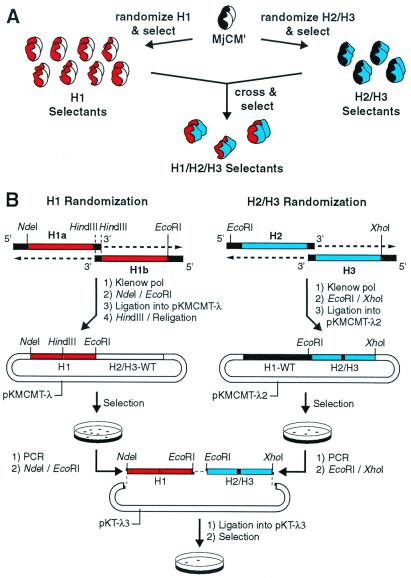
Construction of binary patterned CMs. (A) The general experimental strategy involved initially selecting functional enzymes from protein libraries in which only the H1 (red) or H2/H3 (blue) helices were replaced with randomized modules created according to the binary patterning scheme of Fig. 2. In a second stage, selected H1 and H2/H3 modules were combined combinatorially, and functional H1/H2/H3 enzymes were identified by genetic selection. (B) The H1 and H2/H3 binary patterned libraries were constructed at the genetic level from synthetic oligonucleotides in which polar and nonpolar residues were designated by specific degenerate codons (see Materials and Methods). Briefly, appropriately randomized oligonucleotide pairs were annealed at complementary overlap sites, extended with Klenow polymerase fragment, and cloned into acceptor vectors containing the complementary WT gene segment. Functional H1 and H2/H3 modules from the libraries were identified by genetic selection. PCR amplification of the encoding gene segments and subsequent three-fragment ligation with the acceptor vector pKT-λ3 yielded the H1/H2/H3 library plasmid pool, encoding CMs in which all secondary structural elements (≈80% of the protein) are derived from the binary patterned helical modules. Active clones were again identified by genetic selection.
Figure 4
Figure 4
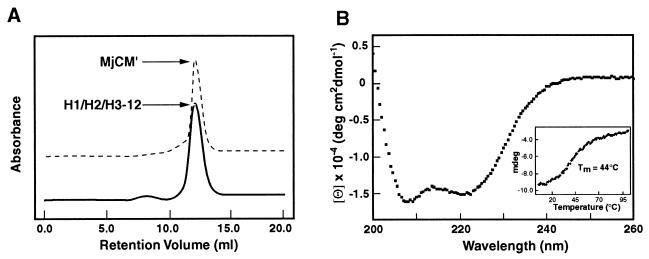
Characterization of a binary patterned CM. (A) Size-exclusion chromatography traces of H1/H2/H3–12 (solid line) and MjCM′ (dashed line), showing similar retention times. MjCM′ was previously shown to be homodimeric by analytical ultracentrifugation (13). (B) The CD spectrum of H1/H2/H3–12. The molar ellipticities at 208 and 222 nm are comparable to those of WT MjCM′ (data not shown) and show that the protein is highly helical. (Inset) The cooperative thermal denaturation of H1/H2/H3–12.
Figure 5
Figure 5
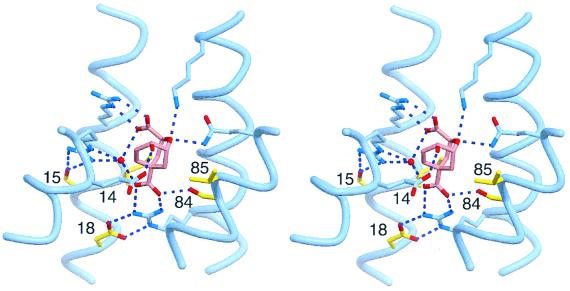
Stereoview of the EcCM active site with bound transition state analog (pink) (18), showing the positions of the catalytic residues (blue) and the first and second sphere residues (yellow) that had highly restricted sequence requirements in active clones from the MjCM′ H1/H2/H3 library. The amino acid at position 84 forms a hydrogen bond with the tertiary carboxylate of the bound inhibitor (pink), while residues 14 and 85 are in van der Waals contact with the ligand. Amino acids at positions 15 and 18 help position active site residues Arg-51 and Arg-28, respectively. Image was created by using molscript (39) and RASTER3D (40).

References

    1. Hill R B, Raleigh D P, Lombardi A, DeGrado W F. Acc Chem Res. 2000;33:745–754. - PMC - PubMed
    1. Harbury P B, Plecs J J, Tidor B, Alber T, Kim P S. Science. 1998;282:1462–1467. - PubMed
    1. Dahiyat B I, Mayo S L. Science. 1997;278:82–87. - PubMed
    1. Cordes M H J, Davidson A R, Sauer R T. Curr Opin Struct Biol. 1996;6:3–10. - PubMed
    1. Wilson D S, Szostak J W. Annu Rev Biochem. 1999;68:611–647. - PubMed

Publication types

MeSH terms

Substances

LinkOut - more resources