. 2001 Sep 11;98(19):10584-9.
doi: 10.1073/pnas.191375298. Epub 2001 Sep 4.

Overlapping recognition determinants within the ssrA degradation tag allow modulation of proteolysis

Affiliations

Overlapping recognition determinants within the ssrA degradation tag allow modulation of proteolysis

J M Flynn et al. Proc Natl Acad Sci U S A. .

Abstract

The ssrA tag, an 11-aa peptide added to the C terminus of proteins stalled during translation, targets proteins for degradation by ClpXP and ClpAP. Mutational analysis of the ssrA tag reveals independent, but overlapping determinants for its interactions with ClpX, ClpA, and SspB, a specificity-enhancing factor for ClpX. ClpX interacts with residues 9-11 at the C terminus of the tag, whereas ClpA recognizes positions 8-10 in addition to residues 1-2 at the N terminus. SspB interacts with residues 1-4 and 7, N-terminal to the ClpX-binding determinants, but overlapping the ClpA determinants. As a result, SspB and ClpX work together to recognize ssrA-tagged substrates efficiently, whereas SspB inhibits recognition of these substrates by ClpA. Thus, dissection of the recognition signals within the ssrA tag provides insight into how multiple proteins function in concert to modulate proteolysis.


Figures
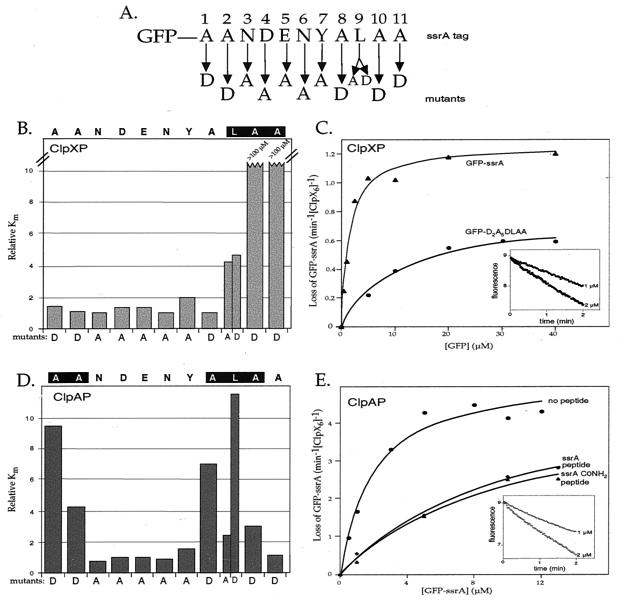
Figure 1
Figure 1
Degradation of GFP-ssrA variants by ClpXP and ClpAP. (A) SsrA-tag sequence and identity of single-residue substitutions. (B) Relative Km values for ClpXP degradation of GFP-ssrA mutants. Rates of ClpXP-mediated degradation of GFP-ssrA variants, determined by the loss of native fluorescence, were determined at different substrate concentrations (see Materials and Methods) and fit to a Michaelis–Menten model. The Km values plotted were normalized by dividing by Km for ClpXP degradation of wild-type GFP-ssrA (1.5 μM). Vmax values for mutants 1–9 were within 2-fold of the wild-type value (1.2 min−1 ClpXformula image) except for Y7A, which had a Vmax of 0.45 min−1 ClpXformula image). (C) Michaelis–Menten plots of ClpXP degradation of GFP-ssrA and GFP-D2A5DLAA. The solid lines are fits to the Michaelis–Menten equation for GFP-ssrA (Km = 1.5 μM, Vmax = 1.2 min−1) and GFP-D2A5DLAA (Km = 10.1 μM, Vmax = 0.8 min−1). The decrease in Vmax for the consensus mutant is probably caused by the decreased Vmax of the Y9A substitution. (Inset) The change in fluorescence at 511 nm of 1 μM GFP-ssrA and 2 μM GFP-ssrA following incubation with ClpXP. (D) Relative Km values for ClpAP degradation of GFP-ssrA mutants. Km values were normalized by dividing by the Km value (1.5 μM) for ClpAP degradation of wild-type GFP-ssrA. See legend to B for other details. (E) Inhibition of ClpAP degradation of GFP-ssrA by ssrA peptides. Michaelis–Menten plots for ClpAP degradation of GFP-ssrA in the absence of peptide (Km = 1.5 ± 0.4 μM, Vmax = 4.9 ± 0.3 μM/min−1) or presence of the wild-type ssrA peptide (Km apparent = 10.4 ± 1.6 μM, Vmax = 5.1 ± 0.4 μM/min−1, KI = 16.9 μM) or the carboxamide ssrA peptide (Km apparent = 10.7 ± 1.2 μM, Vmax = 4.9 ± 0.3 μM/min−1, KI = 16.4 μM). KI values were calculated from Km apparent = [1 + ([I]/KI)] * Km. (Inset) The change in fluorescence at 511 nm of 1 μM GFP-ssrA and 2 μM GFP-ssrA following incubation with ClpAP.
Figure 2
Figure 2
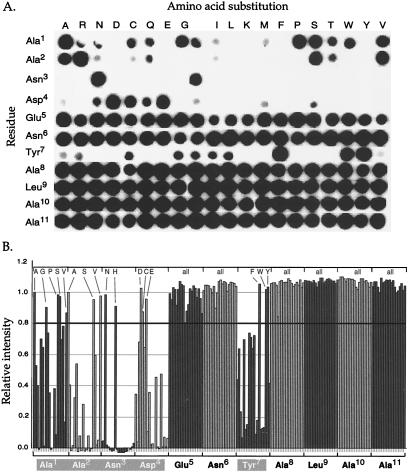
Effects of ssrA-peptide mutations on SspB recognition. (A) A library consisting of 220 ssrA peptide variants was used to assay SspB binding via an “indirect” Western. The filter containing covalently bound peptides was first incubated in 10 μg/ml SspB, and bound SspB was detected with anti-SspB antibody followed by horseradish peroxidase-conjugated goat anti-rabbit IgG antibody and the ECL substrate. (B) The filter in A was digitally scanned, and the number of pixels in each spot was quantified by using imagequant. These values are presented relative to the intensity of the wild-type ssrA peptide. Substitutions that show 80% or more of wild-type binding are indicated above the graph.
Figure 3
Figure 3
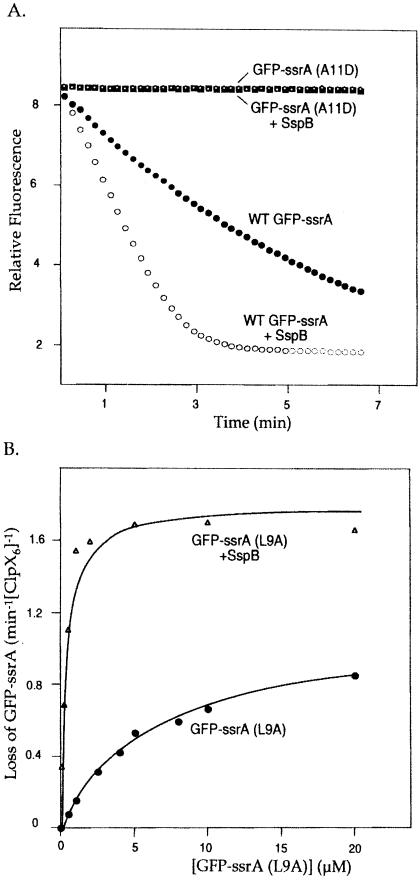
(A) Degradation of GFP-ssrA (A11D) in the presence of SspB. ClpXP degradation, assayed by loss of fluorescence at 511 nm of 1 μM GFP-ssrA with or without SspB and 1 μM GFP-ssrA (A11D) with or without SspB. When present, the SspB concentration was 1 μM. (B) Degradation of L9A in the presence of SspB. Michaelis–Menten plots for ClpXP degradation of GFP-ssrA (L9A) in the absence (Km = 6.2 μM, Vmax = 1.1 min−1) or presence of saturating amounts of SspB (Km = 0.34 μM, Vmax = 1.8 min−1). The Km represents an upper limit because of the relatively high enzyme concentration (0.3 μM ClpX6) used in the experiment. The solid lines are fits to the Michaelis–Menten equation.
Figure 4
Figure 4
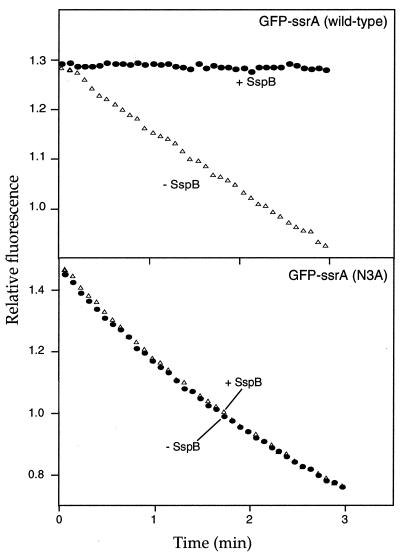
SspB inhibits degradation by ClpAP. ClpAP degradation of 1 μM GFP-ssrA or GFP-ssrA (N3A), assayed by loss of fluorescence at 511 nm, without SspB or with SspB (2 μM).
Figure 5
Figure 5
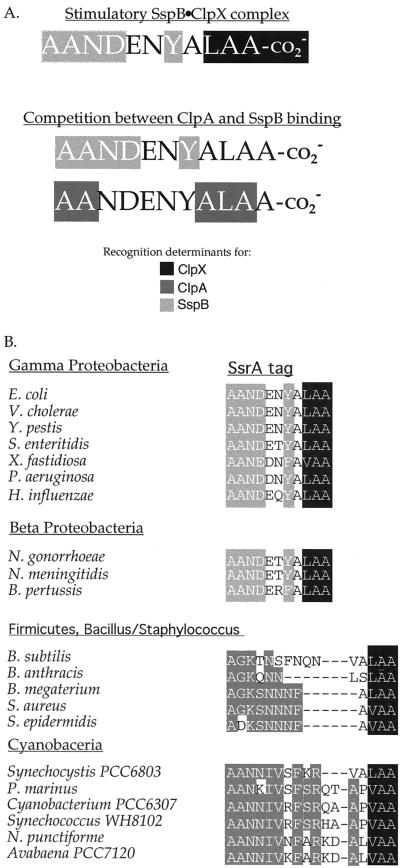
(A) Recognition determinants within the ssrA tag for ClpX, ClpA, and SspB. Recognition determinants for ClpX are highlighted in black, those for ClpA in dark gray, and those for SspB in light gray. (B) SsrA-degradation tags from different bacteria. The conserved SspB-binding determinants in the γ- and β-proteobacteria are highlighted in light gray. Shown are the predicted ssrA tag sequences from representative members of various families of bacteria. The conserved residues in the N-terminal regions of the ssrA tag in the other families are highlighted in dark gray. All sequenced γ and β proteobacteria have a predicted ssrA tag sequence that contains an acceptable SspB binding site with the exception of Buchnera sp., strain APS [tag sequence (A)ANNKQNYALAA]. Interestingly, this bacterium does not have a detectable ortholog of SspB. Of the bacteria listed, the following appear to have a ClpA ortholog, in addition to a ClpX: E. coli, Vibrio cholerae, Xylella fastidiosa, and Pseudomonas aeruginosa.

References

    1. Hochstrasser M. Annu Rev Genet. 1996;30:405–439. - PubMed
    1. Hershko A, Ciechanover A. Annu Rev Biochem. 1998;67:425–479. - PubMed
    1. Voges D, Zwickl P, Baumeister W. Annu Rev Biochem. 1999;68:1015–1068. - PubMed
    1. Gottesman S, Roche E, Zhou Y, Sauer R T. Genes Dev. 1998;12:1338–1347. - PMC - PubMed
    1. Tu G F, Reid G E, Zhang J G, Moritz R L, Simpson R J. J Biol Chem. 1995;270:9322–9326. - PubMed

Publication types

MeSH terms