. 2001 Oct;183(19):5709-17.
doi: 10.1128/JB.183.19.5709-5717.2001.

Genome of the bacterium Streptococcus pneumoniae strain R6

Affiliations

Genome of the bacterium Streptococcus pneumoniae strain R6

J Hoskins et al. J Bacteriol. 2001 Oct.

Abstract

Streptococcus pneumoniae is among the most significant causes of bacterial disease in humans. Here we report the 2,038,615-bp genomic sequence of the gram-positive bacterium S. pneumoniae R6. Because the R6 strain is avirulent and, more importantly, because it is readily transformed with DNA from homologous species and many heterologous species, it is the principal platform for investigation of the biology of this important pathogen. It is also used as a primary vehicle for genomics-based development of antibiotics for gram-positive bacteria. In our analysis of the genome, we identified a large number of new uncharacterized genes predicted to encode proteins that either reside on the surface of the cell or are secreted. Among those proteins there may be new targets for vaccine and antibiotic development.


Figures
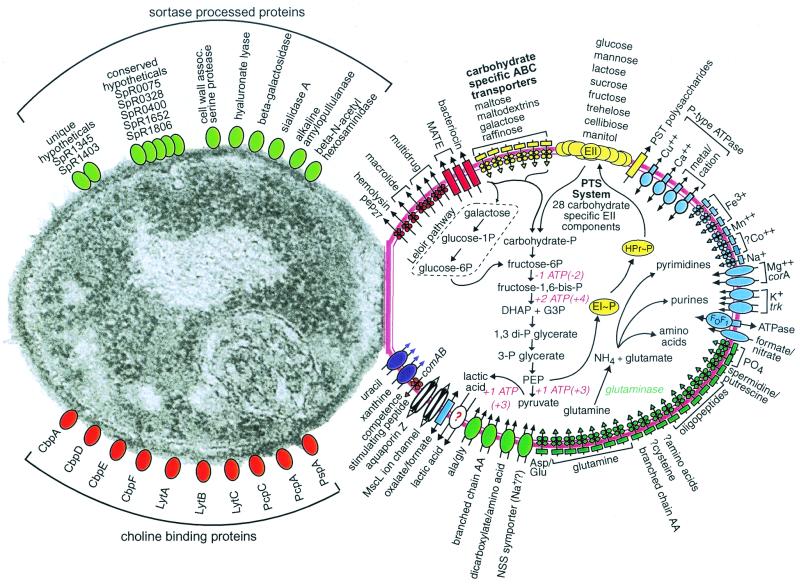
FIG. 1
FIG. 1
S. pneumoniae substrate transport, carbohydrate and glutamine metabolism, and selected categories of cell surface proteins. Transporters are shown in the cell on the right and are grouped by substrate specificity: multidrug and peptide exporters (red), carbohydrates (yellow), cations (blue), anions and amino acids (green), nucleosides, purines, and pyrimidines (purple), and other substrates (white). Question marks indicate uncertainty in the identity of the genes, direction of transport, or substrate. Permeases are drawn as rectangles; porins are drawn as cylinders; ATPases are drawn as ovals overlapping rectangles; other transporters are drawn as ovals; and ABC transporter elements are depicted as circles for nucleotide-binding proteins, diamonds for membrane-spanning permeases, and rectangles for the substrate-binding proteins. The 21 hypothetical ABC transporters for which no substrate could be predicted are not shown in the figure. Glutaminase, an enzyme we expected to find but could not identify, is listed in green italics. The glycolytic pathway leading to lactate is shown along with the pathway for glutamine to nitrogen-containing compounds. (Additional material on carbohydrate metabolism is at http://www.lilly.com/s.pneumoniae.) The ATP consumption and production values listed are for monosaccharides; ATP values for disaccharide catabolism are in parentheses. The choline-binding proteins are autolysin (LytA), endo-beta-N-acetylglucosaminidase (LytB), a surface protein involved in adherence and immunoglobulin A inactivation (CbpA), a putative lactoferrin-binding protein (PspA), and several surface proteins of unknown function (CbpD, PcpA, PcpC, PcpC1). Micrograph reprinted from reference with permission of the publisher.
FIG. 2
FIG. 2
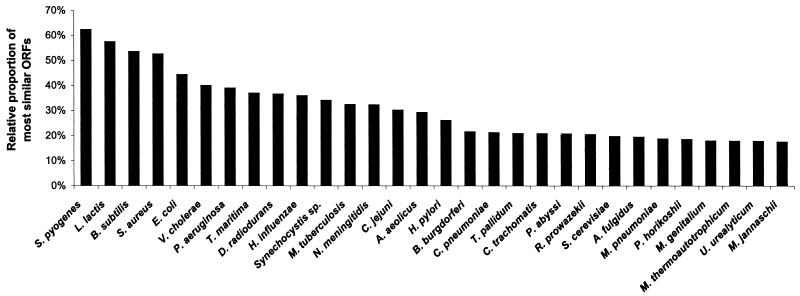
Comparison of the predicted S. pneumoniae R6 ORFs with those of other completely sequenced genomes. All S. pneumoniae R6 ORFs were searched against other genomes with BLAST2. The percentage of S. pneumoniae R6 ORFs with significant similarity (E ≤ 10−12) to predicted ORFs in the other genomes is shown.

References

    1. Auzat I, Capuy-Regaud S, LeBras G, DosSantos D, Ogunniyi A D, LeThonas I, Garel J-R, Paton G C, Tombe M C. The NADH oxidase of Streptococcus pneumoniae: its involvement in competence and virulence. Mol Microbiol. 1999;34:1018–1028. - PubMed
    1. Avery O T, MacLeod C, McCarty M. Studies on the chemical nature of the substance inducing transformation of the pneumococcal types. J Exp Med. 1944;79:137–158. - PMC - PubMed
    1. Baltz R H, Norris F H, Matsushima P, DeHoff B S, Rockey P, Porter G, Burgett S, Peery R, Hoskins J, Braverman L, Jenkins I, Solenberg P, Young M, McHenney M A, Skatrud P L, Rosteck P R., Jr DNA sequence sampling of the Streptococcus pneumoniae genome to identify novel targets for antibiotic development. Microb Drug Resist. 1998;4:1–9. - PubMed
    1. Boyd D A, Cvitikovitch D G, Bleiweis A S, Kiriukhin M Y, Debabov D V, Neuhaus F C, Hamilton I R. Defects in d-alanyl-lipoteichoic acid synthesis in Streptococcus mutans results in acid sensitivity. J Bacteriol. 2000;182:6055–6065. - PMC - PubMed
    1. Briles D E, Hollingshead S, Brooks-Walter A, Nabors G S, Ferguson L, Schilling M, Gravenstein S, Braun P, King J, Swift A. The potential to use PspA and other pneumococcal proteins to elicit protection against pneumococcal infection. Vaccine. 2000;18:1707–1711. - PubMed

Publication types

MeSH terms

Substances

Associated data