


Comment
doi: 10.1172/JCI13714.
Turning down insulin signaling
Affiliations
- PMID: 11544268
- PMCID: PMC209386
- DOI: 10.1172/JCI13714
Item in Clipboard
Comment
Turning down insulin signaling
J Clin Invest.
2001 Sep.
No abstract available
Figures
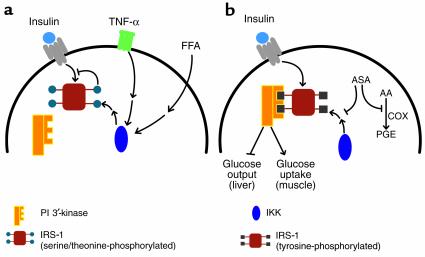
Effect of salicylates on insulin signaling during insulin resistance. (a) Normally, the occupied insulin receptor phosphorylates scaffold proteins, such as the IRS-1, on critical tyrosine residues. However, in insulin-resistant states, a number of agents, such as the cytokine TNF-α or circulating FFAs, lead through intermediary signaling pathways to the activation of IKK, which in turn indirectly increases the number of phosphorylated serine and threonine residues (indicated by blue circles) on IRS-1. This modification blocks the tyrosine phosphorylation and converts IRS-1 into an insulin receptor inhibitory protein. (b) In the presence of salicylates, IKK activity is inhibited, reducing the IRS-1 serine/threonine phosphorylation and allowing IRS-1 to be phosphorylated on tyrosine. These phosphorylated tyrosine residues (black squares) serve as binding sites for a number of signaling molecules, most importantly PI 3′-kinase, which initiate signaling pathways regulating metabolism. Aspirin (ASA) also inhibits cyclooxygensases (COX) to prevent the generation of inflammatory prostaglandins (PGE) from arachidonic acid (AA) in a pathway unrelated to the effects of the drug on insulin action.
Comment on
-
Prevention of fat-induced insulin resistance by salicylate.J Clin Invest. 2001 Aug;108(3):437-46. doi: 10.1172/JCI11559. J Clin Invest. 2001. PMID: 11489937 Free PMC article.
References
-
- King H, Rewers M. Global estimates for prevalence of diabetes mellitus and impaired glucose tolerance in adults. WHO Ad Hoc Diabetes Reporting Group. Diabetes Care. 1993;16:157–177. - PubMed
-
- Harris MI, et al. Prevalence of diabetes, impaired fasting glucose, and impaired glucose tolerance in US adults. The Third National Health and Nutrition Examination Survey, 1988-1994. Diabetes Care. 1998;21:518–524. - PubMed
-
- Economic consequences of diabetes mellitus in the U.S. in 1997. American Diabetes Association. Diabetes Care. 1998;21:296–309. - PubMed
-
- Yuan, M., et al. 2001. Reversal of obesity- and diet-induced insulin resistance with salicylates or targeted disruption of IKKβ. Science. In press. - PubMed
Publication types
MeSH terms
Substances
LinkOut - more resources
Full Text Sources
Other Literature Sources
Medical
