. 2001 Sep;108(5):669-78.
doi: 10.1172/JCI12346.

Tumor-specific immunity and antiangiogenesis generated by a DNA vaccine encoding calreticulin linked to a tumor antigen

Affiliations

Tumor-specific immunity and antiangiogenesis generated by a DNA vaccine encoding calreticulin linked to a tumor antigen

W F Cheng et al. J Clin Invest. 2001 Sep.

Abstract

Antigen-specific cancer immunotherapy and antiangiogenesis have emerged as two attractive strategies for cancer treatment. An innovative approach that combines both mechanisms will likely generate the most potent antitumor effect. We tested this approach using calreticulin (CRT), which has demonstrated the ability to enhance MHC class I presentation and exhibit an antiangiogenic effect. We explored the linkage of CRT to a model tumor antigen, human papilloma virus type-16 (HPV-16) E7, for the development of a DNA vaccine. We found that C57BL/6 mice vaccinated intradermally with CRT/E7 DNA exhibited a dramatic increase in E7-specific CD8(+) T cell precursors and an impressive antitumor effect against E7-expressing tumors compared with mice vaccinated with wild-type E7 DNA or CRT DNA. Vaccination of CD4/CD8 double-depleted C57BL/6 mice and immunocompromised (BALB/c nu/nu) mice with CRT/E7 DNA or CRT DNA generated significant reduction of lung tumor nodules compared with wild-type E7 DNA, suggesting that antiangiogenesis may have contributed to the antitumor effect. Examination of microvessel density in lung tumor nodules and an in vivo angiogenesis assay further confirmed the antiangiogenic effect generated by CRT/E7 and CRT. Thus, cancer therapy using CRT linked to a tumor antigen holds promise for treating tumors by combining antigen-specific immunotherapy and antiangiogenesis.


Figures
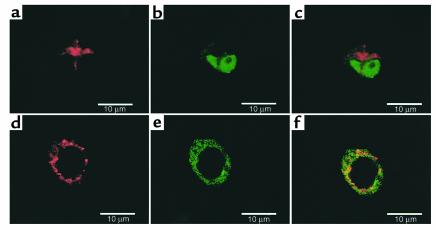
Figure 1
Figure 1
Confocal fluorescent microscopy to demonstrate the expression and distribution of E7 and chimeric CRT/E7 proteins. The 293 Db,Kb cells were transfected with pcDNA3-E7/GFP (ac) or pcDNA3- CRT/E7/GFP DNA (df). Immunofluorescent staining was performed as described in Methods. For the detection of GFP protein, green fluorescence was noted (b and e). For the detection of endogenous calnexin protein, red fluorescence was observed (a and d). Controls omitting primary Ab’s did not demonstrate specific red fluorescence (data not shown). Colocalization of GFP and calnexin was demonstrated by the yellow color in the combined image (c and f).
Figure 2
Figure 2
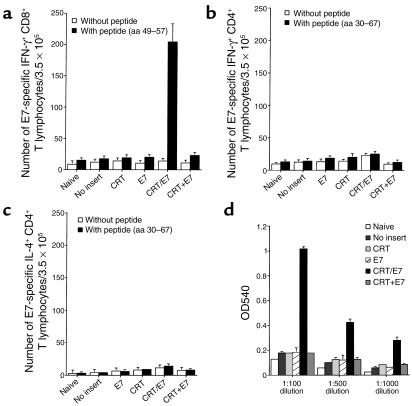
Immunological profile of vaccinated mice using intracellular cytokine staining and ELISA. Mice were immunized and splenocytes were prepared as described in Methods. The number of (a) IFN-γ–secreting CD8+ T cell precursors, (b) IFN-γ–secreting CD4+ T cells, and (c) IL-4–secreting CD4+ T cells in the presence (filled columns) or absence (open columns) of the corresponding E7 peptide (aa 49-57 for CD8, aa 30-67 for CD4) was analyzed using flow cytometry. Data are expressed as mean number of IFN-secreting T cells per 3 × 10⁵ splenocytes ± SEM. (d) ELISA demonstrates E7-specific Ab’s in mice vaccinated with various DNA vaccines. The results from the 1:100, 1:500, and 1:1,000 dilution are presented, showing mean absorbance (OD 450 nm) ± SEM. The data collected from all of the above experiments are from one representative experiment of two performed.
Figure 3
Figure 3
CTL assays to demonstrate enhanced presentation of E7 through the MHC class I pathway in cells transfected with CRT/E7 DNA and in bone marrow–derived DCs pulsed with cell lysates containing chimeric CRT/E7 protein. (a) CTL assays with various E/T ratios (E/T = 1:1, 3:1, 9:1, 27:1) were performed as described in Methods. The 293 Db,Kb cells transfected with various DNA constructs were used as target cells while Db-restricted E7-specific CD8+ T cells were used as effector cells. (b) CTL assays were performed at a fixed E/T ratio of 9:1 using bone marrow–derived DCs pulsed with cell lysates from 293 Db,Kb cells transfected with various DNA constructs at different concentrations as target cells and Db-restricted E7-specific CD8+ T cells as effector cells. The results presented in this figure are from one representative experiment of two performed.
Figure 4
Figure 4
In vivo tumor protection experiments in mice vaccinated with various DNA vaccines and in vivo Ab depletion experiments in mice vaccinated with CRT/E7. (a) Mice were immunized with various DNA vaccines and challenged as described in the Methods to assess the antitumor effect generated by each DNA vaccine. (b) Mice were immunized with CRT/E7 DNA and challenged with TC-1 tumor cells to determine the effect of lymphocyte subsets on the potency of the CRT/E7 DNA vaccine. CD4, CD8, and NK1.1 depletions were initiated 1 week before tumor challenge and lasted 40 days after tumor challenge. The data from the Ab depletion experiments shown here are from one representative experiment of two performed.
Figure 5
Figure 5
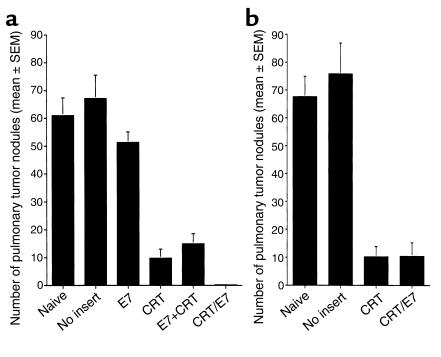
In vivo tumor treatment experiments in C57BL/6 mice and C57BL/6 mice depleted of both CD4+ and CD8+ T cells that are treated with various DNA constructs. Mice were challenged and subsequently treated with various DNA vaccines at a high therapeutic dose as described in Methods. (a) Tumor treatment experiments in C57BL/6 mice. (b) Tumor treatment experiments in C57BL/6 mice depleted of both CD4+ and CD8+ T cells. The data are expressed as mean number of pulmonary lung nodules ± SEM. Data shown are from one representative experiment of two performed.
Figure 6
Figure 6
In vivo tumor treatment experiments to compare the antitumor effect generated by CRT and CRT/E7 DNA vaccines in nude mice. (a) Tumor treatment experiments in nude (BALB/c nu/nu) mice. Mice were intravenously challenged with TC-1 tumor cells and treated with various DNA vaccines as described in Methods. The mean number of pulmonary tumor nodules (± SEM) shown here is from one representative experiment of two performed. (b) Representative gross pictures of pulmonary tumors in each vaccinated group.
Figure 7
Figure 7
Determination of the MVD of pulmonary tumor nodules in DNA-treated nude mice. Immunohistochemical labeling and microvessel counts were performed as described in Methods. (a) The mean MVD is shown for each of the vaccination groups. (b) Representative photographs of immunohistochemical labeling in sections from lung nodules obtained from different vaccinated nude mice. Positive labeling of intratumoral microvessels is indicated with arrows.
Figure 8
Figure 8
In vivo angiogenesis assay using Matrigel to characterize the antiangiogenic effect mediated by treatment with various DNA constructs. Mice were treated with various DNA constructs and injected with Matrigel as described in Methods. Nine days later, mice were euthanized, and Matrigel plugs were resected. (a) Matrigel hemoglobin content using the Drabkin method. The mean hemoglobin content (± SEM) shown here is from one representative experiment of two performed. (b) Mean MVD in Matrigel samples from each vaccination group. (c) Representative photographs of sections of Matrigel samples from each vaccination group (Giemsa stain, ×400).

References

    1. Boon T, Cerottini JC, Van den Eynde B, van der Bruggen P, Van Pel A. Tumor antigens recognized by T lymphocytes. Annu Rev Immunol. 1994;12:337–365. - PubMed
    1. Chen CH, Wu TC. Experimental vaccine strategies for cancer immunotherapy. J Biomed Sci. 1998;5:231–252. - PubMed
    1. Folkman J. Angiogenesis: initiation and control. Ann NY Acad Sci. 1982;401:212–227. - PubMed
    1. Hanahan D, Folkman J. Patterns and emerging mechanisms of the angiogenic switch during tumorigenesis. Cell. 1996;86:353–364. - PubMed
    1. Nash PD, Opas M, Michalak M. Calreticulin: not just another calcium-binding protein. Mol Cell Biochem. 1994;135:71–78. - PubMed

Publication types

MeSH terms