. 2001 Sep;108(5):733-7.
doi: 10.1172/JCI11775.

Effect of triiodothyronine on mitochondrial energy coupling in human skeletal muscle

Affiliations

Effect of triiodothyronine on mitochondrial energy coupling in human skeletal muscle

V Lebon et al. J Clin Invest. 2001 Sep.

Abstract

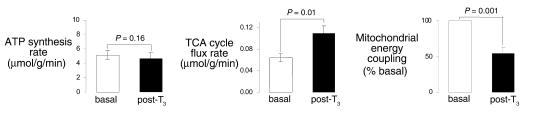
The mechanism underlying the regulation of basal metabolic rate by thyroid hormone remains unclear. Although it has been suggested that thyroid hormone might uncouple substrate oxidation from ATP synthesis, there are no data from studies on humans to support this hypothesis. To examine this possibility, we used a novel combined (13)C/(31)P nuclear magnetic resonance (NMR) approach to assess mitochondrial energy coupling in skeletal muscle of seven healthy adults before and after three days of triiodothyronine (T(3)) treatment. Rates of ATP synthesis and tricarboxylic acid (TCA) cycle fluxes were measured by (31)P and (13)C NMR spectroscopy, respectively, and mitochondrial energy coupling was assessed as the ratio. Muscle TCA cycle flux increased by approximately 70% following T(3) treatment. In contrast, the rate of ATP synthesis remained unchanged. Given the disproportionate increase in TCA cycle flux compared with ATP synthesis, these data suggest that T(3) promotes increased thermogenesis in part by promoting mitochondrial energy uncoupling in skeletal muscle.


Figures
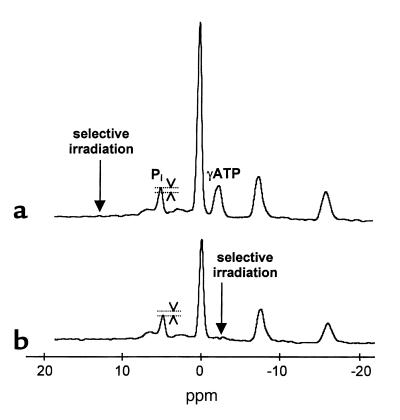
Figure 1
Figure 1
Principle of ATP synthesis rate measurement by 31P NMR spectroscopy. (a) Control spectrum in one volunteer: the saturation pulse is applied symmetrically to the γATP Larmor frequency. (b) Spectrum with γATP saturation acquired in the same volunteer (NS = 128). Subtraction of spectrum (b) from (a) gives the fraction of Pi involved in the synthesis of ATP, as shown on the Pi peak. ppm, parts per million.
Figure 2
Figure 2
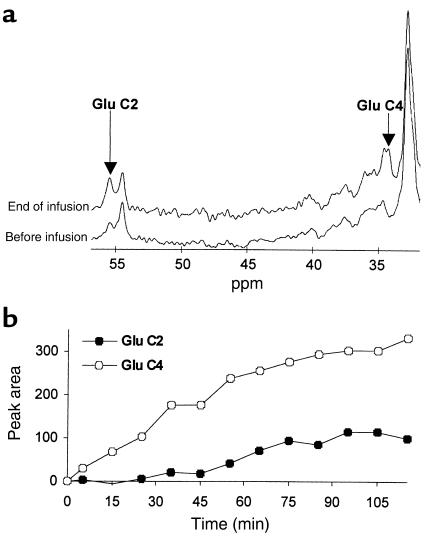
13C NMR data. (a) 13C spectra acquired in a volunteer before and at the end of the [2-13C]acetate infusion. (b) Time course of glutamate C4 and glutamate C2 peak areas during the same experiment. Glutamate C4 appears soon after the beginning of the [2-13C]acetate infusion. The increase in glutamate C2 is delayed in comparison to that of glutamate C4, reflecting the extra turn of the TCA cycle required to randomize the 13C-labeled carbon into this position.
Figure 3
Figure 3
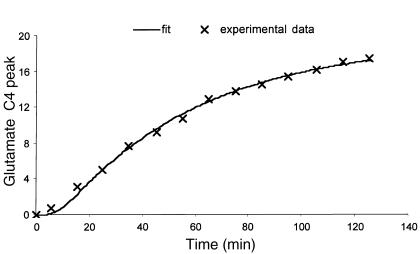
Typical model fit of the 13C NMR data of glutamate C4 in skeletal muscle (R2 = 0.93).
Figure 4
Figure 4
Muscle TCA cycle and ATP synthesis fluxes measured in seven volunteers before (basal) and after T3 treatment (post-T3). Thyroid hormone induces a significant increase in muscle TCA cycle flux, whereas the rate of ATP synthesis does not show any significant change. The resulting ATP/TCA ratio (normalized to the basal state) reflects a decrease in mitochondrial energy coupling following T3 treatment.

References

    1. Magnus-Levi A. Uber den respiratorischen Gaswechsel unter dem Einfluss des Thyroidea sowie unter vershiedenen pathalogishen Zustanden. Berl Klin Wochenschr. 1895;34:650.
    1. Izmail-Beigi F, Edelman IS. Mechanism of thyroid calorigenesis: role of active sodium transport. Proc Natl Acad Sci USA. 1970;67:1071–1078. - PMC - PubMed
    1. Newsholme EA, Crabtree B. Substrate cycles in metabolic regulation and in heat generation. Biochem Soc Symp. 1976;41:61–109. - PubMed
    1. Shulman GI, Ladenson PW, Wolfe MH, Ridgway EC, Wolfe RR. Substrate cycling between gluconeogenesis and glycolysis in euthyroid, hypothyroid, and hyperthyroid man. J Clin Invest. 1985;76:757–764. - PMC - PubMed
    1. Gustafsson R, Tata JR, Lindberg O, Ernster L. The relationship between the structure and activity of rat skeletal muscle mitochondria after thyroidectomy and thyroid hormone treatment. J Cell Biol. 1965;26:555–578. - PMC - PubMed

Publication types