. 2001:1:11.
doi: 10.1186/1472-6793-1-11. Epub 2001 Aug 17.

1,25-Dihydroxyvitamin D3 increases the expression of the CaT1 epithelial calcium channel in the Caco-2 human intestinal cell line

Affiliations

1,25-Dihydroxyvitamin D3 increases the expression of the CaT1 epithelial calcium channel in the Caco-2 human intestinal cell line

R J Wood et al. BMC Physiol. 2001.

Abstract

Background: The active hormonal form of vitamin D (1,25-dihydroxyvitamin D) is the primary regulator of intestinal calcium absorption efficiency. In vitamin D deficiency, intestinal calcium absorption is low leading to an increased risk of developing negative calcium balance and bone loss. 1,25-dihydroxyvitamin D has been shown to stimulate calcium absorption in experimental animals and in human subjects. However, the molecular details of calcium transport across the enterocyte are not fully defined. Recently, two novel epithelial calcium channels (CaT1/ECaC2 and ECaC1/CaT2) have been cloned and suggested to be important in regulating intestinal calcium absorption. However, to date neither gene has been shown to be regulated by vitamin D status. We have previously shown that 1,25-dihydroxyvitamin stimulates transcellular calcium transport in Caco-2 cells, a human intestinal cell line.

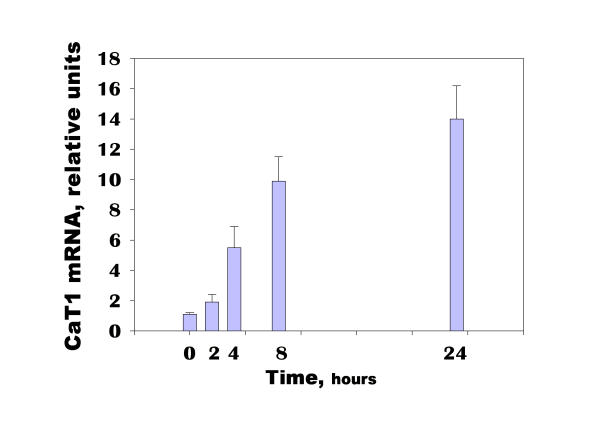
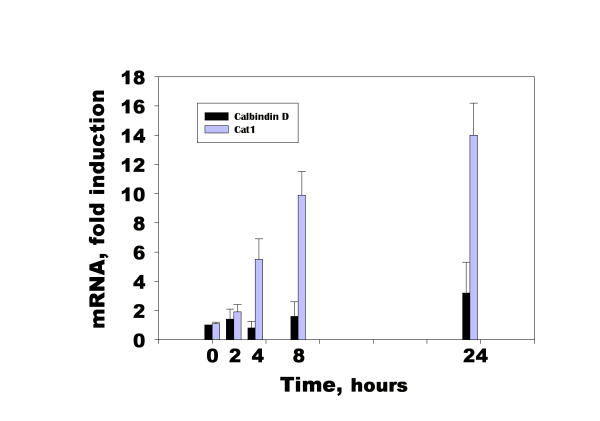
Results: In the current study, we have demonstrated that Caco-2 cells express low but detectable levels of CaT1 mRNA in the absence of 1,25-dihydroxyvitamin D treatment. CaT1 mRNA expression is rapidly up regulated (4-fold increase at 4 h and 10-fold at 24 h) by treatment with 1,25-dihydroxyvitamin D (10(-7) moles/L). Moreover, the increase in CaT1 mRNA expression preceded by several hours the vitamin D induction of calbindin D9K, a putative cytosolic calcium transport protein.

Conclusion: These observations are the first to demonstrate regulation of CaT1 expression by vitamin D and are consistent with a new model of intestinal calcium absorption wherein vitamin D-mediated changes in brush border membrane CaT1 levels could be the primary gatekeeper regulating homeostatic modulation of intestinal calcium absorption efficiency.


Figures
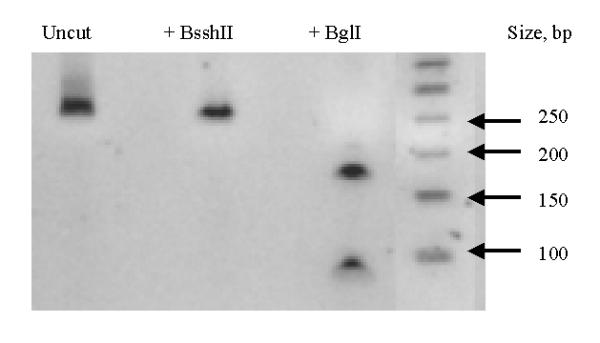
Figure 1
Figure 1
Restriction Enzyme Digest of PCR Product From Caco-2 Cells. The amplified PCR product for the apical calcium transporter from Caco-2 cells (see text) was digested with Bgl1 or BssHII restriction enzymes. Digestion with Bgl1 resulted in the generation of two smaller appropriately sized products (180 bp and 80 bp) as would be expected only if the PCR product was CaT1 due to the presence of this restriction enzyme cut site only in CaT1 but not ECaC1 in the region amplified (GenBank acc. no. AF365927 nucleotide location 545–803). BssHII digestion did not result in any smaller bands being observed. Thus was expected since this enzyme was not predicted to cut either CaT1 or ECaC1 (GenBank acc. no. AF304464) in the region of interest and thereby could serve as a negative control to exclude the possibility that nonspecific fragmentation of under the restriction digest conditions.
Figure 2
Figure 2
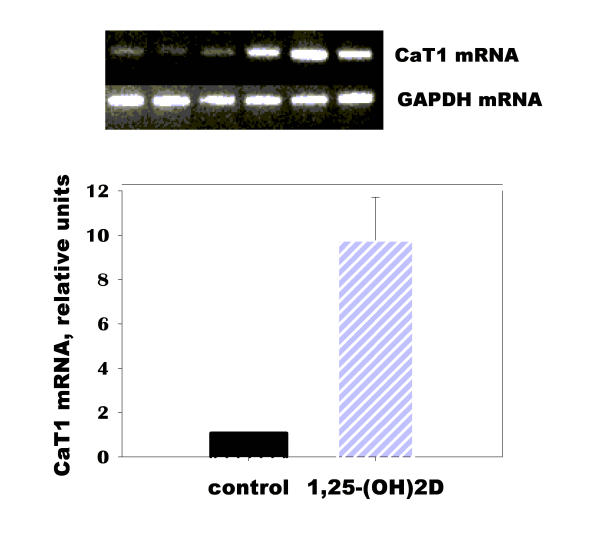
1,25-Dihydroxyvitamin D Up Regulates The Expression Of CaT1 mRNA In Caco-2 Cells. Cells were treated with ethanol vehicle or 1,25-dihydroxyvitamin D (100 nM, 10 -7 mol/L) for 24 h. Total RNA was harvested and CaT1 mRNA (28 cycles) and GAPDH mRNA (21 cycles) were determined by RT-PCR. The PCR products were electrophoresed on a 2% agarose gel and stained with ethidium bromide for visualization and digital capture. The upper picture in the illustration shows the CaT1 PCR products from 6 individual wells of a single experiment (3 control and 3 + 1,25-dihydroxyvitamin D). CaT1 expression in the gel has been juxtaposed on top of the corresponding GAPDH expression. GAPDH is a housekeeping gene used to standardize CaT1 mRNA expression. Low levels of CaT1 mRNA are discernable in the absence of vitamin D treatment and the up regulating effect of 1,25-dihydroxyvitamin D by 24 h of treatment is clearly evident. The bar graph shows the combined mean (SEM) effect of 1,25-dihydroxyvitamin D on CaT1 expression normalized for GAPDH from 10 independent studies. 1,25-dihydroxyvitamin D treatment caused a significant (p < 0.001) 10-fold increase in CaT1 mRNA expression compared to vehicle treated control cells.
Figure 3
Figure 3
Early Temporal Response of CaT1 mRNA to 1,25-dihydroxyvitamin D in Caco-2 Cells. Caco-2 cells were treated with 1,25-dihydroxyvitamin D (10 -7 mol/L) for 0, 2, 4, 8 or 24 h. The bar graph illustrates the mean (SEM) fold-increase in CaT1 mRNA expression at each of the time points from 6 independent time course studies. There was a significant (p < 0.0001, ANOVA) time-dependent induction of CaT1 mRNA expression by 1,25-dihydroxyvitamin D with evidence of increased induction as early as 2 h and clear and progressive up regulation of CaT1 expression between 4 h and 24 h.
Figure 4
Figure 4
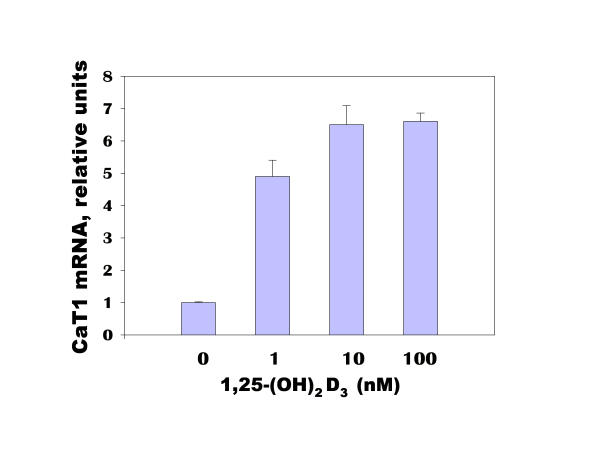
Effect of 1,25-dihydroxyvitamin D Dose on CaT1 mRNA in Caco-2 cells. Cells were treated for 24 h with increasing doses (1–100 nM) of 1,25-dihydroxyvitamin D. The mean effect of 1,25-dihydroxyvitamin D (n= 3 studies) on CaT1 mRNA was evident at the lowest dose (10 -9 mol/L) investigated. In these experiments there was a further increase in expression at 10 -8 mol/L 1,25-dihydroxyvitamin D, but no further increase in expression at a 10-fold higher dose of 1,25-dihydroxyvitamin D.
Figure 5
Figure 5
Comparison of the Time Course of CaT1 mRNA and Calbindin D 9K mRNA Induction by 1,25-dihydroxyvitamin D in Caco-2 Cells. Caco-2 cells were treated with 1,25-dihydroxyvitamin D (10 -7 mol/L) for 0, 2, 4, 8 or 24 h. The bar graph indicates the mean (SEM) fold-increase in CaT1 mRNA and calbindin D mRNA expression at each of the time points. The early induction of CaT1 mRNA by 4 h and 8 h following 1,25-dihydroxyvitamin D treatment is not evident for calbindin D mRNA, which did not increase above control until the 24 h time point. The data for CaT1 is the same as presented in Figure 3.

References

    1. Heaney RP, Recker RR. Distribution of calcium absorption in middle-aged women. Am J Clin Nutr. 1986;43:299–305. - PubMed
    1. Ensrud KE, Duong T, Cauley JA, Heaney RP, Wolf RL, Harris E, Cummings SR. Low fractional calcium absorption increases the risk for hip fracture in women with low calcium intake. Study of Osteoporotic Fractures Research Group. Ann Intern Med. 2000;132:345–353. - PubMed
    1. Norman A. Intestinal calcium absorption: a vitamin D-hormone-mediated adaptive response. Am J Clin Nutr. 1990;51:290–300. - PubMed
    1. Nemere I, Dormanen M, Hammond M, Okamura W, Norman A. Identification of a specific binding protein for 1 alpha,25-dihydroxyvitamin D in the basal-lateral membranes of chick intestinal epithelium and relationship to transcaltachia. J Biol Chem. 1994;269:23750–23756. - PubMed
    1. Sitrin MD, Bissonnette M, Bolt MJ, Wali R, Khare S, Scaglione-Sewell B, Skarosi S, Brasitus TA. Rapid effects of 1,25(0H)2 vitamin D3 on signal transduction systems in colonic cells. Steroids. 1999;64:137–142. - PubMed

Publication types

LinkOut - more resources