. 2001 Sep 25;98(20):11691-6.
doi: 10.1073/pnas.191380698. Epub 2001 Sep 11.

Behavioral screening for cocaine sensitivity in mutagenized zebrafish

Affiliations

Behavioral screening for cocaine sensitivity in mutagenized zebrafish

T Darland et al. Proc Natl Acad Sci U S A. .

Abstract

Understanding the molecular basis of addiction could be greatly aided by using forward genetic manipulation to lengthen the list of candidate genes involved in this complex process. Here, we report that zebrafish exhibit cocaine-induced conditioned place preference. In a pilot screen of 18 F(2) generation families of mutagenized fish, we found three with abnormally low responses to cocaine. This behavior was inherited by the F(3) generation in a manner that suggests the abnormalities were because of dominant mutations in single genes. Performance profiles in secondary behavioral screens measuring visual dark-adaptation and learning suggest that the defects were the result of mutations in distinct genes that affect dopaminergic signaling in the retina and brain.


Figures
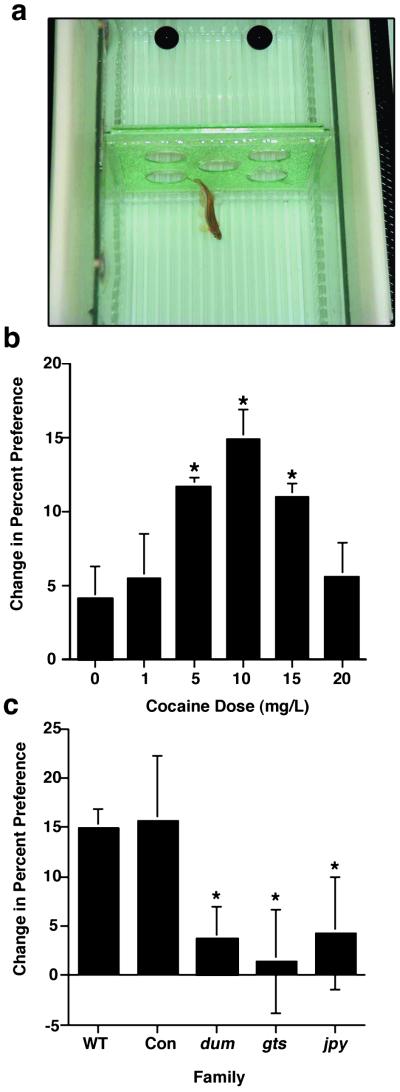
Figure 1
Figure 1
Cocaine-induced CPP in zebrafish. (a) An example of a test subject and apparatus used in these experiments. The response to cocaine is a decided shift in preference for the side of the apparatus in which the fish were exposed to cocaine. (b) This response was dose dependent with a maximal effect at 10 mg/liter. Values are averages of means from multiple experiments conducted at each dose (six families at 0 and 10 mg/liter, three families at the other doses, and a minimum of five fish tested per family). Values at 5, 10, and 15 were significantly higher than both untreated and lidocaine controls (*P < 0.05 by ANOVA). (c) F3 generation fish derived from mutagenized F2 families that showed lower conditioned place preference. Con was a control family derived from normal responders of the same family that produced dum. The F3 families dum, gts, and jpy all show lower cocaine-induced place preference than both wild-type families and the control family (*, P < 0.05 for each compared with wild-type untreated control fish by ANOVA). Error bars represent ± SEM.
Figure 2
Figure 2
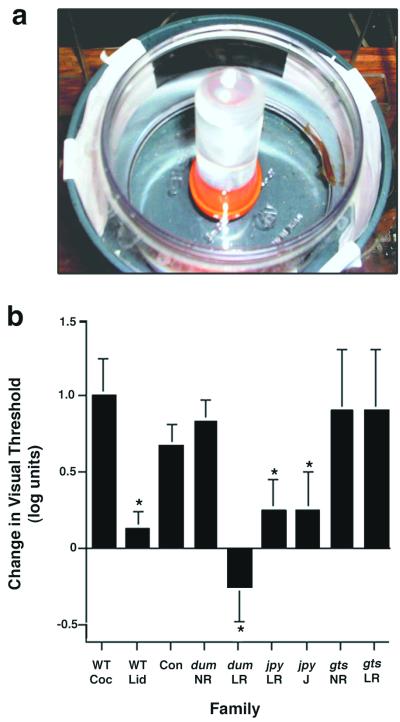
Cocaine partially inhibits dark-adaptation. Visual sensitivity was measured by observing the escape response of dark-adapted fish to varying levels of incident light. (a) The apparatus with a fish turning to avoid the moving black panel. (b) Cocaine induces a log-unit drop in visual sensitivity of dark-adapted wild-type fish, whereas lidocaine has no effect. Fish from the control family (Con) showed normal cocaine sensitivity. Fish from dum and jpy that showed normal cocaine-induced CPP (NR) also had normal sensitivity to the drug in the visual test. In contrast, fish from dum and jpy families that showed low cocaine-induced CPP (LR) were also insensitive to the visual effect of the drug. Also shown are “jumpy” fish from the jpy family (jpyJ) with undeterminable CPP but relative insensitivity to cocaine in the visual test. Fish from the gts family showing both normal and low cocaine-induced CPP (NR and LR) show normal sensitivity to the drug in the visual test (*, P < 0.05 when compared with wild-type fish treated with cocaine as measured by ANOVA, with a minimum of four fish from each group). Error bars represent ± SEM.
Figure 3
Figure 3
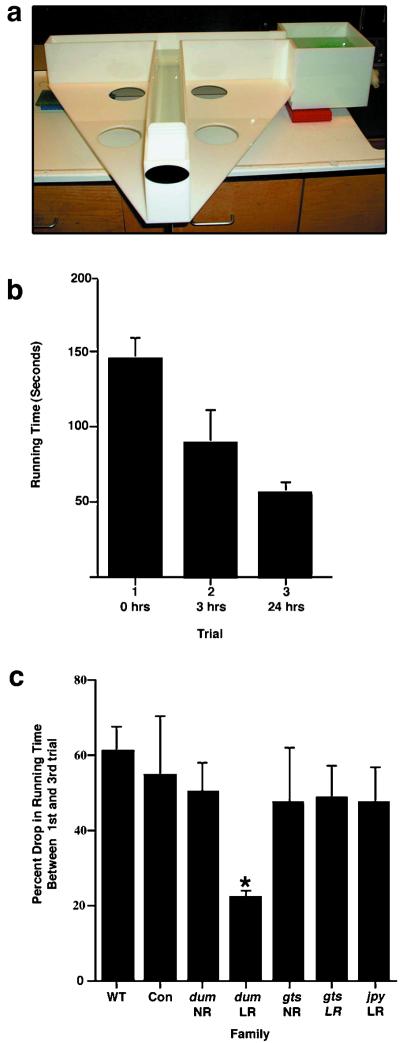
(a) Cognitive ability of zebrafish was tested by using a T-maze. (b) The time taken in seconds to find the reservoir for 20 wild-type fish was tested in three successive trials. The fish reduced their running time by an average of 60% by the third trial. The behavior in the T-maze of the F3 cocaine-insensitive families was tested. All of the families tested normally with the exception of the dum low-responding family members (dum LR) that displayed very poor learning (*, P < 0.5 compared with wild-type by ANOVA). A minimum of three fish was analyzed from each group, and values were not assigned for fish exhibiting “flunker” or “fast” behavior in their initial trial (see text). Error bars represent ± SEM.

References

    1. Mark T L, Woody G E, Juday T, Kleber H D. Drug Alcohol Depend. 2001;61:195–206. - PubMed
    1. Crabbe J C, Phillips T J, Buck K J, Cunningham C L, Belknap J K. Trends Neurosci. 1999;22:173–179. - PubMed
    1. Picciotto M R, Wickman K. Physiol Rev. 1998;78:1131–1163. - PubMed
    1. Bainton R J, Tsai L T Y, Singh C M, Moore M S, Neckameyer W S, Heberlein U. Curr Biol. 2000;10:187–194. - PubMed
    1. Solnica-Krezel L, Schier A F, Driever W. Genetics. 1994;136:1401–1420. - PMC - PubMed

Publication types

LinkOut - more resources