. 2001 Sep 25;98(20):11277-82.
doi: 10.1073/pnas.201250598. Epub 2001 Sep 11.

The S4-S5 linker couples voltage sensing and activation of pacemaker channels

Affiliations

The S4-S5 linker couples voltage sensing and activation of pacemaker channels

J Chen et al. Proc Natl Acad Sci U S A. .

Abstract

Voltage-gated channels are normally opened by depolarization and closed by repolarization of the membrane. Despite sharing significant sequence homology with voltage-gated K(+) channels, the gating of hyperpolarization-activated, cyclic-nucleotide-gated (HCN) pacemaker channels has the opposite dependence on membrane potential: hyperpolarization opens, whereas depolarization closes, these channels. The mechanism and structural basis of the process that couples voltage sensor movement to HCN channel opening and closing is not understood. On the basis of our previous studies of a mutant HERG (human ether-a-go-go-related gene) channel, we hypothesized that the intracellular linker that connects the fourth and fifth transmembrane domains (S4-S5 linker) of HCN channels might be important for channel gating. Here, we used alanine-scanning mutagenesis of the HCN2 S4-S5 linker to identify three residues, E324, Y331, and R339, that when mutated disrupted normal channel closing. Mutation of a basic residue in the S4 domain (R318Q) prevented channel opening, presumably by disrupting S4 movement. However, channels with R318Q and Y331S mutations were constitutively open, suggesting that these channels can open without a functioning S4 domain. We conclude that the S4-S5 linker mediates coupling between voltage sensing and HCN channel activation. Our findings also suggest that opening of HCN and related channels corresponds to activation of a gate located near the inner pore, rather than recovery of channels from a C-type inactivated state.


Figures
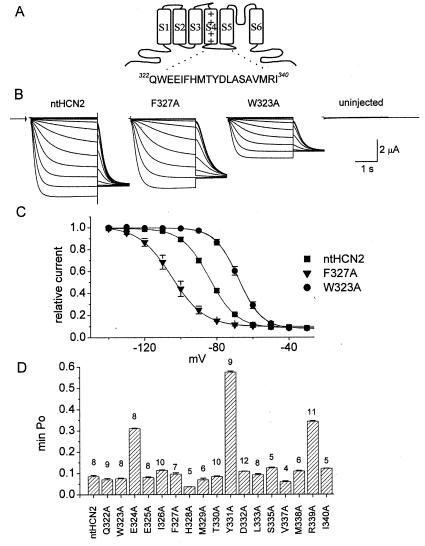
Figure 1
Figure 1
Alanine-scanning mutagenesis of the S4–S5 linker of ntHCN2 channel. (A) Schematic of a single HCN2 subunit showing location and amino acid sequence of the S4–S5 linker. (B) Representative whole-cell recordings of WT, F327A, and W323A ntHCN2 channel currents elicited with 3-s pulses, applied from a holding potential of −30 mV in 10-mV increments to potentials ranging from −140 to −30 mV. The tail currents were measured at −130 mV. Arrow indicates zero current level. (C) Voltage dependence of ntHCN2 channel activation. Currents recorded at −130 mV immediately after each test pulse were normalized to the largest current, then plotted as a function of test potential. The resulting data were fitted to a Boltzmann function to obtain the V1/2 and slope factor (k) for the relationship (see Table 1 for values). (D) Bar graph of min-Po for all S4–S5 linker Ala mutant channels. The number of oocytes is indicated above each bar.
Figure 2
Figure 2
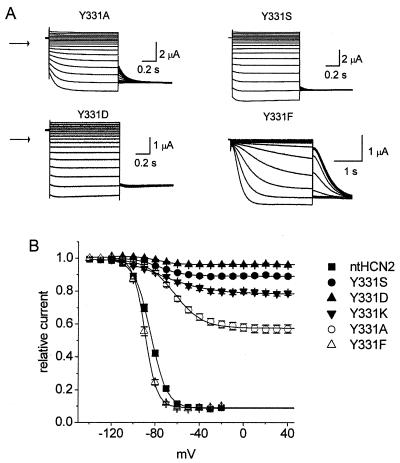
Mutation of Y331 disrupts ntHCN2 channel closure. (A) Representative current traces for Y331A, Y331S, Y331D, and Y331F ntHCN2 channels. Holding potential was 0 mV and test potentials were −120 to +40 mV for Y331A, Y331S, and Y331D channels. Holding potential was −30 mV and test potentials were −140 to −30 mV for Y331F channels. Arrow indicates zero current level. (B) Voltage dependence for activation of WT and Y331 mutant ntHCN2 channels. V1/2 and k for each relationship are shown in Table 2.
Figure 3
Figure 3
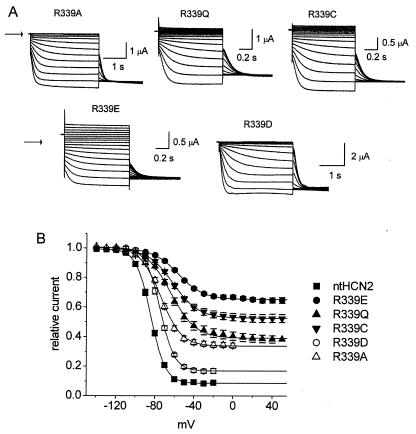
Effects of R339 mutations on ntHCN2 channel gating. (A) Representative current traces for R339A, R339Q, R339C, R339E, and R339D ntHCN2 channels. Holding potential was −30 mV and test potentials ranged from −140 to −30 mV for R339A and R339D. Holding potential was 0 mV and test potentials ranged from −120 to +40 mV for R339Q, R339C, and R339E ntHCN2 channels. Arrow indicates zero current level. (B) Voltage dependence for activation of WT and R339 mutant ntHCN2 channels. V1/2 and k for each relationship are shown in Table 2.
Figure 4
Figure 4
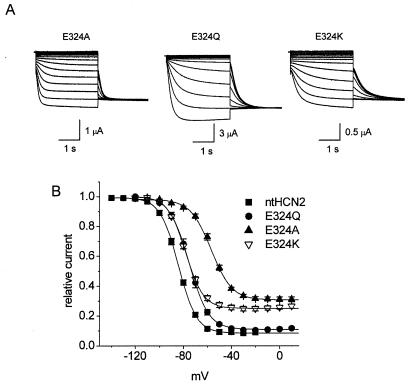
Effects of E324 mutations on ntHCN2 channel gating. (A) Representative current traces for E324A, E324Q, and E324K ntHCN2 channels. The holding potential was 0 mV and test potentials were from −140 to 0 mV for E324Q and −120 to 0 mV for E324A and E324K. Arrow indicates zero current level. (B) Voltage dependence for activation of WT and E324 mutant ntHCN2 channels. V1/2 and k for each relationship are shown in Table 2.
Figure 5
Figure 5
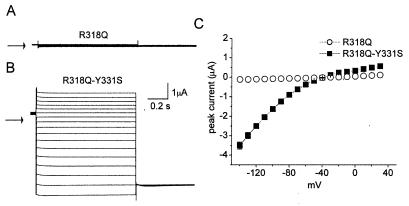
R318Q/Y331S ntHCN2 channels are constitutively open. (A) R318Q ntHCN2 channel currents were undetectable. (B) R318Q/Y331S ntHCN2 channel currents activate instantaneously and have no time-dependent component, unlike Y331S channel currents (Fig. 2A). Currents were elicited from a holding potential of −30 mV with 1-s pulses to potentials of −140 to +20 mV, applied in 10-mV increments. (C) Current–voltage relationships for R318Q and R318Q/Y331S HCN2 channel currents.

References

    1. DiFrancesco D, Noma A, Trautwein W. Pflügers Arch. 1979;381:271–279. - PubMed
    1. DiFrancesco D. Annu Rev Physiol. 1993;55:455–472. - PubMed
    1. Pape H-C. Annu Rev Physiol. 1996;58:299–327. - PubMed
    1. Ludwig A, Zong X, Jeglitsch M, Hofmann F, Biel M. Nature (London) 1998;393:587–591. - PubMed
    1. Santoro B, Liu D T, Yao H, Bartsch D, Kandel E R, Siegelbaum S A, Tibbs G R. Cell. 1998;93:717–729. - PubMed

Publication types

MeSH terms

LinkOut - more resources