. 2001 Nov;69(5):1127-33.
doi: 10.1086/323765. Epub 2001 Sep 10.

Arginine:glycine amidinotransferase deficiency: the third inborn error of creatine metabolism in humans

Affiliations

Arginine:glycine amidinotransferase deficiency: the third inborn error of creatine metabolism in humans

C B Item et al. Am J Hum Genet. 2001 Nov.

Abstract

Arginine:glycine amidinotransferase (AGAT) catalyzes the first step of creatine synthesis, resulting in the formation of guanidinoacetate, which is a substrate for creatine formation. In two female siblings with mental retardation who had brain creatine deficiency that was reversible by means of oral creatine supplementation and had low urinary guanidinoacetate concentrations, AGAT deficiency was identified as a new genetic defect in creatine metabolism. A homozygous G-A transition at nucleotide position 9297, converting a tryptophan codon (TGG) to a stop codon (TAG) at residue 149 (T149X), resulted in undetectable cDNA, as investigated by reverse-transcription PCR, as well as in undetectable AGAT activity, as investigated radiochemically in cultivated skin fibroblasts and in virus-transformed lymphoblasts of the patients. The parents were heterozygous for the mutant allele, with intermediate residual AGAT activities. Recognition and treatment with oral creatine supplements may prevent neurological sequelae in affected patients.


Figures

Figure  1
Figure 1
Metabolic pathway of creatine/phospho-creatine. CRTR, creatine transporter; CK, creatine kinase.
Figure  2
Figure 2
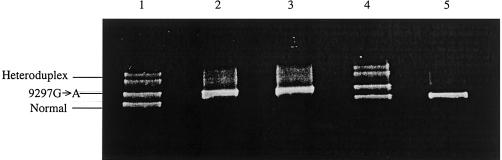
Identification of AGAT nonsense mutation in lymphoblasts of two female siblings and leukocytes of their parents, by DGGE analysis of exon 3. Lane 1, Father, genotype T149X/N. Lane 2, Patient 1, genotype T149X/T149X. Lane 3, Patient 2, genotype T149X/T149X. Lane 4, Mother, genotype T149X/N. Lane 5, Wild-type DNA from unaffected control, genotype N/N. DNA extraction from EBV-transfected lymphoblasts and cultivated fibroblasts was performed using guanidinhydrochloride/proteinase K (Nucleospin C+T kit [Machery Nagel]). PCR primers were designed to cover exons 1–9 and the adjoining introns of the AGAT gene. PCR reactions were carried out over 37 cycles with 2.5 U of Ampli-Taq Gold DNA polymerase (Perkin Elmer) in a Perkin-Elmer-Cetus DNA Thermal Cycler. DGGE analysis of PCR products was essentially performed as described by Greber-Platzer et al. (1997), after heteroduplex formation by loading 20 μl of sample onto an 8% polyacrylamide gel containing a 15%–55% or 25%–65% linearly increasing denaturing gradient (100% = 7 M urea and 40% (vol/vol) deionized formamide). Electrophoresis was performed at 160 V for 6 h in a 1× TAE buffer at 60°C, using a DCode system (Biorad). After electrophoresis, gels were stained in ethidium bromide and examined under ultraviolet illumination. DGGE analysis of exon 1 was not possible, because of its high melting temperature; therefore, direct sequencing of exon 1 was performed. In the patients, no aberrations from the normal sequence were found on exon 1.
Figure  3
Figure 3
Direct sequencing of PCR products showing putative sequence variations, as pointed out by DGGE analysis, was performed by double-stranded automated cycle sequencing of the PCR products on a ABI 370 sequencer (Applied Biosystems). a, Patients 1 and 2. b, Control. c, Parents.
Figure  4
Figure 4
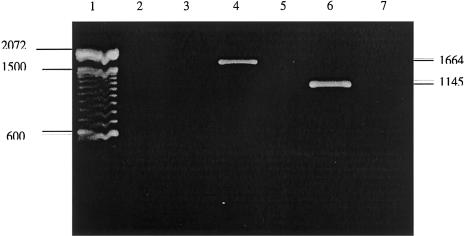
RT-PCR analysis to examine the expression of the T149X allele in lymphoblasts of both siblings. Lane 1, 100-bp DNA ladder. Lane 2, RT-PCR, patient 1. Lane 3, RT-PCR, patient 2. Lane 4, RT-PCR, unaffected control. Lane 5, Nested PCR, patient 1. Lane 6, Nested PCR, unaffected control. Lane 7, Nested PCR, patient 2. Total RNA extraction was performed from EBV-transfected lymphoblasts (Molecular Research Center, Inc.), using RNAzolB. A one step RT-PCR was performed using the Qiagen kit (Qiagen, Inc.). Two micrograms of the extracted RNA in aqueous solution was reverse transcribed in a volume of 50 μl containing 800 nM each of the AGAT specific primers on the 5′-UTR and 3′-UTR of the total RNA (forward primer: 5′-GAGCGACGCGGCCCAGAGGCCAGGAACATT-3′; reverse primer: 5′-CCTTTTGGAAAGAAAATTAAAAACAGAGGT-3′), 400 μM of each dNTP, 10 U of RNase inhibitor, 10 μl of 5× Qiagen buffer, and 2 μl RT-PCR enzyme mix, at 50°C for 30 min. A PCR activation step at 95°C for 15 min and 40 cycles of PCR consisting of denaturation at 94°C for 1 min, annealing at 65°C for 1 min, extension at 72°C for 1 min, followed by a final elongation at 72°C for 10 minutes were performed (PCR product 1,664 bp). In a second round of PCR, 35 cycles were performed in a PCR mixture containing 0.5 μl of PCR product from the first round of amplification, 400 nM of each nested primer on exons 1 and 9 (forward primer: 5′-ATGCTGCGGGTGCGGTGTCTGCGCGGCGGG-3′; reverse primer: 5′-ATCTTTTGAATTGGAACTTCATTGGCATCC-3′), 10 mM Tris-HCl, pH 8.3, 1.5 mM KCl, 2 mM MgCl2, 200 μM of each deoxyribonucleotide, and 2.5 U of AmpliTaq Gold DNA polymerase in a volume of 50 μl (PCR product 1,145 bp) . RT-PCR products were run on a 1% agarose gel and were visualized by ethidium bromide staining.

References

Electronic-Database Information

    1. GenBank, http://www.ncbi.nlm.nih.gov/Genbank/ (for AGAT genomic DNA [accession number 1432573] and AGAT mRNA [accession number S68805])
    1. Online Mendelian Inheritance in Man (OMIM), http://www.ncbi.nlm.nih.gov/Omim/ (for AGAT [MIM 602360], GAMT [MIM 601240], and X-linked creatine transporter [MIM 300036])

References

    1. Bianchi MC, Tosetti M, Fornai F, Alessandrì MG, Cipriani P, De Vito G, Canapicchi R (2000) Reversible brain creatine deficiency in two sisters with normal blood creatine level. Ann Neurol 47:511–513 - PubMed
    1. Bodamer OA, Bloesch SH, Stöckler-Ipsiroglu S, O'Brien WE (2001) Analysis of guanidinoacetate and creatine by isotope dilution electrospray tandem mass-spectrometry. Clin Chim Acta 308:173–178 - PubMed
    1. Cecil KM, Salomons G, Ball WS, Wong B, Chuck G, Verhoeven NM, Jakobs C, DeGrauw TJ (2001) Irreversible brain creatine deficiency with elevated serum and urine creatine: a creatine transporter defect? Ann Neurol 49:401–404 - PubMed
    1. Cotton RG (2000) Methods in clinical molecular genetics. Eur J Pediatr 159:S179–S182 - PubMed
    1. Cotton RGH, Scriver CR (1998) Proof of “disease causing” mutation. Hum Mutat 12:1–3 - PubMed

Publication types

MeSH terms