. 2001 Sep 25;98(20):11760-4.
doi: 10.1073/pnas.201390398. Epub 2001 Sep 18.

Disruption of Sur2-containing K(ATP) channels enhances insulin-stimulated glucose uptake in skeletal muscle

Affiliations

Disruption of Sur2-containing K(ATP) channels enhances insulin-stimulated glucose uptake in skeletal muscle

W A Chutkow et al. Proc Natl Acad Sci U S A. .

Abstract

ATP-sensitive potassium channels (K(ATP)) are involved in a diverse array of physiologic functions including protection of tissue against ischemic insult, regulation of vascular tone, and modulation of insulin secretion. To improve our understanding of the role of K(ATP) in these processes, we used a gene-targeting strategy to generate mice with a disruption in the muscle-specific K(ATP) regulatory subunit, SUR2. Insertional mutagenesis of the Sur2 locus generated homozygous null (Sur2(-/-)) mice and heterozygote (Sur2(+/-)) mice that are viable and phenotypically similar to their wild-type littermates to 6 weeks of age despite, respectively, half or no SUR2 mRNA expression or channel activity in skeletal muscle or heart. Sur2(-/-) animals had lower fasting and fed serum glucose, exhibited improved glucose tolerance during a glucose tolerance test, and demonstrated a more rapid and severe hypoglycemia after administration of insulin. Enhanced glucose use was also observed during in vivo hyperinsulinemic euglycemic clamp studies during which Sur2(-/-) mice required a greater glucose infusion rate to maintain a target blood glucose level. Enhanced insulin action was intrinsic to the skeletal muscle, as in vitro insulin-stimulated glucose transport was 1.5-fold greater in Sur2(-/-) muscle than in wild type. Thus, membrane excitability and K(ATP) activity, to our knowledge, seem to be new components of the insulin-stimulated glucose uptake mechanism, suggesting possible future therapeutic approaches for individuals suffering from diabetes mellitus.


Figures
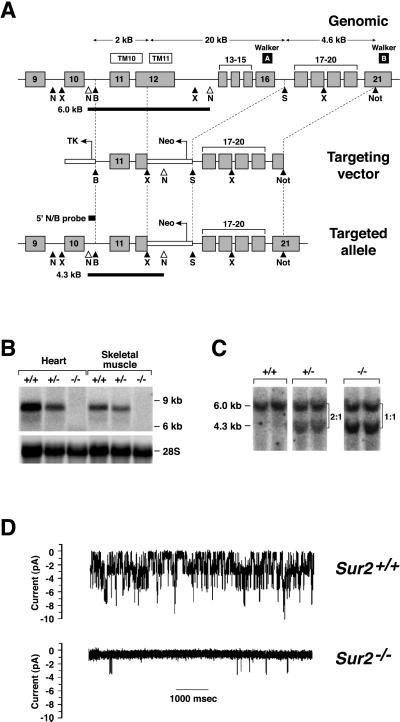
Figure 1
Figure 1
Generation and evaluation of SUR2 mutant mice. (A) Schematic of the mouse Sur2 targeting strategy. Exons are shaded in gray, and functional motifs are depicted above the exons. TM, predicted transmembrane spanning domain; Neo, neomyicin resistance gene; TK, thymidine kinase sequences. Walker A and B motifs are identified as black boxes. Restriction sites are indicated: B, BamHI; N, NcoI; S, Sse838; X, XbaI. Open triangles, the NcoI sites for Southern blot analysis. The probe used for Southern analysis is shown below the targeted allele. (B) Northern blot analysis of heart and skeletal muscle for Sur2+/+, Sur2+/, and Sur2−/− mice. (Upper) Autoradiogram of total RNA probed with a 32P-labeled Sur2 cDNA probe (bp 0–4231). (Lower) Ethidium bromide staining of the 28S ribosomal subunit. (C) Sur2 genotyping. NcoI-digested genomic DNA was hybridized with the 32P-labeled probe depicted in the schematic. +/+, wild type; +/−, heterozygote; −/−, homozygote mutant allele. The ratio of the labeled fragment signal intensities for wild-type-to-mutant alleles differentiates heterozygotes (2:1) from homozygotes (1:1). (D) Single-channel current recordings in open-cell-attached mode from ventricular myocytes of Sur2+/+ (upper tracing) and Sur2/ (lower tracing). At −40 mV, open current activity is shown as a downward deflection.
Figure 2
Figure 2
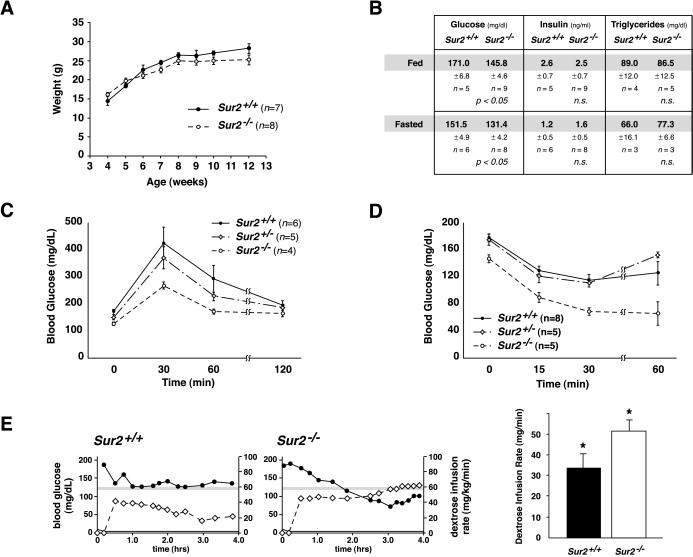
(A) Weight gain in male mice with unrestricted access to standard chow. Weights are expressed as mean values ± SEM. (B) Serum glucose, insulin, and triglyceride levels for wild-type and Sur2−/− mice between 10 and 12 weeks of age, both in the fasted and fed states. Significance of values between wild-type and Sur2−/− mice are indicated. n.s., nonsignificant. (C) Response of mice to i.p. injection of glucose (2 g/kg). Serum glucose levels at the indicated time points are expressed as mean values ± SEM (D) i.p. insulin tolerance test. Glucose levels were determined in mice injected i.p. with insulin (0.5 U/kg). Values are mean ± SEM (E) Representative hyperinsulinemic, euglycemic clamp assays from Sur2+/+ (Left) and Sur2−/− (Right) mice. Mice were infused with a constant rate of insulin and variable glucose as described in Materials and Methods. The closed circles represent the blood glucose levels, and the gray region represents the target blood glucose range. Open diamonds represent the rate of glucose infusion from a 20% glucose solution. A compilation of the rates of glucose infusion is summarized as a bar graph, with an n = 3 for Sur2+/+ mice and an n = 3 for Sur2−/− (Right) mice. *, P < 0.05.
Figure 3
Figure 3
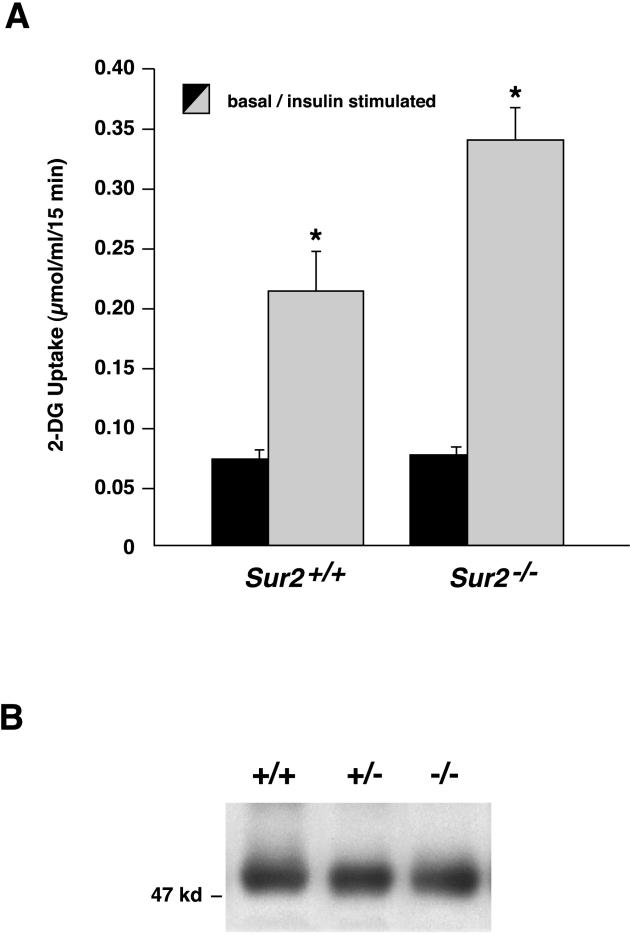
(A) In vitro 2-[14C]deoxyglucose uptake into the soleus muscle of male Sur2+/+ and Sur2−/− mice. Soleus muscles were incubated in the absence of insulin (basal transport) or high insulin (2,000 microunits/ml) before and during transport study. Bars represent mean ± SEM, n = 5, for each group. *, P < 0.04 vs. Sur2+/+ mice. (B) Representative Western blot of hindlimb skeletal muscle of Sur2+/+, Sur2 +/, and Sur2−/− mice. The microsomal fraction was separated by SDS/PAGE and probed with anti-GLUT4 antiserum. 2-DG, 2-[3H]deoxyglucose.

References

    1. Chutkow W A, Simon M C, Le Beau M M, Burant C F. Diabetes. 1996;45:1439–1445. - PubMed
    1. Seino S. Annu Rev Physiol. 1999;61:337–362. - PubMed
    1. Clement J P t, Kunjilwar K, Gonzalez G, Schwanstecher M, Panten U, Aguilar-Bryan L, Bryan J. Neuron. 1997;18:827–838. - PubMed
    1. Inagaki N, Gonoi T, Clement J P t, Namba N, Inazawa J, Gonzalez G, Aguilar-Bryan L, Seino S, Bryan J. Science. 1995;270:1166–1170. - PubMed
    1. Chutkow W A, Makielski J C, Nelson D J, Burant C F, Fan Z. J Biol Chem. 1999;274:13656–13665. - PubMed

Publication types

MeSH terms