. 2001 Sep;134(2):333-42.
doi: 10.1038/sj.bjp.0704264.

Inhibitory action of nociceptin/orphanin FQ on functionally different thalamic neurons in urethane-anaesthetized rats

Affiliations

Inhibitory action of nociceptin/orphanin FQ on functionally different thalamic neurons in urethane-anaesthetized rats

D Albrecht et al. Br J Pharmacol. 2001 Sep.

Abstract

1. In this study we administered nociceptin/orphanin FQ (NC) ionotophoretically onto neurons located in functionally distinct thalamic structures of urethane-anesthetized rats. Extracellular single unit recordings were made in the medial and lateral ventroposterior nucleus, posterior thalamic nucleus, zona incerta, lateral posterior nucleus, laterodorsal nucleus, ventrolateral nucleus and reticular nucleus. 2. NC decreased the firing rate in 60% of thalamic neurons. This decrease in firing rate was accompanied by a significant reduction in the number of high threshold bursts. 3. In about 20% of the neurons NC increased the firing rate. In most cells NC-induced increases in discharge rate could be blocked by the GABA(A) receptor antagonists bicuculline and SR 95531. 4. The NC receptor ligands [Phe(1)Psi(CH(2)-NH)Gly(2)] nociceptin(1-13)NH(2), Ac-RYYRIK-NH(2) and [Nphe(1)]NC(1-13)NH(2) were also evaluated. All these peptides inhibited NC-induced changes in firing rate. In addition, in some neurons where NC inhibited firing, [Nphe(1)]NC(1-13)NH(2) and Ac-RYYRIK-NH(2) elicited per se an increase in firing rate, suggesting the existence of tonic innervation of thalamic neurons by NC-containing fibres. 5. In NC-inhibited neurons nocistatin induced a significant increase in firing rate. 6. The present study demonstrated that NC regulates various thalamic nuclei related not only to somatosensory, but also to the visual and motor functions.


Figures
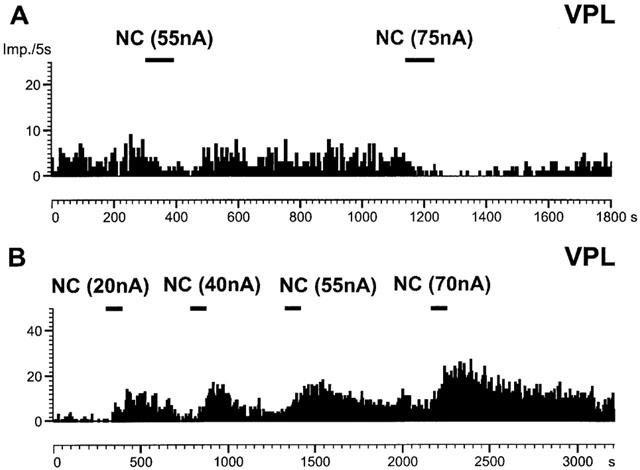
Figure 1
Figure 1
Effects of nociceptin (NC) on discharge rate. Frequency time histograms show dose-dependent decreases (A) or increases (B) in the firing rate of two neurons located in lateral ventroposterior nucleus (VPL). The y-axes indicate the number of spikes per 5 s, the x-axes indicate the time in seconds. The bars represent time and duration of ejection, the numbers show current intensity.
Figure 2
Figure 2
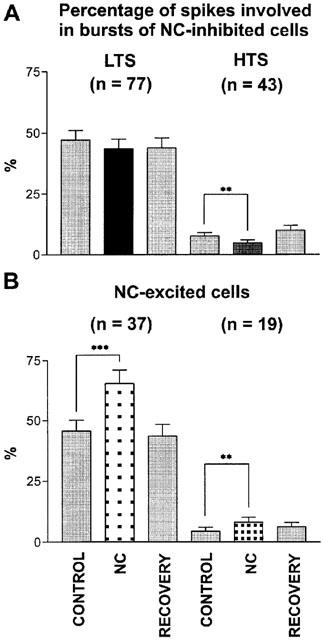
Effects of NC on appearance of burst discharges. Bar histogram shows the percentage of spikes involved in bursts of low threshold-type (LTS) and high threshold-type (HTS). Bars represent the percentage (±s.e.mean) before NC (control), during (NC) and after NC administration (recovery). The asterisks show significant differences (**P<0.001, ***P<0.0001); n=number of neurons.
Figure 3
Figure 3
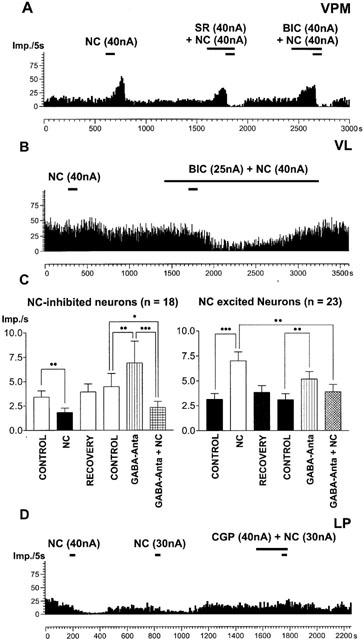
Effects of GABA receptor antagonists. (A, B) Frequency time histograms showing that SR 95531 (SR) and bicuculline (BIC) blocked NC-induced increases in firing rate in two neurons located in the lateral ventroposterior (VPM) and ventrolateral (VL) nuclei. With the exception of some neurons (B), bicuculline or SR 95531 alone induced strong increases in firing rate (A). (C) Histogram demonstrating the effect of co-administration of bicuculline or SR 95531 and NC on mean firing rate (Imp s−1±s.e.mean). In both samples of neurons GABAA receptor antagonists (GABA-Anta) significantly enhanced activity (*P<0.05, **P<0.001, ***P<0.0001). In NC-excited neurons NC-induced discharge rate differed significantly from that activity induced by the co-ejection of GABAA antagonists and NC. In contrast, in NC-inhibited neurons GABAA antagonists did not influence the inhibitory effect of NC. Co-administration of GABAA antagonists and NC did differ significantly from baseline recorded immediately prior to GABAA antagonists ejection (control) (n=number of neurons). (D) The GABAB antagonist CGP35348 reduced NC-induced decrease in firing rate in a neuron located in the lateral posterior nucleus (LP). In (A, B, D) the y-axes indicate the number of spikes per 5 s, the x-axes indicate the time in seconds. The bars represent time and duration of ejection and numbers show current intensity.
Figure 4
Figure 4
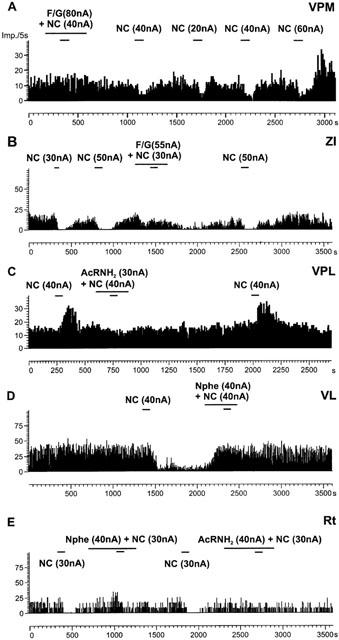
Representative examples of the action of NC receptor antagonists. Frequency time histograms show NC-induced decreases or increases in firing rate of different neurons located in the medial ventroposterior nucleus (VPM), the zona incerta (ZI), the lateral ventroposterior (VPL), the ventrolateral (VL) and the reticular nucleus (Rt). In (A) the NC receptor antagonist F/G blocked NC-induced inhibition. An example of an agonist effect of F/G is shown in (B). The NC receptor antagonists AcRNH2 and Nphe effectively blocked NC-induced effects on discharge rate (C – E). The y-axes indicate the number of spikes per 5 s, the x-axes indicate the time in seconds. The bars represent time and duration of ejection and numbers show current intensity.
Figure 5
Figure 5
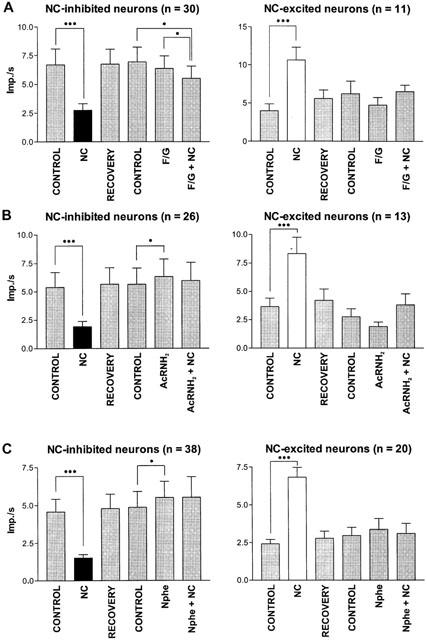
Effects of NC receptor antagonists. Bar histograms demonstrate the changes in mean firing rates±s.e.mean induced by NC, by the NC-receptor antagonists (F/G, AcRNH2, Nphe) and by co-administration of antagonists and NC. Co-administration of F/G and NC caused a significant decrease in firing rate when compared to baseline activity recorded immediately prior to F/G ejection (control) in the sample of NC-inhibited neurons. In addition, there was a significant difference between the firing rate during F/G ejection and that during co-administration of F/G and NC. AcRNH2 and Nphe alone induced a significant increase in firing rate. Co-administration of NC antagonists and NC blocked the NC-induced effects. *P<0.05, ***P<0.0001, n=number of neurons.
Figure 6
Figure 6
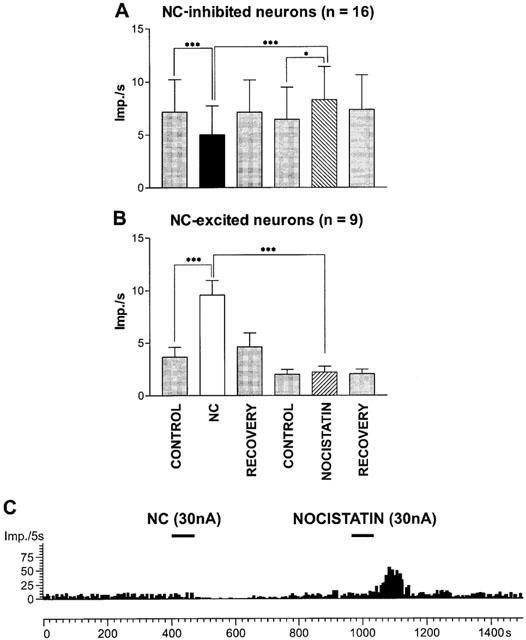
Effects of nocistatin on mean firing rate (±s.e.mean) in the sample of nociceptin-inhibited (A) and NC-excited neurons (B). Significant NC-induced decreases in firing rates were accompanied by significant increases in firing rate induced by nocistatin (A). There were no significant changes induced by nocistatin (B). *P<0.05, ***P<0.0001, n=number of neurons. (C) Frequency time histogram shows a representative example of a neuronal response to nocistatin.

References

    1. ABDULLA F.A., SMITH P.A. Nociceptin inhibits T-type Ca2+ channel current in rat sensory neurons by a G-protein-independent mechanism. J. Neurosci. 1997;17:8721–8728. - PMC - PubMed
    1. ALBRECHT D., DAVIDOWA H. Action of urethane on dorsal lateral geniculate neurons. Brain Res. Bull. 1989;22:923–927. - PubMed
    1. ALBRECHT D., ROYL G., KANEOKE Y. Very slow oscillatory activity in lateral geniculate neurons of freely moving and anesthetized rats. Neurosci. Res. 1998;32:209–220. - PubMed
    1. ALLEN C.N., JIANG Z.G., TESHIMA K., DARLAND R., IKEDA M., NELSON C.S., QUIGLEY D.I., YOSHIOKA T., ALLEN R.G., REA M.A., GRANDY D.S. Orphanin-FQ/nociceptin (OFQ/N) modulates the activity of suprachiasmatic nucleus neurons. J. Neurosci. 1999;19:2152–2160. - PMC - PubMed
    1. BERGER H., ALBRECHT E., WALLUKAT G., BIENERT M. Antagonism by acetyl-RYYRIK-NH2 of G-protein activation in rat brain preparations and of chronotropic effect on rat cardiomyocytes evoked by nociceptin/orphanin FQ. Br. J. Pharmacol. 1999;126:555–558. - PMC - PubMed

Publication types

MeSH terms