. 2001 Oct;21(20):7020-4.
doi: 10.1128/MCB.21.20.7020-7024.2001.

Cse1l is essential for early embryonic growth and development

Affiliations

Cse1l is essential for early embryonic growth and development

T K Bera et al. Mol Cell Biol. 2001 Oct.

Abstract

The CSE1L gene, the human homologue of the yeast chromosome segregation gene CSE1, is a nuclear transport factor that plays a role in proliferation as well as in apoptosis. CSE1 and CSE1L are essential genes in Saccharomyces cerevisiae and mammalian cells, as shown by conditional yeast mutants and mammalian cell culture experiments with antisense-mediated depletion of CSE1L. To analyze whether CSE1L is also essential in vivo and whether its absence can be compensated for by other genes or mechanisms, we have cloned the murine CSE1L gene (Cse1l) and analyzed its tissue- and development-specific expression: Cse1l was detected at embryonic day 7.0 (E7.0), E11.0, E15.0, and E17.0, and in adults, high expression was observed in proliferating tissues. Subsequently, we inactivated the Cse1l gene in embryonic stem cells to generate heterozygous and homozygous knockout mice. Mice heterozygous for Cse1l appear normal and are fertile. However, no homozygous pups were born after interbreeding of heterozygous mice. In 30 heterozygote interbreeding experiments, 50 Cse1l wild-type mice and 100 heterozygotes were born but no animal with both Cse1l alleles deleted was born. Embryo analyses showed that homozygous mutant embryos were already disorganized and degenerated by E5.5. This implicates with high significance (P < 0.0001, Pearson chi-square test) an embryonically lethal phenotype of homozygous murine CSE1 deficiency and suggests that Cse1l plays a critical role in early embryonic development.


Figures
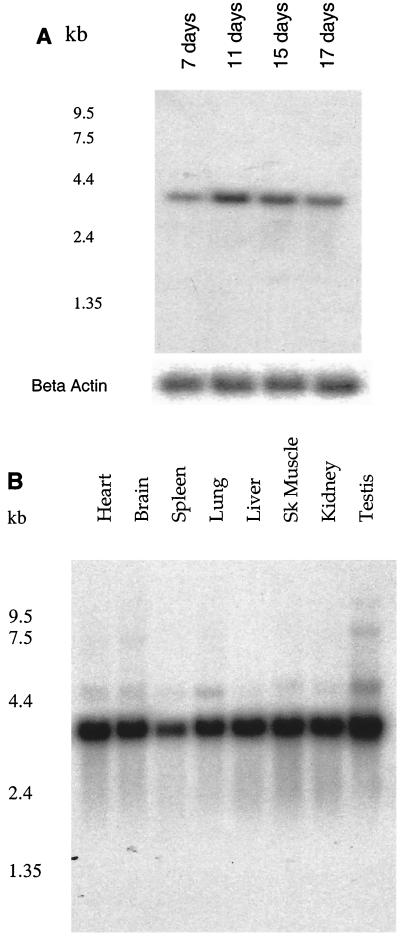
FIG. 1
FIG. 1
Tissue- and development-specific expression of the Cse1l transcript in mice. Northern blot analysis of Cse1l expression in developmental stages (A) and in eight adult tissues (B). The filters were obtained from Clontech and contained 2 μg of poly (A)+ RNA in each lane. Beta Actin, blots hybridized with the beta-actin probe; Sk Muscle, skeletal muscle.
FIG. 2
FIG. 2
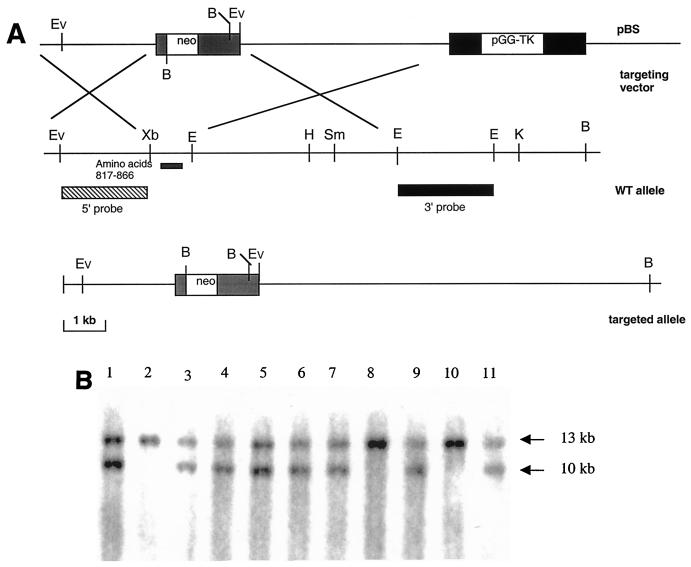
Targeted disruption of the Cse1l gene. (A) Diagram showing the genomic organization of Cse1l gene, the targeting vector, and the targeted allele after the homologous recombination. Restriction sites are indicated: B, BamHI; E, EcoRI; Ev, EcoRV; H, HindIII; K, KpnI; Sm, SmaI, and Xb, XbaI. The DNA fragments used for probe are indicated (5′ and 3′ probe). (B) Southern blot analysis of representative tail DNA samples derived from 2-week-old offspring of intercrosses between heterozygous Cse1l mice. The 13-kh band represents the wild-type allele, and the 10-kb band represents the targeted allele.
FIG. 3
FIG. 3
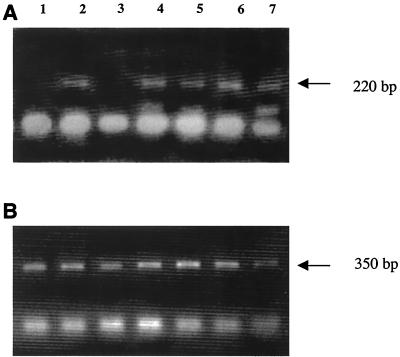
Representative genotype analysis of E7.5 embryos from Cse1l+/− intercrosses. DNA samples were subjected to PCR amplification using a primer pair specific for wild-type and heterozygous alleles (A) and a primer pair specific for heterozygous and null alleles (B).
FIG. 4
FIG. 4
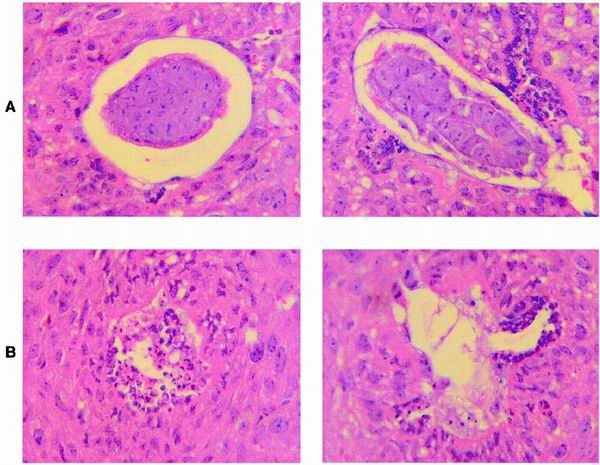
Histological sections of embryos grown in utero at E5.5. Two hematoxylin- and eosin-stained representative normal embryos (A) and two presumed mutant embryos (B) are shown at ×200 original magnification.

References

    1. Bera T K, Pastan I. Mesothelin is not required for normal mouse development or reproduction. Mol Cell Biol. 2000;20:2902–2906. - PMC - PubMed
    1. Brinkmann U. CAS, the human homologue of the yeast chromosome-segregation gene CSE1, in proliferation, apoptosis, and cancer. Am J Hum Genet. 1998;62:509–513. - PMC - PubMed
    1. Brinkmann U, Brinkmann E, Bera T K, Wellmann A, Pastan I. Tissue specific alternatively spliced variants of hCSE1/CAS may be regulators of nuclear transporter of tissue specific proteins. Genomics. 1999;58:41–49. - PubMed
    1. Brinkmann U, Brinkmann E, Gallo M, Pastan I. Cloning and characterization of a cellular apoptosis susceptibility gene, the human homolog to the yeast chromosome segregation gene CSE1. Proc Natl Acad Sci USA. 1995;92:10427–10431. - PMC - PubMed
    1. Brinkmann U, Brinkmann E, Pastan I. Expression cloning of cDNAs that render cancer-cells resistant to pseudomonas and diphtheria-toxin and immunotoxins. Mol Med. 1995;1:206–216. - PMC - PubMed

MeSH terms

Substances