Is voice therapy an effective treatment for dysphonia? A randomised controlled trial
- PMID: 11566828
- PMCID: PMC55924
- DOI: 10.1136/bmj.323.7314.658
Is voice therapy an effective treatment for dysphonia? A randomised controlled trial
Abstract
Objectives: To assess the overall efficacy of voice therapy for dysphonia.
Design: Single blind randomised controlled trial.
Setting: Outpatient clinic in a teaching hospital.
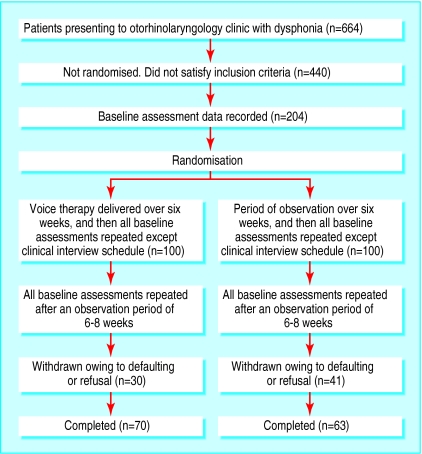
Participants: 204 outpatients aged 17-87 with a primary symptom of persistent hoarseness for at least two months.
Interventions: After baseline assessments, patients were randomised to six weeks of either voice therapy or no treatment. Assessments were repeated at six weeks on the 145 (71%) patients who continued to this stage and at 12-14 weeks on the 133 (65%) patients who completed the study. The assessments at the three time points for the 70 patients who completed treatment and the 63 patients in the group given no treatment were compared.
Main outcome measures: Ratings of laryngeal features, Buffalo voice profile, amplitude and pitch perturbation, voice profile questionnaire, hospital anxiety and depression scale, clinical interview schedule, SF-36.
Results: Voice therapy improved voice quality as assessed by rating by patients (P=0.001) and rating by observer (P<0.001). The treatment effects for these two outcomes were 4.1 (95% confidence interval 1.7 to 6.6) points and 0.82 (0.50 to 1.13) points. Amplitude perturbation showed improvement at six weeks (P=0.005) but not on completion of the study. Patients with dysphonia had appreciable psychological distress and lower quality of life than controls, but voice therapy had no significant impact on either of these variables.
Conclusion: Voice therapy is effective in improving voice quality as assessed by self rated and observer rated methods.
Comment in
-
More randomised controlled studies in speech and language therapy.BMJ. 2001 Sep 22;323(7314):645-6. doi: 10.1136/bmj.323.7314.645. BMJ. 2001. PMID: 11566815 Free PMC article. No abstract available.
References
-
- Scott S, Wilson JA, Robinson K, MacKenzie K. Patient reported problems associated with dysphonia. Clin Otolaryngol. 1997;22:37–40. - PubMed
-
- Aronson A, Peterson H, Litin E. Psychiatric symptomology in functional dysphonia and aphonia. J Speech Hear Disord. 1996;31:115–127. - PubMed
-
- Matas M. Psychogenic voice disorders: literature review and case report. Can J Psychiatry. 1991;36:363–365. - PubMed
-
- Gerritsma EJ. An investigation into some personality characteristics of patients with psychogenic aphonia and dysphonia. Folia Phoniatr Logop. 1991;43:13–20. - PubMed
Publication types
MeSH terms
LinkOut - more resources
Full Text Sources
Medical