. 2001 Oct;183(20):5848-54.
doi: 10.1128/JB.183.20.5848-5854.2001.

Salmonella enterica serovar typhimurium swarming mutants with altered biofilm-forming abilities: surfactin inhibits biofilm formation

Affiliations

Salmonella enterica serovar typhimurium swarming mutants with altered biofilm-forming abilities: surfactin inhibits biofilm formation

J R Mireles 2nd et al. J Bacteriol. 2001 Oct.

Abstract

Swarming motility plays an important role in surface colonization by several flagellated bacteria. Swarmer cells are specially adapted to rapidly translocate over agar surfaces by virtue of their more numerous flagella, longer cell length, and encasement of slime. The external slime provides the milieu for motility and likely harbors swarming signals. We recently reported the isolation of swarming-defective transposon mutants of Salmonella enterica serovar Typhimurium, a large majority of which were defective in lipopolysaccharide (LPS) synthesis. Here, we have examined the biofilm-forming abilities of the swarming mutants using a microtiter plate assay. A whole spectrum of efficiencies were observed, with LPS mutants being generally more proficient than wild-type organisms in biofilm formation. Since we have postulated that O-antigen may serve a surfactant function during swarming, we tested the effect of the biosurfactant surfactin on biofilm formation. We report that surfactin inhibits biofilm formation of wild-type S. enterica grown either in polyvinyl chloride microtiter wells or in urethral catheters. Other bio- and chemical surfactants tested had similar effects.


Figures
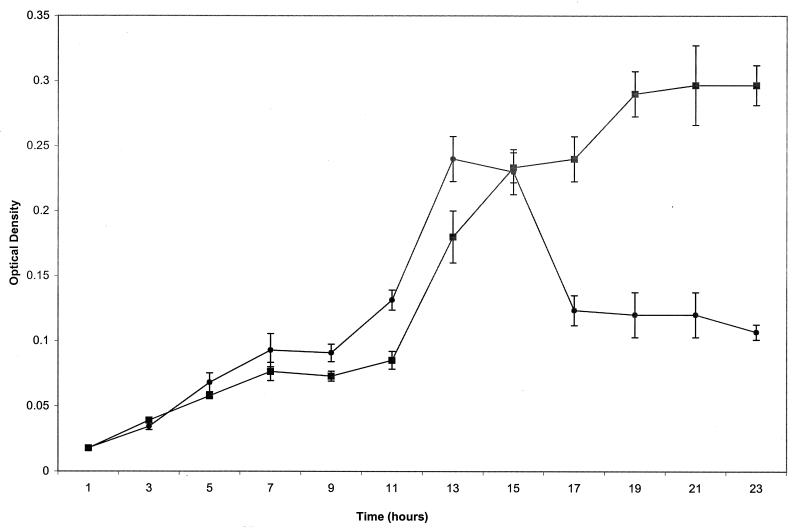
FIG. 1
FIG. 1
Kinetics of biofilm formation by wild-type S. enterica. SJW1103 was cultured at 30°C in PVC 96-well plates containing LB without NaCl plus 0.2% glucose. Samples were harvested at designated time points to determine growth (OD630) and biofilm formation after crystal violet staining (OD550) as described in the text. ▪, OD630; ●, OD550.
FIG. 2
FIG. 2
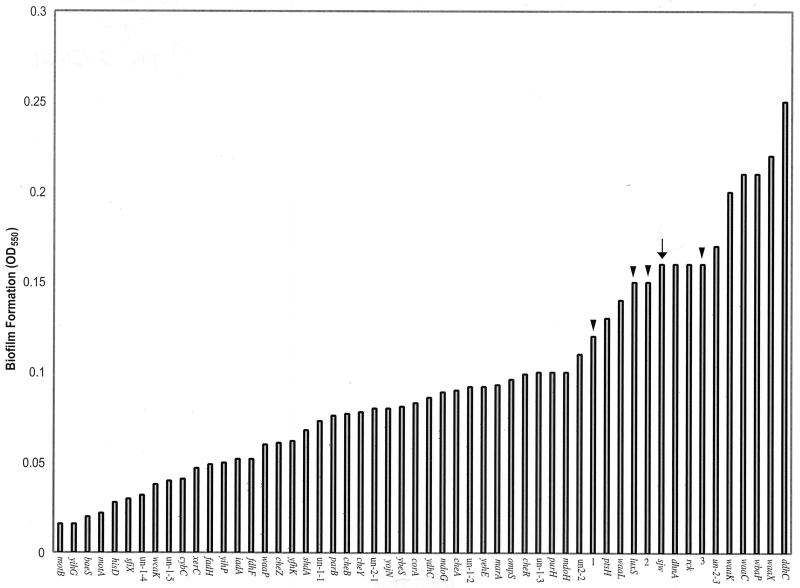
Biofilm formation by S. enterica swarming mutants. Growth conditions were as described in the legend to Fig. 1. The OD630 of all samples was approximately 0.2. Arrow points to biofilm levels (OD550) of wild-type SJW1103, and arrowheads point to those of mutants not affected in swarming. The data are means of triplicate samples monitored on the same day. There was a significant variation in the absolute biofilm values of samples processed on different days, but the relative values with respect to the wild-type value were very reproducible.
FIG. 3
FIG. 3
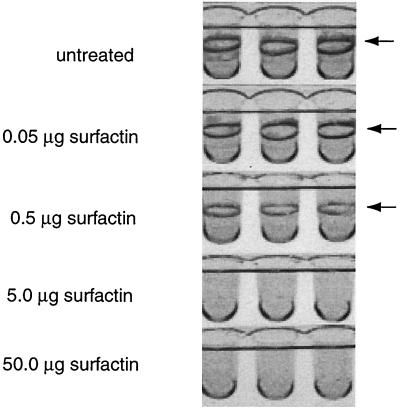
Surfactin inhibits biofilm formation by wild-type S. enterica. PVC wells were coated with the indicated amounts of surfactin before inoculation with S. enterica. After overnight incubation at 30°C, the wells were rinsed out and stained with crystal violet. The biofilm is concentrated at the interface between the air and the liquid medium (indicated by arrows).
FIG. 4
FIG. 4
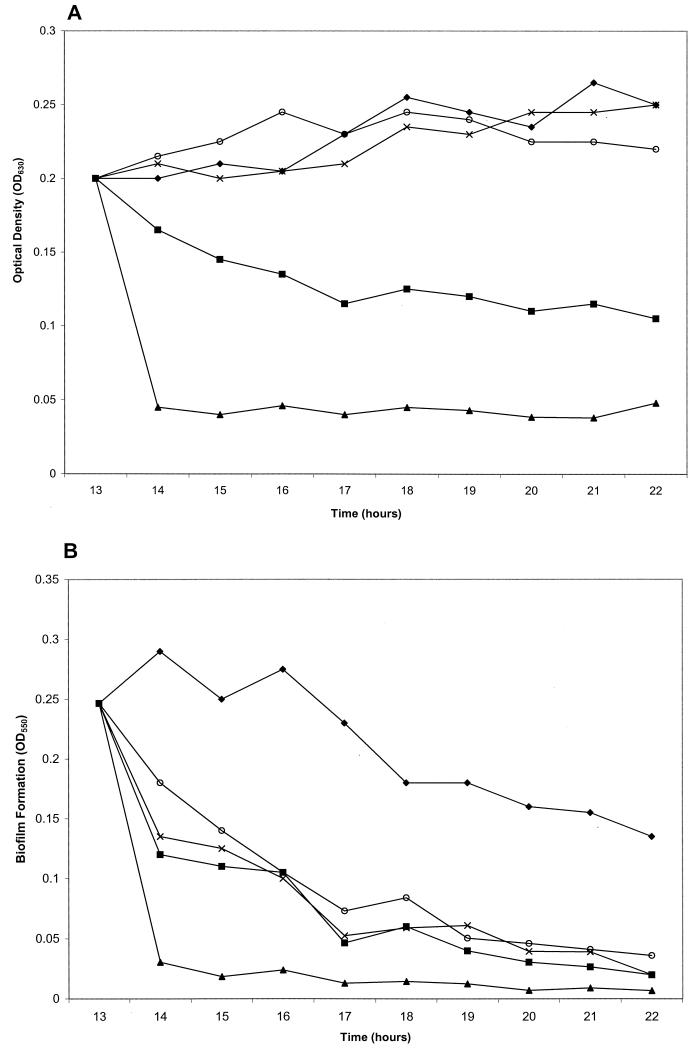
Addition of surfactin and other surfactants to a preformed biofilm accelerates biofilm dispersal. After S. enterica had reached an OD630 of ≈0.15 to 0.2, the indicated surfactants were gently mixed into the cultures in microtiter wells. Samples were harvested, and either growth (A), as determined by OD630, or biofilm levels (B), as measured by OD550 of crystal violet-stained material, were analyzed at the indicated time points. ⧫, no treatment; ○, 100 μg of surfactin; ×, 0.25% Tween 80; ▪, 100 μg of rhamnolipid; ▴, 0.2% SDS. The data are means of triplicate samples monitored on the same day.
FIG. 5
FIG. 5
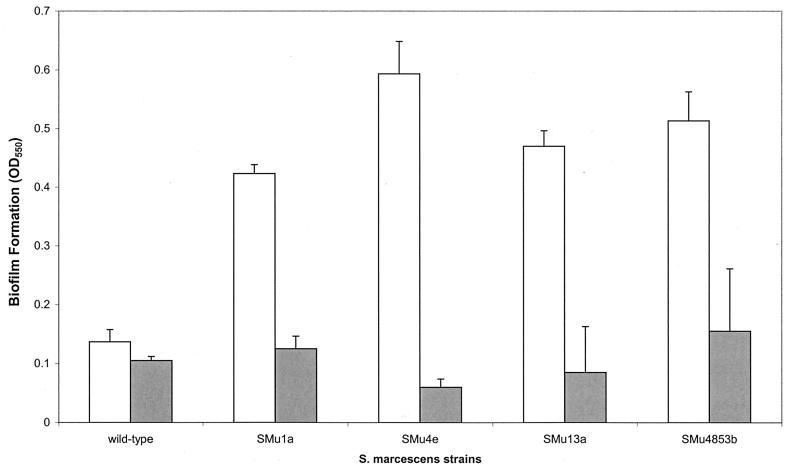
Biofilm formation by S. marcescens and its mutants. Wild-type S. marcescens 274 and its serrawettin mutants (SMu1a, SMu4e, SMu13a, and SMu4853b [9]) were analyzed for biofilm formation in the absence and presence of surfactin as described in the legend to Fig. 3. The OD630 of all the cultures was ≈0.15 (not shown). Open bars, no surfactin; shaded bars, 100 μg of surfactin.
FIG. 6
FIG. 6
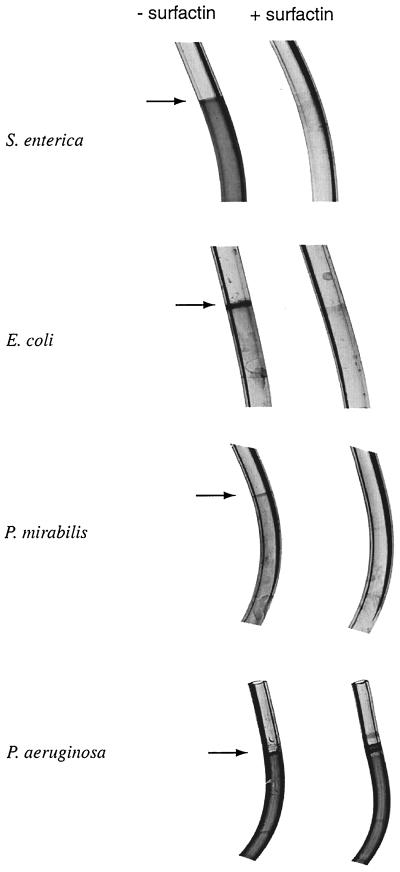
Surfactin inhibits biofilm formation on urethral catheters. The indicated organisms were grown overnight at 30°C in sterile urethral catheters containing medium with and without 100 μg of surfactin as described in the text. Biofilms were analyzed by staining with crystal violet.

References

    1. Busscher H J, van Hoogmoed C G, Geertsema-Doornbusch G I, van der Kuijl-Booij M, van der Mei H C. Streptococcus thermophilus and its biosurfactants inhibit adhesion by Candida spp. on silicone rubber. Appl Environ Microbiol. 1997;63:3810–3817. - PMC - PubMed
    1. Costerton J W, Lewandowski Z, Caldwell D E, Korber D R, Lappin-Scott H M. Microbial biofilms. Annu Rev Microbiol. 1995;49:711–745. - PubMed
    1. Danese P N, Pratt L A, Kolter R. Exopolysaccharide production is required for development of Escherichia coli K-12 biofilm architecture. J Bacteriol. 2000;182:3593–3596. - PMC - PubMed
    1. Davies D G, Parsek M R, Pearson J P, Iglewski B H, Costerton J W, Greenberg E P. The involvement of cell-to-cell signals in the development of a bacterial biofilm. Science. 1998;280:295–298. - PubMed
    1. Eberl L, Molin S, Givskov M. Surface motility of Serratia liquefaciens MG1. J Bacteriol. 1999;181:1703–1712. - PMC - PubMed

Publication types