


Multiple lateral transfers of dissimilatory sulfite reductase genes between major lineages of sulfate-reducing prokaryotes
- PMID: 11567003
- PMCID: PMC99682
- DOI: 10.1128/JB.183.20.6028-6035.2001
Multiple lateral transfers of dissimilatory sulfite reductase genes between major lineages of sulfate-reducing prokaryotes
Abstract
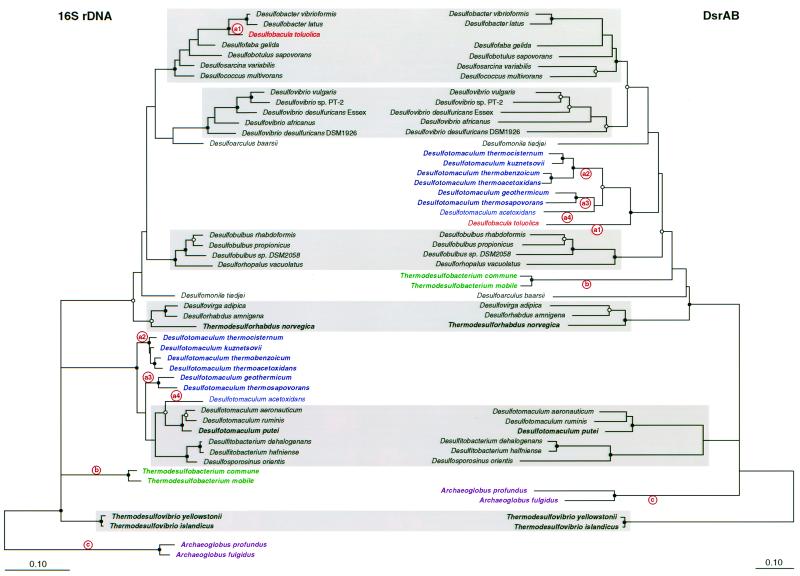
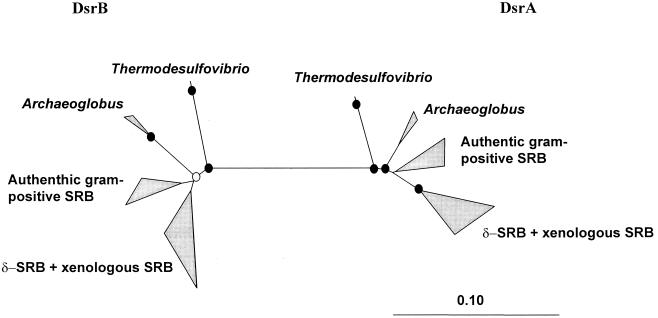
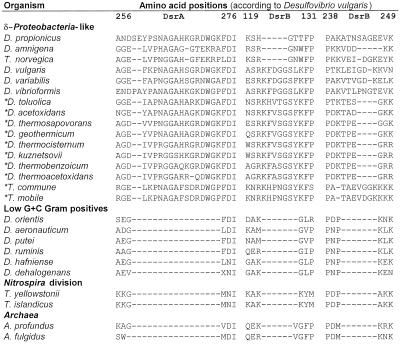
A large fragment of the dissimilatory sulfite reductase genes (dsrAB) was PCR amplified and fully sequenced from 30 reference strains representing all recognized lineages of sulfate-reducing bacteria. In addition, the sequence of the dsrAB gene homologs of the sulfite reducer Desulfitobacterium dehalogenans was determined. In contrast to previous reports, comparative analysis of all available DsrAB sequences produced a tree topology partially inconsistent with the corresponding 16S rRNA phylogeny. For example, the DsrAB sequences of several Desulfotomaculum species (low G+C gram-positive division) and two members of the genus Thermodesulfobacterium (a separate bacterial division) were monophyletic with delta-proteobacterial DsrAB sequences. The most parsimonious interpretation of these data is that dsrAB genes from ancestors of as-yet-unrecognized sulfate reducers within the delta-Proteobacteria were laterally transferred across divisions. A number of insertions and deletions in the DsrAB alignment independently support these inferred lateral acquisitions of dsrAB genes. Evidence for a dsrAB lateral gene transfer event also was found within the delta-Proteobacteria, affecting Desulfobacula toluolica. The root of the dsr tree was inferred to be within the Thermodesulfovibrio lineage by paralogous rooting of the alpha and beta subunits. This rooting suggests that the dsrAB genes in Archaeoglobus species also are the result of an ancient lateral transfer from a bacterial donor. Although these findings complicate the use of dsrAB genes to infer phylogenetic relationships among sulfate reducers in molecular diversity studies, they establish a framework to resolve the origins and diversification of this ancient respiratory lifestyle among organisms mediating a key step in the biogeochemical cycling of sulfur.
Figures
References
-
- Crane B R, Siegel L M, Getzoff E D. Sulfite reductase structure at 1.6 A: evolution and catalysis for reduction of inorganic anions. Science. 1995;270:59–67. - PubMed
-
- Dahl C, Kredich N M, Deutzmann R, Trüper H G. Dissimilatory sulfite reductase form Archaeoglobus fulgidus: physico-chemical properties of the enzyme and cloning, sequencing and analysis of the reductase gene. J Gen Microbiol. 1993;139:1817–1828. - PubMed
-
- Fauque G, Lino A R, Czechowski M, Kang L, DerVartanian D V, Moura J J, LeGall J, Moura I. Purification and characterization of bisulfite reductase (desulfofuscidin) from Desulfovibrio thermophilus and its complexes with exogenous ligands. Biochim Biophys Acta. 1990;1040:112–118. - PubMed
Publication types
MeSH terms
Substances
LinkOut - more resources
Full Text Sources
Other Literature Sources
Molecular Biology Databases
