


Long-wavelength long-lifetime luminophores
- PMID: 11569820
- PMCID: PMC6816243
- DOI: 10.1021/ac0101050
Long-wavelength long-lifetime luminophores
Abstract
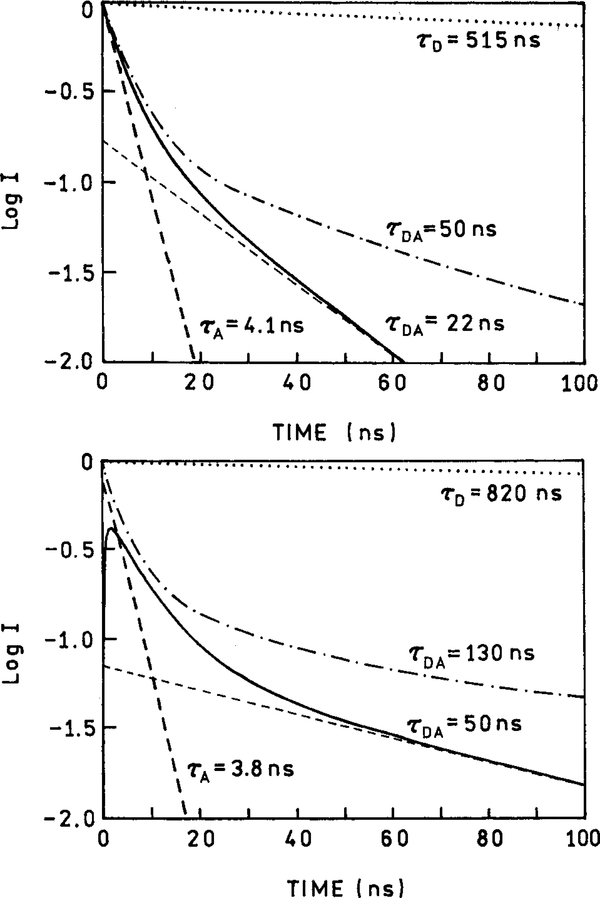
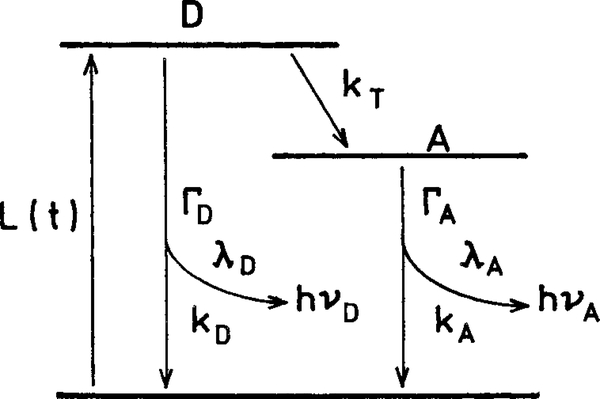
We describe a new approach to making luminophores that display long emission wavelengths, long decay times, and high quantum yields. These luminophores are covalently linked pairs with a long-lifetime resonance-energy-transfer donor and a long-wavelength acceptor. The donor was a ruthenium (Ru) metal-ligand complex. The acceptor was the Texas Red. The donor and acceptor were covalently linked by polyproline spacers. The long-lifetime donor results in a long-lived component in the acceptor decay, which is due to RET. Importantly, the quantum yield of the luminophores approaches that of the higher quantum yield acceptor, rather than the lower quantum yield typical of metal-ligand complexes. The emission maxima and decay time of such tandem luminophores can be readily adjusted by selection of the donor, acceptor, and distance between them. Luminophores with these useful spectral properties can also be donor-acceptor pairs brought into close proximity by some biochemical association reaction. Luminophores with long-wavelength emission and long lifetimes can have numerous applications in biophysics, clinical diagnostics, DNA analysis, and drug discovery.
Figures



References
-
- Thompson RB In Topics in Fluorescence Spectroscopy; Lakowicz JR, Ed.; Plenum Press: New York, 1994; Vol.4, pp 151–222.
-
- Daehne S; Resch-Genger U; Wolfbeis OS In Near-Infrared Dyes for High Technology Applications, Daehen S, Ed.; Kluwer Academic Publishers: Netherlands, 1998, p 458.
-
- Southwick PL; Ernst LA; Tauriello EW; Parker SR; Mujumdar RB; Mujumdar SW; Clever HA; Waggoner AS Cytometry 1990, 11, 418–430. - PubMed
-
- Rahavendran SV; Karnes HT J. Pharm. Biomed Anal 1996, 15, 83–98. - PubMed
-
- Rahavendran SV; Karnes HT Anal. Chem 1996, 68, 3763–3768. - PubMed
Publication types
MeSH terms
Substances
Grants and funding
LinkOut - more resources
Full Text Sources
Other Literature Sources
