


Genome sequence of an industrial microorganism Streptomyces avermitilis: deducing the ability of producing secondary metabolites
- PMID: 11572948
- PMCID: PMC59794
- DOI: 10.1073/pnas.211433198
Genome sequence of an industrial microorganism Streptomyces avermitilis: deducing the ability of producing secondary metabolites
Abstract
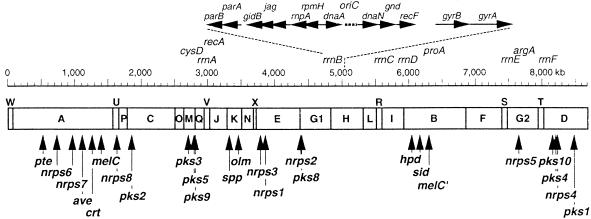
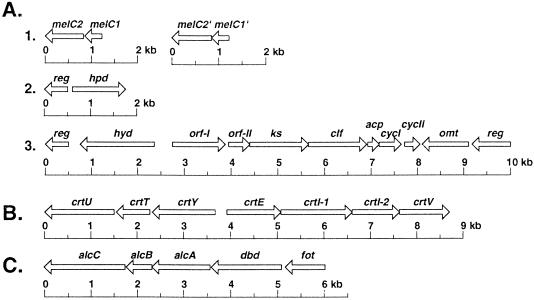
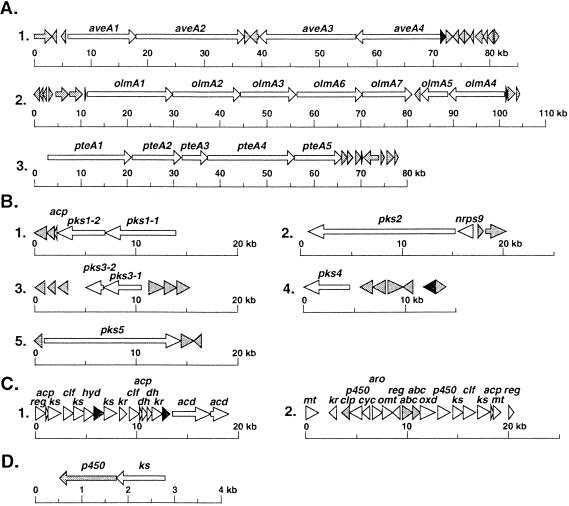
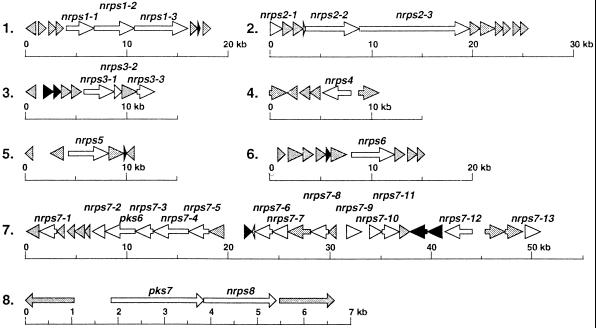
Streptomyces avermitilis is a soil bacterium that carries out not only a complex morphological differentiation but also the production of secondary metabolites, one of which, avermectin, is commercially important in human and veterinary medicine. The major interest in this genus Streptomyces is the diversity of its production of secondary metabolites as an industrial microorganism. A major factor in its prominence as a producer of the variety of secondary metabolites is its possession of several metabolic pathways for biosynthesis. Here we report sequence analysis of S. avermitilis, covering 99% of its genome. At least 8.7 million base pairs exist in the linear chromosome; this is the largest bacterial genome sequence, and it provides insights into the intrinsic diversity of the production of the secondary metabolites of Streptomyces. Twenty-five kinds of secondary metabolite gene clusters were found in the genome of S. avermitilis. Four of them are concerned with the biosyntheses of melanin pigments, in which two clusters encode tyrosinase and its cofactor, another two encode an ochronotic pigment derived from homogentiginic acid, and another polyketide-derived melanin. The gene clusters for carotenoid and siderophore biosyntheses are composed of seven and five genes, respectively. There are eight kinds of gene clusters for type-I polyketide compound biosyntheses, and two clusters are involved in the biosyntheses of type-II polyketide-derived compounds. Furthermore, a polyketide synthase that resembles phloroglucinol synthase was detected. Eight clusters are involved in the biosyntheses of peptide compounds that are synthesized by nonribosomal peptide synthetases. These secondary metabolite clusters are widely located in the genome but half of them are near both ends of the genome. The total length of these clusters occupies about 6.4% of the genome.
Figures
References
-
- Demain A L. Appl Microbiol Biotechnol. 1999;52:455–463. - PubMed
-
- Huang C-H, Lin Y-S, Yang Y-L, Huang S-W, Chen C W. Mol Microbiol. 1998;28:905–916. - PubMed
-
- Sambrook J, Fritsch E F, Maniatis T. Molecular Cloning: A Laboratory Manual. 2nd Ed. Plainview, NY: Cold Spring Harbor Lab. Press; 1989.
-
- Pang C-H, Shiiyama M, Ikeda H, Tanaka H, Ōmura S. Actinomycetologica. 1994;8:21–25.
MeSH terms
Substances
Associated data
- Actions
- Actions
- Actions
- Actions
- Actions
- Actions
- Actions
- Actions
- Actions
- Actions
- Actions
- Actions
- Actions
- Actions
- Actions
- Actions
- Actions
- Actions
- Actions
- Actions
- Actions
- Actions
- Actions
- Actions
LinkOut - more resources
Full Text Sources
Other Literature Sources
Molecular Biology Databases
