


Drought- and salt-tolerant plants result from overexpression of the AVP1 H+-pump
- PMID: 11572991
- PMCID: PMC58749
- DOI: 10.1073/pnas.191389398
Drought- and salt-tolerant plants result from overexpression of the AVP1 H+-pump
Abstract
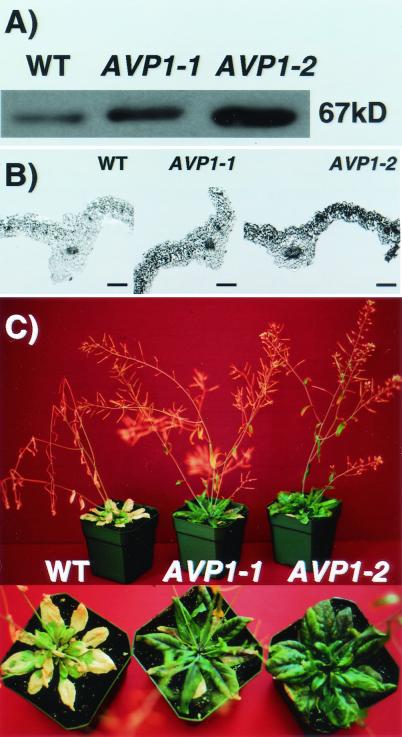
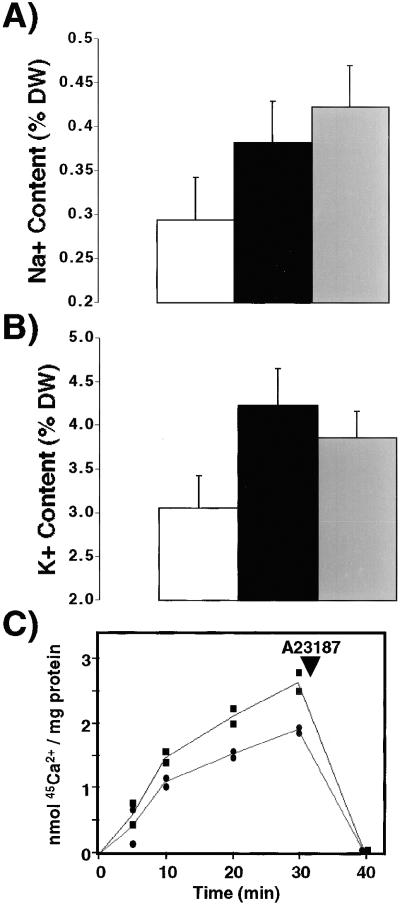
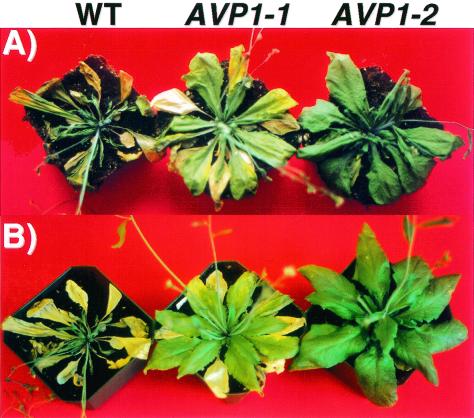
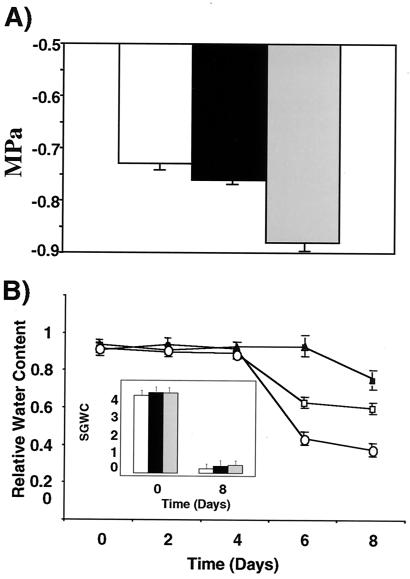
Transgenic plants overexpressing the vacuolar H(+)-pyrophosphatase are much more resistant to high concentrations of NaCl and to water deprivation than the isogenic wild-type strains. These transgenic plants accumulate more Na(+) and K(+) in their leaf tissue than the wild type. Moreover, direct measurements on isolated vacuolar membrane vesicles derived from the AVP1 transgenic plants and from wild type demonstrate that the vesicles from the transgenic plants have enhanced cation uptake. The phenotypes of the AVP1 transgenic plants suggest that increasing the vacuolar proton gradient results in increased solute accumulation and water retention. Presumably, sequestration of cations in the vacuole reduces their toxic effects. Genetically engineered drought- and salt-tolerant plants could provide an avenue to the reclamation of farmlands lost to agriculture because of salinity and a lack of rainfall.
Figures
References
-
- Radin W J. In: Limitations to Efficient Water Use in Crop Production. Taylor H M, Jordan W R, Sinclair T R, editors. Madison, WI: ASA-CSSA-SSSA; 1983. pp. 267–276.
-
- Bray E A, Bailey-Serres J, Weretilnyk E. In: Biochemistry and Molecular Biology of Plants. Buchanan B B, Gruissem W, Jones R L, editors. Rockville, MD: American Society of Plant Physiologists; 2000. pp. 1159–1175.
-
- Zhen R G, Kim E J, Rea P A. The Plant Vacuole. Vol. 25. San Diego: Academic; 1997. pp. 298–337.
Publication types
MeSH terms
Substances
Grants and funding
LinkOut - more resources
Full Text Sources
Other Literature Sources
Molecular Biology Databases
