. 2001 Oct;39(10):3446-51.
doi: 10.1128/JCM.39.10.3446-3451.2001.

Sensitive and specific method for rapid identification of Streptococcus pneumoniae using real-time fluorescence PCR

Affiliations

Sensitive and specific method for rapid identification of Streptococcus pneumoniae using real-time fluorescence PCR

J C McAvin et al. J Clin Microbiol. 2001 Oct.

Abstract

Molecular surveillance of pathogens has shown the need for rapid and dependable methods for the identification of organisms of clinical and epidemiological importance. As the leading cause of community-acquired pneumonia, Streptococcus pneumoniae was used as a model organism to develop and refine a real-time fluorescence PCR assay and enhanced DNA purification method. Seventy clinical isolates of S. pneumoniae, verified by latex agglutination, were screened against 26 negative control clinical isolates employing a TaqMan assay on a thermocycler (LightCycler). The probe, constructed from the lytA gene, correctly detected all S. pneumoniae genomes without cross-reaction to negative controls. The speed and ease of this approach will make it adaptable to identification of many bacterial pathogens and provide potential for adaptation to direct detection from patient specimens.


Figures
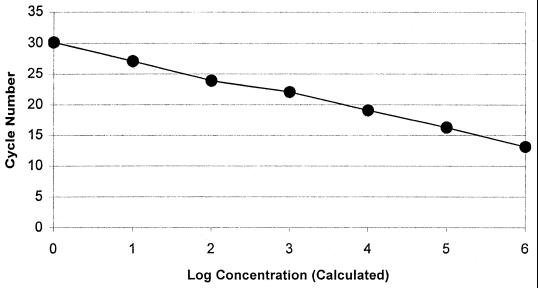
FIG. 1
FIG. 1
Serial dilutions of S. pneumoniae (ATCC 33400) DNA isolated by a standardized method and quantitated spectrophotometrically to 4.4e6 through 4.4e0 genomic equivalents were used for determination of real-time PCR assay detection limits or in vitro sensitivity testing. Cycle number plotted against the log of calculated concentration values resulted in a standard curve with an error of 0.592 and correlation coefficient at unity. Human genomic DNA at 4,500 genomic equivalents and NTC samples did not fluoresce above background signal. The detection limits of the PCR assay demonstrated similar results when the dilution series panel was run in testing of all cross-reaction panel and unknown organisms.

References

    1. Berry A M, Lock R A, Hansman D, Paton J C. Contribution of autolysin to virulence of Streptococcus pneumoniae. Infect Immun. 1989;57:2324–2330. - PMC - PubMed
    1. Brown P D, Lerner S A. Community-acquired pneumonia. Lancet. 1998;352:1295–1302. - PubMed
    1. Cherian T, Lalitha M K, Manoharan A, Thomas K, Yolken R H, Steinhoff M C. PCR-enzyme immunoassay for detection of Streptococcus pneumoniae DNA in cerebrospinal fluid samples from patients with culture-negative meningitis. J Clin Microbiol. 1998;36:3605–3608. - PMC - PubMed
    1. Doern G V, Brueggemann A B, Huynh H, Wingert E. Antimicrobial resistance with Streptococcus pneumoniae in the United States, 1997–98. Emerg Infect Dis. 1999;5:757–765. - PMC - PubMed
    1. du Plessis M, Smith A M, Klugman K P. Application of pbp1A PCR in identification of penicillin-resistant Streptococcus pneumoniae. J Clin Microbiol. 1999;37:628–632. - PMC - PubMed

MeSH terms

LinkOut - more resources
