


Use of random amplified polymorphic DNA PCR to examine epidemiology of Stenotrophomonas maltophilia and Achromobacter (Alcaligenes) xylosoxidans from patients with cystic fibrosis
- PMID: 11574579
- PMCID: PMC88395
- DOI: 10.1128/JCM.39.10.3597-3602.2001
Use of random amplified polymorphic DNA PCR to examine epidemiology of Stenotrophomonas maltophilia and Achromobacter (Alcaligenes) xylosoxidans from patients with cystic fibrosis
Abstract
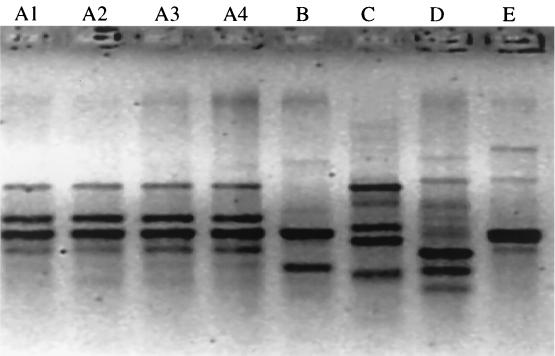
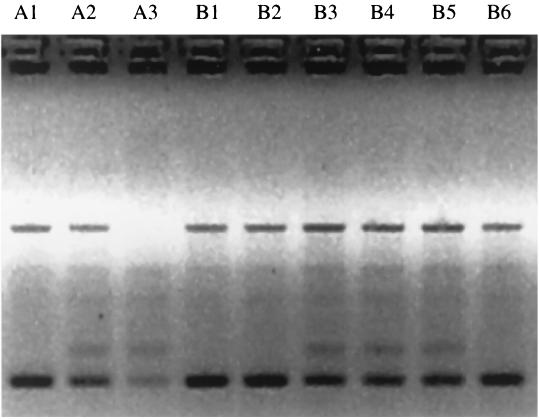
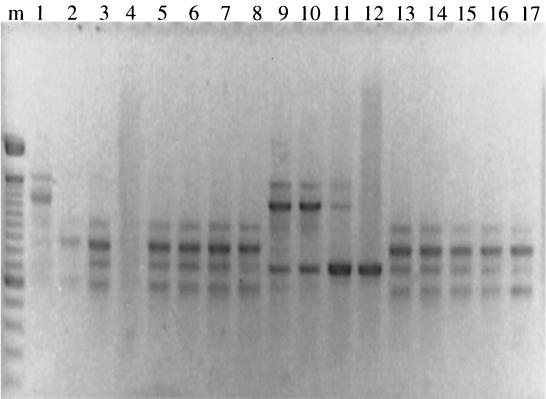
Stenotrophomonas maltophilia and Achromobacter (Alcaligenes) xylosoxidans have been increasingly recognized as a cause of respiratory tract colonization in cystic fibrosis (CF). Although both organisms have been associated with progressive deterioration of pulmonary function, demonstration of causality is lacking. To examine the molecular epidemiology of S. maltophilia and A. xylosoxidans in CF, isolates from patients monitored for up to 2 years were fingerprinted using a PCR-based randomly amplified polymorphic DNA (RAPD-PCR) method. Sixty-one of 69 CF centers screened had 183 S. maltophilia culture-positive patients, and 46 centers had 92 A. xylosoxidans-positive patients. At least one isolate from each patient was genotyped, and patients with > or =10 positive cultures (12 S. maltophilia cultures, 15 A. xylosoxidans cultures) had serial isolates genotyped. In addition, centers with multiple culture-positive patients were examined for evidence of shared clones. There were no instances of shared genotypes among different CF centers. Some patients demonstrated isolates with a single genotype throughout the observation period, and others had intervening or sequential genotypes. At the six centers with multiple S. maltophilia culture-positive patients and the seven centers with multiple A. xylosoxidans-positive patients, there were three and five instances of shared genotypes, respectively. The majority of shared isolates were from pairs who were siblings or otherwise epidemiologically linked. These findings suggest RAPD-PCR typing can distinguish unique CF isolates of S. maltophilia and A. xylosoxidans, person-to-person transmission may occur, there are not a small number of clones infecting CF airways, and patients with long-term colonization may either have a persistent organism or may acquire additional organisms over time.
Figures
Comment in
-
Molecular epidemiology of Stenotrophomonas maltophilia isolated from cystic fibrosis patients.J Clin Microbiol. 2002 May;40(5):1884. doi: 10.1128/JCM.40.5.1884.2002. J Clin Microbiol. 2002. PMID: 11980986 Free PMC article. No abstract available.
References
-
- Ballestero S, Virseda I, Escobar H, Suarez L, Baquero F. Stenotrophomonas maltophilia in cystic fibrosis patients. Eur J Clin Microbiol Infect Dis. 1995;14:728–729. - PubMed
-
- Benaoudia F, Bingen E. Evidence for the genetic unrelatedness of nosocomial Alcaligenes xylosoxidans strains in a pediatric hospital. Infect Control Hosp Epidemiol. 1997;18:132–134. - PubMed
-
- Blessing J, Walker J, Maybury B, Yeager A S, Lewiston N. Pseudomonas cepacia and Pseudomonas maltophilia in the cystic fibrosis patient. Am Rev Respir Dis. 1979;119:262. . (Abstract.)
-
- Burns J L, Emerson J, Stapp J R, Yim D L, Krzewinski J, Louden L, Ramsey B W, Clausen C R. Microbiology of sputum from patients at cystic fibrosis centers in the United States. Clin Infect Dis. 1998;27:158–163. - PubMed
-
- Burns J L, Gibson R L, McNamara S, Yim D, Emerson J, Rosenfeld M, Hiatt P, McCoy K, Castile R, Smith A L, Ramsey B W. Longitudinal assessment of Pseudomonas aeruginosa in young children with cystic fibrosis. J Infect Dis. 2001;183:444–452. - PubMed
MeSH terms
LinkOut - more resources
Full Text Sources
Medical
