


Class-1 translation termination factors: invariant GGQ minidomain is essential for release activity and ribosome binding but not for stop codon recognition
- PMID: 11574680
- PMCID: PMC60236
- DOI: 10.1093/nar/29.19.3982
Class-1 translation termination factors: invariant GGQ minidomain is essential for release activity and ribosome binding but not for stop codon recognition
Abstract
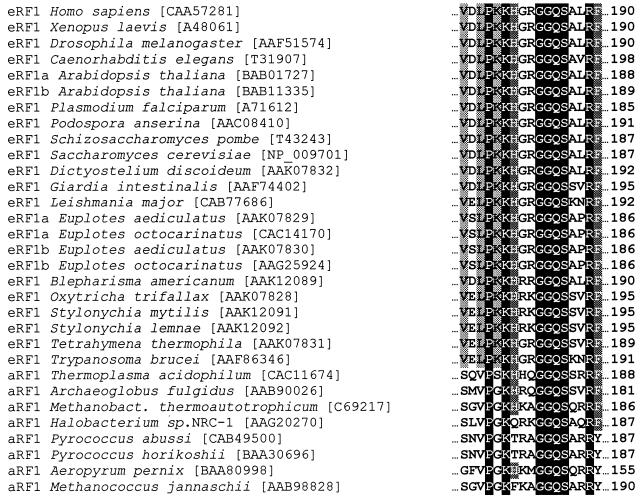
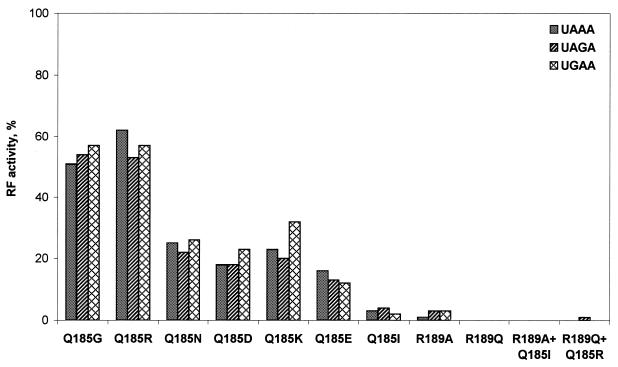
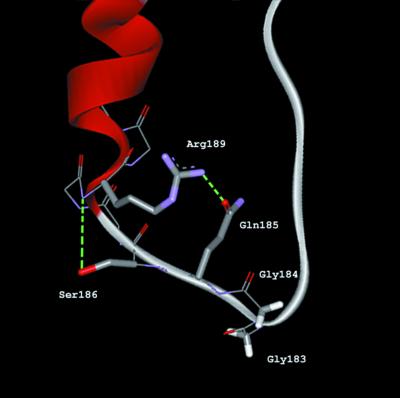
Previously, we have shown that all class-1 polypeptide release factors (RFs) share a common glycine-glycine-glutamine (GGQ) motif, which is critical for RF activity. Here, we subjected to site-directed mutagenesis two invariant amino acids, Gln185 and Arg189, situated in the GGQ minidomain of human eRF1, followed by determination of RF activity and the ribosome binding capacity for mutant eRF1. We show that replacement of Gln185 with polar amino acid residues causes partial inactivation of RF activity; Gln185Ile, Arg189Ala and Arg189Gln mutants are completely inactive; all mutants that retain partial RF activity respond similarly to three stop codons. We suggest that loss of RF activity for Gln185 and Arg189 mutants is caused by distortion of the conformation of the GGQ minidomain but not by damage of the stop codon recognition site of eRF1. Our data are inconsistent with the model postulating direct involvement of Gln185 side chain in orientation of water molecule toward peptidyl-tRNA ester bond at the ribosomal peptidyl transferase centre. Most of the Gln185 mutants exhibit reduced ability to bind to the ribosome, probably, to rRNA and/or (peptidyl)-tRNA(s). The data suggest that the GGQ motif is implicated both in promoting peptidyl-tRNA hydrolysis and binding to the ribosome.
Figures
References
-
- Kisselev L. and Buckingham,R.H. (2000) Translational termination comes of age. Trends Biochem. Sci., 25, 561–566. - PubMed
-
- Frolova L., Le Goff,X., Rasmussen,H.H., Cheperegin,S., Drugeon,G., Kress,M., Arman,I., Haenni,A.-L., Celis,J.E., Philippe,M., Justesen,J. and Kisselev,L. (1994) A highly conserved eukaryotic protein family possessing properties of polypeptide chain release factor. Nature, 372, 701–703. - PubMed
-
- Nakamura Y., Ito,K. and Ehrenberg,M. (2000) Mimicry grasps reality in translation termination. Cell, 101, 349–352. - PubMed
-
- Brown C.M. and Tate,W.P. (1994) Direct recognition of mRNA stop signals by Escherichia coli polypeptide chain release factor two. J. Biol. Chem., 269, 33164–33170. - PubMed
